Circumstances beyond the control of the editorial board delayed publication of the first issue of the Neue Rheinische Zeitung. The second issue will therefore appear a fortnight after the first at the latest, and will contain amongst others the following articles:
1848-49. II. June 13, 1849.—III. Repercussions of June 13 on the Continent.—IV. Current Situation; England.[59]—By Karl Marx. The Campaign for the German Imperial Constitution. III. The Palatinate.—IV. To Die for the Fatherland.[60]—By Frederick Engels. The third issue will contain among other items: What Is Bourgeois Property? II. Landed Property.—Lectures
given at the German Workers' Educational Society in London,[61]
by Karl Marx. The Last Days of the German Parliament. By W. Wolff. The Financial State of Prussia, etc., etc.[62]
Care will be taken that in future the paper is published between the first and the tenth of each month.
The Editorial Board
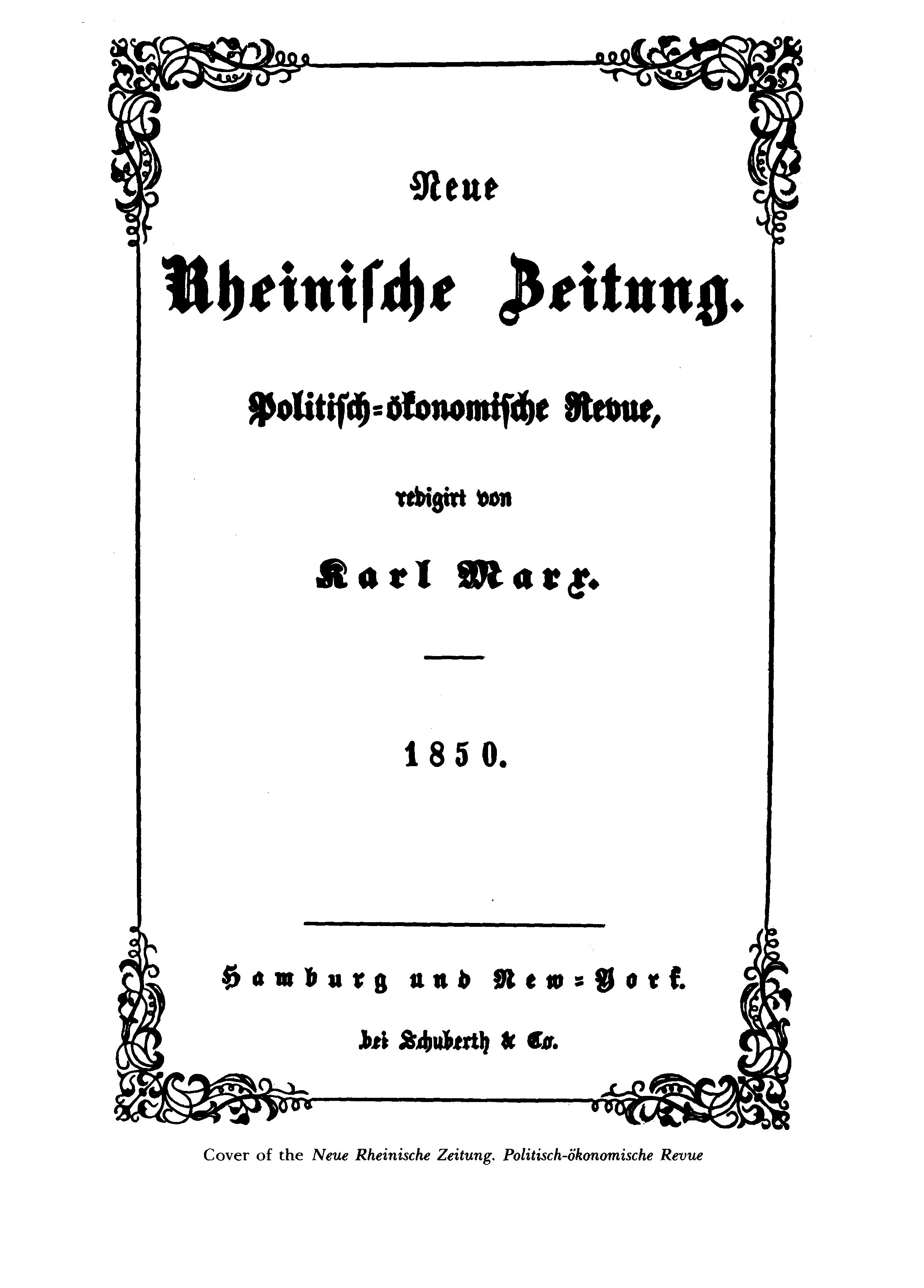
Cover of the Atewe Rheinische Zeitung. Politisch-ökonomische Revue
Endnotes
[58] The Announcement, written by Marx and Engels concerning the delay in printing the first issue of the Neue Rheinische Zeitung. Politisch-ökonomische Revue (see Note 2), the material for which was sent from London to Hamburg early in February 1850, was forwarded to Hamburg not later than February 20. It was published at the beginning of the first number with the following note: "The Neue Rheinische Zeitung is a monthly of no less than five signatures. Subscription for three months is 25 silver groschen. Separate numbers ten silver groschen. Responsible publisher K.Schramm."
[59] The second chapter "June 13, 1849" of Marx's work The Class Struggles in France, 1848 to 1850, mentioned here (initially published as "1848-1849"), came out in the second issue of the Neue Rheinische Zeitung. Politisch-ökonomische Revue; the third chapter mentioned in the Announcement—"Repercussions of June 13 on the Continent"—was published in No. 3 of the Revue, entitled "Consequences of June 13, 1849". Marx realised his plans for the fourth and partly for the third chapter by writing some other material for the Revue, in particular in the international reviews written jointly with Engels.
[60] Chapter IV of Engels' The Campaign for the German Imperial Constitution, "To Die for the Republic", was published in the Neue Rheinische Zeitung. Politisch-ökonomische Revue No. 3, which came out about April 17, 1850.
[61] Marx did not prepare his lectures on political economy for publication as he had intended. The German Workers' Educational Society in London was founded in February 1840 by Karl Schapper, Joseph Moll and other members of the League of the Just (an organisation of German craftsmen and workers, and also of emigrant workers of other nationalities). After the reorganisation of the League of the Just in the summer of 1847 and the founding of the Communist League, the latter's local communities played the leading role in the Society. During various periods of its activity, the Society had branches in working-class districts in London. In 1847 and 1849-50, Marx and Engels took an active part in the Society's work, but on September 17, 1850, Marx, Engels and a number of their followers withdrew because the Willich-Schapper sectarian and adventurist faction had temporarily increased its influence in the Society causing a split in the Communist League. In the late 1850s, Marx and Engels resumed their work in the Educational Society, which existed up to 1918, when it was closed down by the British Government.
[62] The article by Wilhelm Wolff was published in No. 4 of the Revue under the title "Nachträgliches aus dem Reich" (Additional News from the Empire). The article on the financial state of Prussia was to be written by G. A. Bergen-roth, a German democrat who took part in the 1848-49 revolution. This article was however never received by the journal.