Working Men! To you I dedicate a work, in which I have tried to lay before my German Countrymen a faithful picture of your condition, of your sufferings and struggles, of your hopes and prospects. I have lived long enough amidst you to know something about your circumstances; I have devoted to their knowledge my most serious attention, I have studied the various official and non-official documents as far as I was able to get hold of them — I have not been satisfied with this, I wanted more than a mere abstract knowledge of-my subject, I wanted to see you in your own homes, to observe you in your every-day life, to chat with you on your condition and grievances, to witness your struggles against the social and political power of your oppressors. I have done so: I forsook the company and the dinner-parties, the port-wine and champaign of the middle-classes, and devoted my leisure-hours almost exclusively to the intercourse with plain Working-Men ; I am both glad and proud of having done so. Glad, because thus I was induced to spend many a happy hour in obtaining a knowledge of the realities of life — many an hour, which else would have been wasted in fashionable talk and tiresome etiquette; proud, because thus I got an opportunity of doing justice to an oppressed and calumniated class of men who with all their faults and under all the disadvantages of their situation, yet command the respect of every one but an English money-monger; proud, too, because thus I was placed in a position to save the English people from the growing contempt which on the Continent has been the necessary consequence of the brutally selfish policy and general behaviour of your ruling middle-class.
Having, at the same time, ample opportunity to watch the. middle-classes, your opponents, I soon came to the conclusion that you are right, perfectly right in expecting no support whatever from them. Their interest is diametrically opposed to yours, though they always will try to maintain the contrary and to make you believe in their most hearty sympathy with your fates. Their doings give them the lie. I hope to have collected more than sufficient evidence of the fact, that — be their words what they please — the middle-classes intend in reality nothing else but to enrich themselves by your labour while they can sell its produce, and to abandon you to starvation as soon as they cannot make a profit by this indirect trade in human flesh. What have they done to prove their professed good-will towards you? Have they ever paid any serious attention to your grievances? Have they done more than paying the expenses of half-a-dozen commissions of inquiry, whose voluminous reports are damned to ever-lasting slumber among heaps of waste paper on the shelves of the Home Office? Have they even done as much as to compile from those rotting blue-books a single readable book from which everybody might easily get some information on the condition of the great majority of "free-born Britons"? Not they indeed, those are things they do not like to speak of — they have left it to a foreigner to inform the civilised world of the degrading situation you have to live in.
A foreigner to them, not to you, I hope. Though my English may not be pure, yet, I hope, you will find it plain English. No working-man in England — nor in France either, by-the-by — ever treated me as a foreigner. With the greatest pleasure I observed you to be free from that blasting curse, national prejudice and national pride, which after all means nothing but wholesale selfishness—I observed you to sympathise with every one who earnestly applies his powers to human progress — may he be an Englishman or not — to admire every thing great and good, whether nursed on your native soil or not — I found you to be more than mere Englishmen, members of a single, isolated nation, I found you to be Men, members of the great and universal family of Mankind, who know their interest a'nd that of all the human race to be the same. And as such, as members of this Family of "One and Indivisible" Mankind, as Human Beings in the most emphatical meaning of the word, as such I, and many others on the Continent, hail your progress in every direction and wish you speedy success.
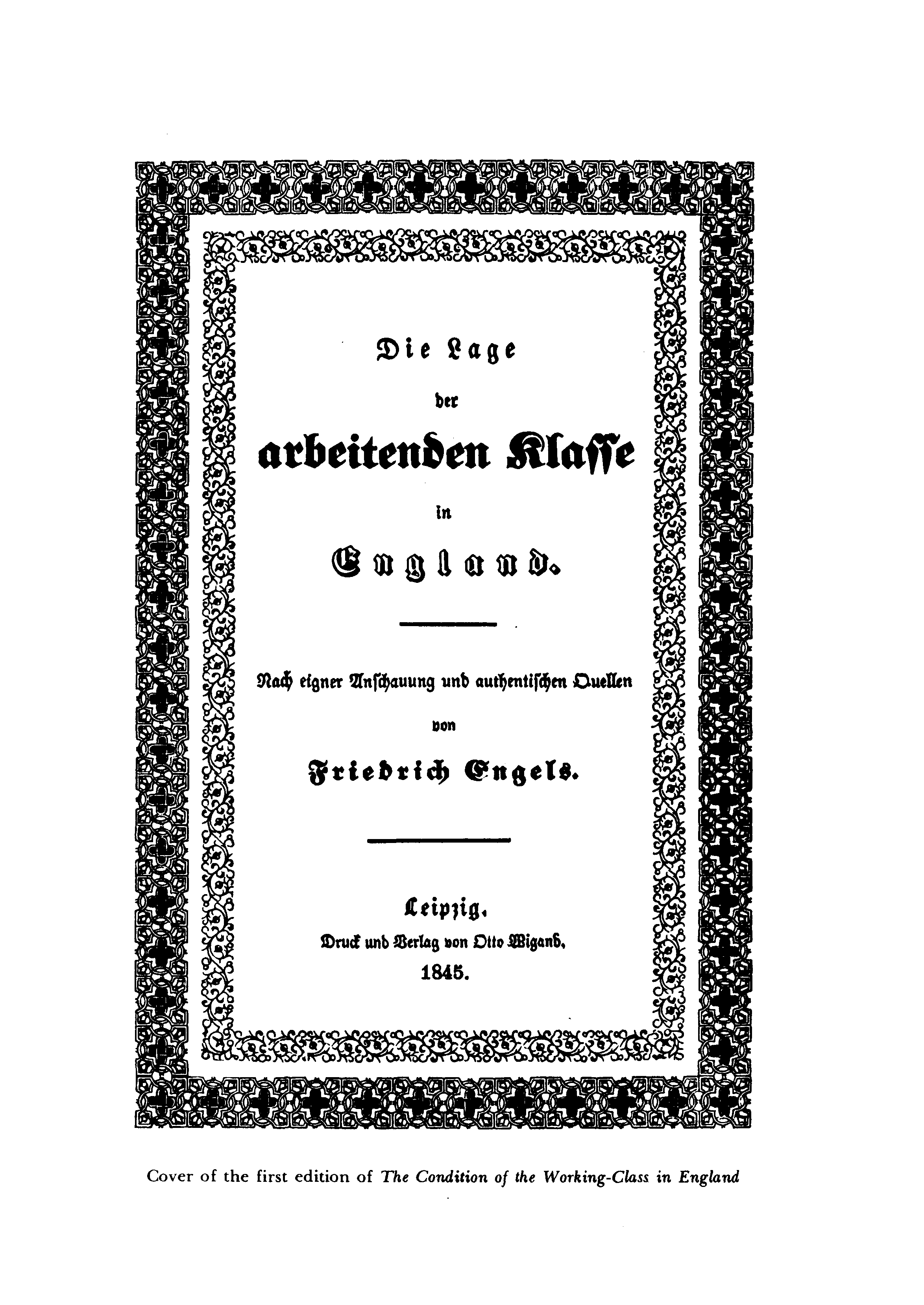
Cover of the first edition of The Condition of the Working-Class in England
Go on then, as you have done hitherto. Much remains to be undergone; be firm, be undaunted — your success is certain, and no step you will have to take in your onward march, will be lost to our common cause, the cause of Humanity!
Barmen (Rhénan Prussia) March 15th, 1845
Frederick Engels
Endnotes
[1] The Holy Family, or Critique of Critical Criticism. Against Bruno Bauer and Co. is the first joint work of Karl Marx and Frederick Engels. At the end of August 1844, Engels, on his way back from Manchester to Barmen, stopped over in Paris, where he had his second meeting with Marx, a meeting which marked the beginning of their collaboration as authors. During the ten days which Engels spent in Paris, he and Marx agreed to publish a criticism of the representatives of the Young Hegelian trend. They drew up the plan of a book which they at first called A Critique of Critical Criticism. Against Bruno Bauer and Co., divided the sections between themselves and wrote the Foreword. Engels wrote his sections before leaving Paris. Marx, whose share comprised the bigger part of the book, continued to work on it till the end of November 1844, considerably increasing the size of the book and drawing on his "Economic and Philosophic Manuscripts", on which he had been working during the spring and summer of 1844, as well as on his studies of the history of the French Revolution and his notes and summaries. During the printing of the book, Marx, on the advice of the publisher Löwenthal, added to the title the words "The Holy Family". The book was published in February 1845 in Frankfurt am Main by the Literarische Anstalt (J. Rütten) publishers. The table of contents (see contents of this volume, pp. v-xi) showed which sections had been written by Marx and which by Engels. The fact that the book, though of small format, exceeded twenty printed sheets in volume, exempted it from preliminary censorship in accordance with the regulations operating at the time in a number of German states. "The Holy Family" is a sarcastic nickname for the Bauer brothers and their followers who supported the Allgemeine Literatur-Zeitung published in Charlottenburg from the end of 1843 to October 1844. While attacking the Bauers and other Young Hegelians, Marx and Engels at the same time critically analysed the idealist philosophy of Hegel himself. Marx had shown his disagreement with the Young Hegelians already in the autumn of 1842 when, as an editor of the Rheinische Zeitung, he opposed the publication of superficial and pretentious articles submitted by the outwardly ultra-radical Berlin circle of "The Free" (Edgar Bauer, Max Stirner, Eduard Meyen and others). During the two years which had elapsed since Marx's clash with "The Free", Marx's and Engels' disagreement with the Young Hegelians on questions of theory and politics had deepened still more. This was accounted for not only by the transition of Marx and Engels to materialism and communism, but also by the evolution which had taken place during that time in the ideas of the Bauer brothers and their fellow-thinkers. In the Allgemeine Literatur-Zeitung Bauer and his group renounced the "radicalism of 1842" and, besides professing subjective idealist views, and counterposing chosen personalities, the bearers of „pure Criticism", to the allegedly sluggish and inert masses, they began spreading the ideas of moderate liberal philanthropy. Marx's draft of the Preface of his "Economic and Philosophic Manuscripts" shows that already in the summer of 1844 he saw in the evolution of the Young Hegelians' views a degeneration of that initially progressive trend, a deepening of the features of mysticism and transcendentalism peculiar to Hegel's idealism, the disintegration of the Hegelian school (see present edition, Vol. 3, p. 233). It was to exposure of the Young Hegelians' views in the form which they had acquired in 1844 and to defence of their own new materialistic and communistic outlook that Marx and Engels decided to devote their first joint work. The appearance of The Holy Family evoked a lively response in the German press. It was pointed out that this work was the most profound and the most forceful of all that Marx and Engels had recently written {Mannheimer Abend-Zeitung, March 25, 1845), that it expressed socialist views, since it criticised the "inadequacy of any half-measures directed at eliminating the social ailments of our time" {Kölnische Zeitung, March 21, 1845). Reactionary circles immediately discerned the book's revolutionary trend. As early as December 1844, when the work was still printing, it was denounced in reports by Metternich's agents. The conservative Allgemeine Zeitung, polemising against the assessment of The Holy Family given by the Kölnische Zeitung, wrote with irritation on April 8, 1845, that in this book "every line preaches revolt... against the state, the church, the family, legality, religion and property", that in it "prominence is given to the most radical and the most open communism, and this is all the more dangerous as Mr. Marx cannot be denied either extremely broad knowledge or the ability to make use of the polemical arsenal of Hegel's logic, what is customarily called 'iron logic'". A month and a half later, on May 23, 1845, the Allgemeine Zeitung again censured the Kölnische Zeitung for publishing a favourable opinion of The Holy Family. Bruno Bauer's attempt to refute the criticism publicly (in the article "Charakteristik Ludwig Feuerbachs", published in Wigand's Vierteljahrsschrift, Leipzig, 1845, Bd. Ill) boiled down essentially to asserting that he had not been correctly understood. Marx replied to this "anti-criticism" of Bauer's with an article published in the journal Gesellschaftsspiegel, Elberfeld, January 1846 (see present edition, Vol. 5), which partly coincided in content with the section "Der Heilige Bruno gegen die Autoren der 'Heiligen Familie'" in Chapter 2 ("Der Heilige Bruno") of the first volume of The German Ideology (see present edition, Vol. 5). During the lifetimes of Marx and Engels The Holy Family was not published in English. Only part of subsection d), "Critical Battle Against French Materialism", of Chapter VI, was reproduced by Engels in the Introduction to the 1892 English edition of Socialism: Utopian and Scientific (the German version of this introduction was published in Die Neue Zeit in 1895 under the title "Über den französischen Materialismus des XVIII. Jahrhunderts"). In the English language The Holy Family, or Critique of Critical Criticism, was published for the first time in 1956 by the Foreign Languages Publishing House, now Progress Publishers, Moscow, in the translation by Richard Dixon. The literary features of the work include the broad use of citations from French authors (Eugène Sue, Pierre Joseph Proudhon, and others) in the language of the original, alongside citations translated into German, as well as the use of individual expressions in foreign languages, especially French. This feature is preserved in the present edition, the translations of the citations being given in footnotes. Emphasis in the citations (printed in clear-face italics or bold-face italics in cases of special emphasis) mostly belongs to Marx and Engels, who often translated the citations with abridgments. Title-page