Karl Marx Works March 1843-August 1844
KARL MARX
WORKS
March 1843-August 1844 /
1. Contribution to the Critique of Hegel's Philosophy of Law[1]
261. "Over against the spheres of civil law and personal welfare, the family and civil society, the state is on the one hand an external necessity and their superior authority, and both their laws and interests are subordinate to and dependent upon the nature of this authority. On the other hand, however, the state is their immanent end, and its strength lies in the unity of its ultimate general purpose with the particular interest of individuals — in the fact that they have duties towards the state since they have rights as well (para. 155)."
The previous paragraph [i. e., para. 260] tells us that concrete freedom consists in the identity (as an ought, a dual identity) of the system of particular interest (the family and civil society) with the system of general interest (the state). The relation between these spheres has now to be more precisely defined.
On the one hand, the state, over against the sphere of the family and civil society, is an "external necessity", an authority, in relation to which "laws" and "interests" are "subordinate and dependent". That the state is an "external necessity" over against the family and civil society was already implied to some extent in the category of "transition" and to some extent in the conscious relation of family and civil society to the state. The "subordination" to the state, too, corresponds completely to this relation of "external necessity". What Hegel means by "dependence", however, is shown by the following sentence in the Remark to this paragraph:
At the same time, however, he subsumes this dependence under the relation of "external necessity" and contrasts it with the other relation in which the family and civil society have the state as their "immanent end".
"External necessity" can only be taken to mean that where a collision occurs, the "laws" and "interests" of family and society must give way to the "laws" and "interests" of the state; that they are subordinate to it; that their existence is dependent on its existence; or again that its will and its laws appear to their "will" and their "laws" as a necessity!
However, Hegel is not here speaking of empirical collisions: he is speaking of the relation of the "spheres of civil law and personal welfare, the family and civil society" to the state. What is at issue is the essential relationship of these spheres themselves. Not only their "interests", but also their "laws", their "fundamental characteristics" are "dependent" on the state, "subordinate" to it. It stands to their "laws and interests" as "superior authority". Their "interest" and "law" stand as its "subordinate". They live in "dependence" on it. Precisely because "subordination" and "dependence" are external relations which constrain and run counter to independent being, the relation of the "family" and of "civil society" to the state is that of "external necessity", of a necessity which goes against the inner nature of the thing. This fact itself, that the "civil law" depends on and is modified by "the specific character of the state", is therefore subsumed under the relation of "external necessity", precisely because "civil society and family" in their true (i. e., in their independent and complete) development are antecedent as particular "spheres" to the state. "Subordination" and "dependence" are the expressions for an "external", imposed, illusory identity, as the logical expression for which Hegel rightly uses "external necessity". In "subordination" and "dependence" Hegel has further developed one side of the dual identity, namely, the aspect of the estrangement within the unity;
"on the other hand, however, the state is their immanent end, and its strength lies in the unity of its ultimate general purpose with the particular interest of individuals — in the fact that they have duties towards the state since they have rights as well."
Hegel here sets up an unresolved antinomy. On the one hand external necessity, on the other hand immanent end. The unity of the ultimate general purpose of the state with the particular interest of individuals is supposed to consist in the fact that their duties to the state and their rights in the state are identical. (Thus, for example, the duty to respect property is supposed to coincide with the right to property.)
In the Remark [to para. 261] this identity is explained thus: "Duly is primarily behaviour towards something which is for me substantial and which is intrinsically universal; fight, on the other hand, is actually existente of this substance, and is thus the aspect of its particularity and of my particular freedom. Consequently, at formal levels both duty and right appear allocated to different sides or different persons. In the state, as something ethical, as the interpénétration of the substantial and the particular, my obligation to what is substantial is at the same time the form of existence of my particular freedom: in the state, that is, duty and right are united in one and the same relation."
262. "The actual idea, mind, divides itself into the two ideal spheres of its concept, family and civil society, that is, its finite phase, so as to emerge from their ideality as explicitly infinite actual mind. Accordingly, it assigns to these spheres the material of this, its finite actuality, individuals as a multitude, in such a way that with regard to the individual this assignment appears mediated by circumstances, caprice and the individual's own choice of vocation."
Translated into prose, the above yields this: The way in which the state effects its self-mediation with the family and civil society is decided by "circumstances, caprice and the individual's own choice of vocation". Political reason has therefore nothing to do with the distribution of the material of the state to the family and civil society. The state arises from them in an unconscious and arbitrary fashion. The family and civil society appear as the dark natural ground from which the light of the state arises. The material of the state is taken as comprising the concerns of the state, namely, the family and civil society, insofar as they form parts of the state and participate in the state as such.
This exposition is remarkable in two respects.
1) Family and civil society are conceived as spheres of the concept of the state, namely, as the spheres of its finite phase, as its finiteness. It is the state which divides itself into them, which presupposes them, and it does this "so as to emerge from their ideality as explicitly infinite actual mind". "It divides, so as to." It "accordingly assigns to these spheres the material of its actuality in such a way that this assignment, etc., appears mediated". The so-called "actual idea" (mind as infinite and actual) is presented as if it acted on a specific principle and with specific intent. It divides into finite spheres; it does this "so as to return into itself, to be conscious of itself"; and this it does indeed so that what comes to pass is precisely what actually exists.
At this point the logical, pantheistic mysticism becomes very clear.
The actual relation is this: "with regard to the individual the assignment of the material of the state is mediated by circumstances, caprice and the individual's own choice of vocation". Speculative philosophy expresses this fact, this actual relation as appearance, as phenomenon. These circumstances, this caprice, this choice of vocation, this actual mediation—these are merely the appearance of a mediation which the actual idea effects with itself, and which goes on behind the scenes. Reality is expressed not as itself but as another reality. Ordinary empirical fact has not its own but an alien spirit for its law; whereas the form of existence of the actual idea is not an actuality evolved from itself, but ordinary empirical fact.
The idea is made the subject and the actual relation of family and civil society to the state is conceived as its internal imaginary activity. Family and civil society are the premises of the state; they are the genuinely active elements, but in speculative philosophy things are inverted. When the idea is made the subject, however, the real subjects, namely, civil society, family, "circumstances, caprice, etc.", become unreal objective elements of the idea with a changed significance.
The assignment of the material of the state "with regard to the individual ... mediated by circumstances, caprice and the individual's own choice of vocation" is not expressly stated to be what is true, necessary and absolutely warranted. These [circumstances, caprice, etc.] are as such not presented as rational. And yet, on the other hand, they are so presented simply by being presented as a seeming mediation, by being left as they are but at the same time acquiring the significance of being an attribute of the idea, a result, a product of the idea. The difference lies not in the content but in the method of approach or in the manner of speaking. There is a double history, an esoteric and an exoteric. The content lies in the exoteric part. The interest of the esoteric part is always that of finding again in the state the history of the logical concept. It is on the exoteric side, however, that development proper takes place.
Rationally interpreted, Hegel's propositions would only mean this: The family and civil society are parts of the state. The material of the state is distributed amongst them "by circumstances, caprice and the individual's own choice of vocation". The citizens of the state are members of families and members of civil society.
"The actual idea, mind, divides itself into the two ideal spheres of its concept, family and civil society, that is, its finite phase" — hence, the division of the state into family and civil society is ideal, i. e., necessary as part of the essence of the state. Family and civil society are actual components of the state, actual spiritual existences of the will; they are modes of existence of the state. Family and civil society constitute themselves as the state.
They are the driving force. According to Hegel, they are on the contrary produced by the actual idea. It is not the course of their own life which unites them in the state; on the contrary, it is the idea which in the course of its life has separated them off from itself. Indeed, they are the finiteness of this idea. They owe their presence to another mind than their own. They are entities determined by a third party, not self-determined entities. Accordingly, they are also defined as "finiteness", as the "actual idea's" own finiteness. The purpose of their being is not this being itself; rather, the idea separates these presuppositions off from itself "so as to emerge from their ideality as explicitly infinite actual mind". That is to say, there can be no political state without the natural basis of the family and the artificial basis of civil society; they are for it a conditio sine qua non. But the condition is postulated as the conditioned, the determinant as the determined, the producing factor as the product of its product. The actual idea only degrades itself into the "finiteness" of the family and civil society so as by transcending them to enjoy and bring forth its infinity. "Accordingly" (in order to achieve its purpose), it "assigns to these spheres the material of this, its finite actuality" (this? which? these spheres are indeed its "finite actuality", its "material"), "individuals as a multitude" ("the individuals, the multitude" are here the material of theWate; "the state consists of them": this composition of the state is here expressed as an act of the idea, as an "allocation" which it undertakes with its own material. The fact is that the state issues from the multitude in their existence as members of families and as members of civil society. Speculative philosophy expresses this fact as the idea's deed, not as the idea of the multitude, but as the deed of av subjective idea different from the fact itself), "in such a way that with regard to the individual this assignment" (previously the discussion was only about the assignment of individuals to the spheres of the family and civil society) "appears mediated by circumstances, caprice, etc." Empirical actuality is thus accepted as it is. It is also expressed as rational, but it is not rational on account of its own reason, but because the empirical fact in its empirical existence has a different significance from it itself. The fact which is taken as a point of departure is not conceived as such, but as a mystical result. The actual becomes a phenomenon, but the idea has no other content than this phenomenon. Nor has the idea any other purpose than the logical one of being "explicitly infinite actual mind". The entire mystery of the philosophy of law and of Hegel's philosophy as a whole is set out in this paragraph.
2—482 263. "In these spheres in which its elements, individuality and particularity, have their immediate and reflected reality, mind is present as their objective generality shining into them, as the power of the rational in necessity [(para. 184)], i. e., as the institutions considered above."
264. "Since they themselves possess spiritual natures and therefore unite in themselves the two poles, namely, explicitly knowing and willing individuality, and the generality which knows and wills what is substantial, the individuals who make up the multitude acquire their rights on these two counts only insofar as they are actual both as private and as substantial persons. In these spheres [the family and civil society] they attain partly the first of these rights directly, and partly the second, in that they have their essential self-consciousness in the institutions as the inherently general aspect of their particular interests, and partly in that these institutions furnish them in the corporation with an occupation and an activity directed to a general purpose."
265. "These institutions are the components of the constitution (i.e., of developed and actualised rationality) in the sphere of particularity. They are, therefore, the firm foundation of the state as well as of the individual's confidence in it and disposition towards it, and the pillars of public freedom, since in them particular freedom is realised and rational, so that in themselves there is implicitly present the union of freedom and necessity."
266. "But mind is objective and actual to itself not merely as this" (which?) "necessity [...], but also as the ideality and the heart of this necessity. In this way this substantial generality is itself its own object and purpose, and therefore this necessity is equally present to itself in the shape of freedom."
The transition of the family and civil society into the political state is, therefore, this: the mind of these spheres, which is implicitly the mind of the state, now also behaves to itself as such and is actual for itself as their inner core. The transition is thus derived, not from the particular nature of the family, etc., and from the particular nature of the state, but from the general relationship of necessity to freedom. It is exactly the same transition as is effected in logic from the sphere of essence to the sphere of the concept. The same transition is made in the philosophy of nature from inorganic nature to life. It is always the same categories which provide the soul, now for this, now for that sphere. It is only a matter of spotting for the separate concrete attributes the corresponding abstract attributes.
267. "Necessity in ideality is the development of the idea within itself. As subjective substantiality it is political conviction, as objective substantiality, in distinction therefrom, it is the organism of the state, the strictly political state and its constitution."
The subject here is "necessity in ideality"—the "idea within itself". The predicate: political conviction and the political constitution. In plain language political conviction is the subjective and the political constitution the objective substance of the state. The logical development from family and civil society to the state is thus sheer pretence. For it is not explained how family sentiment, civic sentiment, the institution of the family and social institutions as such are related to political conviction and to the political constitution, and how they are connected.
The transition in which mind exists "not merely as this necessity and as a realm of appearance" but is actual for itself and has a particular existence as "the ideality [...] of this necessity", as the soul of this realm, this transition is no transition at all, for the soul of the family exists for itself as love, etc. The pure ideality of an actual sphere, however, could exist only as science.
It is important that Hegel everywhere makes the idea the subject and turns the proper, the actual subject, such as "political conviction", into a predicate. It is always on the side of the predicate, however, that development takes place.
Paragraph 268 contains a fine disquisition on political conviction, patriotism, which has nothing in common with logical exposition, except that Hegel describes this conviction as "only the result of the institutions existing in the state, in which rationality is actually present"; whereas on the contrary, these institutions are just as much an objectification of political conviction. Cf. the Remark to this paragraph.
269. "This conviction gets its distinctive content from the various aspects of the organism of the state. This organism is the development of the idea into its distinct aspects and their objective actuality. These different aspects are thus the various authorities and their functions and activities, through which the general continually engenders itself, and that in a necessary fashion, since they are determined by the nature of the concept; and through these authorities the general also preserves itself, being likewise presupposed in its own production. This organism is the political
constitutum. "
The political constitution is the organism of the state, or the organism of the state is the political constitution. That the various aspects of an organism stand to one another in a necessary connection arising out of the nature of the organism is sheer tautology. That if the political constitution is defined as an organism, the various aspects of the constitution, the various authorities, behave as organic features and stand to one another in a rational relationship, is likewise a tautology. It is a great advance to treat the political state as an organism and therefore to look upon the variety of authorities no longer as something [in]organic,[a] but as a living and rational differentiation. But how does Hegel present this discovery?
1) "This organism is the development of the idea into its distinct aspects and their objective actuality." It does not say: this organism of the state is the development of the state into distinct aspects and their objective actuality. The genuine thought is this: the development of the state or the political constitution into distinct aspects and their actuality is an organic development. The actual distinct aspects or various facets of the political constitution are the premise, the subject. The predicate is their characterisation as organic. Instead of this, the idea is made the subject, and the distinct aspects and their actuality are conceived as the idea's development and product; whereas, on the contrary, the idea has to be developed from the actual distinct aspects. The organic is just the idea of the distinct aspects, their ideal definition. Here, however, the idea is spoken of as a subject, which develops itself into its distinct aspects. Besides this inversion of subject and predicate, the impression is given that some other idea than organism is meant here. The point of departure is the abstract idea, whose development in the state is the political constitution. What is therefore being treated here is not the political idea, but the abstract idea in the political element. By saying "this organism" (of the state, the political constitution) "is the development of the idea into its distinct aspects, etc.", I have said nothing at all about the specific idea of the political constitution; the same statement can be made with the same truth about the animal as about the political organism. By what, then, is the animal organism distinguished from the political? This cannot be deduced from this general definition. But an explanation which does not provide the differentia specifica is no explanation. The sole interest is in rediscovering "the idea" pure and simple, the "logical idea", in every element, whether of the state or of nature, and the actual subjects, in this case the "political constitution", come to be nothing but their mere names, so that all that we have is the appearance of real understanding. They are and remain uncom-prehended, because they are not grasped in their specific character.
"These different aspects are thus the various authorities and their functions and activities." By means of the little word "thus", the appearance is given of logical sequence, of deduction and explanation. We must rather ask "why?" That "the various aspects of the organism of the state" are "the various authorities" and "their functions and activities" is an empirical fact; that they are members of an "organism" is the philosophical "predicate".
Here we note a stylistic peculiarity in Hegel which often recurs, and which is a product of mysticism. The whole paragraph runs:
(1) "This conviction gets its distinctive content from the various aspects of the organism of the state." "These different aspects are ... the various authorities and their functions and activities."
(2) "This conviction gets its distinctive content from the various aspects of the organism of the state. This organism is the development of the idea into its distinct aspects and their objective actuality ... through which the general continually engenders itself, and that in a necessary fashion, since they are determined by the nature of the concept; and through these authorities the general also preserves itself, being likewise presupposed in its own production. This organism is the political constitution."
As can be seen, Hegel uses two subjects, the "various aspects of the organism" and the "organism", as the point of departure for further definitions. In the third sentence [of Hegel's original para. 269] the "different aspects" are described as the "various authorities". By the inserted word "thus" it is made to seem as if these "various authorities" had been derived from the preceding sentence about the organism as the development of the idea.
Then comes more about the "various authorities". The statement that the general continually "engenders" itself and thereby preserves itself says nothing new, for this is already implied in the description [of these authorities] as "aspects of the organism", as "organic" aspects. Or rather this characterisation of the "various authorities" is nothing but a paraphrase of the statement that the organism is "the development of the idea into its distinct aspects, etc."
The propositions that this organism is "the development of the idea into its distinct aspects and their objective actuality" or into distinct aspects through which "the general" (the general is here the same as the idea) "continually engenders itself, and that in a necessary fashion, since they are determined by the nature of the concept; and [...] also preserves itself, being likewise presupposed in its own production"—these propositions are identical. The latter is merely a more detailed elaboration of "the development of the idea into its distinct aspects". Hegel has thereby not advanced one step beyond the general concept of "the idea" or at most of the "organism" as such (for really it is this specific idea which is in question). What, then, entitles him to the final sentence: "This
"This conviction gets its distinctive content from the various aspects of the organism of the state. This organism is the development of the idea into its distinct aspects and their objective actuality. These different aspects are thus the various authorities and their functions and activities, through which the general continually engenders itself, and that in a necessary fashion, since they are determined by the nature of the concept; and through these authorities the general also preserves itself, being likewise presupposed in its own production. This organism is the political constitution."
organism is the political constitution"? Why not "This organism is the solar system"? Because he has subsequently described "the various aspects of the state" as the "various authorities". The proposition that "the various aspects of the state are the various authorities" is an empirical truth and cannot be presented as a philosophical discovery, nor has it in any way emerged as a result of an earlier stage in the argument. By describing the organism, however, as the "development of the idea", by speaking of distinct aspects of the idea, and then inserting the concrete phrase "the various authorities", the impression is created that a specific content has been evolved. To the sentence "This conviction gets it's distinctive content from the various aspects of the organism of the state" Hegel ought not to have conjoined "this organism" but rather "the organism is the development of the idea, etc." At any rate, what he says holds good of every organism, and there is no predicate present which would justify the subject "this". The actual result he wants to attain is the description of the organism as the political constitution. But no bridge has been built whereby one could pass from the general idea of organism to the specific idea of the organism of the state or the political constitution, and no such bridge can ever be built. The opening sentence speaks of "the various aspects of the organism of the state", which are later defined as "the various authorities". What is said, therefore, is merely this: "the various authorities of the organism of the state" or "the state organism of the various authorities" is the "political constitution" of the state. It is not from "organism", "the idea", its "distinct aspects", etc., that the bridge to the "political constitution" is built, but rather from the presupposed concept "various authorities", "organism of the state".
In truth, Hegel has done nothing but dissolve the "political constitution" into the general abstract idea of "organism"; but in appearance and in his own opinion he has evolved something determinate from the "general idea". He has turned the subject of the idea into a product, a predicate, of the idea. He does not develop his thinking from the object, but expounds the object in accordance with a thinking that is cut and dried — already formed and fixed in the abstract sphere of logic. It is not a question of evolving the specific idea of the political constitution, but of establishing a relationship of the political constitution to the abstract idea, of placing it as a phase in the life-history of the idea, a manifest piece of mystification.
Another statement is that the character of the "various authorities" is "determined by the nature of the concept", and therefore that the general "engenders" them "in a necessary fashion". The various authorities are therefore not determined by their "own nature", but by a nature alien to them. Similarly, the necessity is not derived from their own essence, still less critically established. Rather, their fate is predetermined by the "nature of the concept", sealed in "the sacred registers of the Santa Casa",a
of logic. The soul of objects, in this case of the state, is cut and dried, predestined, prior to its body, which is really mere appearance. The "concept" is the Son in the "idea", in God the Father, the agens, the determining, differentiating principle. "Idea" and "concept" are here hypostatised abstractions.
270. "The fact that the purpose of the state is the general interest as such and the conservation therein of particular interests, the general interest being their substance, is, firstly, the abstract actuality or substantiality of the state. But it [this abstract actuality or substantiality of the state] is, secondly, its necessity, since it divides up into the conceptual differentiations of its activities which by virtue of that substantiality are equally actual, concrete attributes [of the state] — the authorities. Thirdly, however, this very substantiality, having passed through the phase of education, is mind knowing and willing itself. The state therefore knows what it wills, and knows it in its generality, as something thought. Hence it works and acts according to consciously adopted ends, known principles, and laws which are not merely implicit but are actually present to consciousness; and further, it acts with precise knowledge of existing conditions and circumstances, inasmuch as its actions have a bearing on these."
(The Remark to this paragraph on the relation of state and church [is to be considered] later.[3])
The application of these logical categories deserves quite special scrutiny.
"The fact that the purpose of the state is the general interest as such and the conservation therein of particular interests, the general interest being their substance, is, firstly, the abstract actuality or substantiality of the state."
The fact that the general interest as such and as the existence of particular interests is the purpose of the state—this fact constitutes the actuality of the state, its existence, abstractly defined. The state is not actual without this purpose. This is the essential object of its willing—but at the same time it is only a quite general definition of this object. This purpose as being is for the state the element of existence.
"But it" (the abstract actuality, substantiality [of the state]) "is, secondly, its necessity, since it divides up into the conceptual differentiations of its activities which by virtue of that substantiality are equally actual, concrete attributes—the authorities."
[1] Friedrich Schiller, Don Carlos, Act V, Scene 10. Santa Casa — literally "the holy house" — the Inquisition's prison in Madrid.— Ed.
It (the abstract actuality, the substantiality) is its (the state's) necessity, since its actuality divides up into distinct activities, whose differentiation is rationally determined and which are moreover concrete attributes. The abstract actuality of the state, its substantiality, is necessity, inasmuch as it is only in the existence of the different state authorities that the true purpose of the state and the true existence of the whole are realised.
That is clear. The first description of the state's actuality was abstract: the state cannot be regarded as simple actuality; it has to be seen as activity — and as differentiated activity.
"The abstract actuality or substantiality of the state [...] is its necessity, since it [the abstract actuality or substantiality] divides up into the conceptual differentiations of its activities which by virtue of that substantiality are equally actual, concrete attributes—the authorities."
The substantiality-relation is a relation of necessity: that is to say, substance appears divided into independent, but essentially determinate actualities or activities. These abstractions will be applicable to anything and everything actual. If I first regard the state under the heading of "abstract actuality", I shall subsequently have to regard it under the heading of "concrete actuality", of "necessity", of realised difference.
"Thirdly, however, this very substantiality, having passed through the phase of education, is mind knowing and willing itself. The state therefore knows what it wills, and knows it in its generality, as something thought. Hence it works and acts according to consciously adopted ends, known principles, and laws which are not merely implicit but are actually present to consciousness; and further, it acts with precise knowledge of existing conditions and circumstances, inasmuch as its actions have a bearing on these."
Now let us translate this whole paragraph into plain language. 1) Mind knowing and willing itself is the substance of the state (mind, educated and self-aware, is the subject and the foundation of the state, its independent existence).
2) The general interest and, therein, the conservation of particular interests constitutes the general purpose and content of this mind—the enduring substance of the state, the political aspect of self-knowing and self-willing mind.
3) Self-knowing, self-willing, self-aware, educated mind achieves the actualisation of this abstract content only in the form of differentiated activities—as the existence of the various authorities, as articulated power.
About Hegel's presentation of this the following should be noted:
a) It is abstract actuality, necessity (or difference of substance), substantiality—hence abstractly logical categories—that are made into subjects. True, the "abstract actuality" and "necessity" are described as "its", the state's, actuality and necessity. But, firstly, "it", "the abstract actuality" or "substantiality", is the state's necessity. Secondly, it is it ["the abstract actuality" or "substantiality"] which "divides up into the conceptual differentiations of its activities". The "conceptual differentiations" are "by virtue of that substantiality equally actual, concrete" attributes, authorities. Thirdly, "substantiality" is no longer treated as an abstract attribute of the state, as "its" substantiality; substantiality as such is made the subject, for we are told, finally, that "this very substantiality, having passed through the phase of education, is mind knowing and willing itself".
b) Finally, it is not stated that "mind educated, etc., is the substantiality", but, on the contrary, that "the substantiality is mind educated, etc." Mind thus becomes the predicate of its predicate.
c) After being described as, firstly, the general purpose of the state, and then, secondly, as the various authorities, substantiality is described, thirdly, as actual mind educated and knowing and willing itself. The true point of departure, self-knowing and self-willing mind, without which the "purpose of the state" and the "state authorities" would be untenable fantasies, unreal, even impossible phenomena, this true starting point makes its appearance only as the last predicate of substantiality, which has already been described as the general purpose and as the various state authorities. Had actual mind been made the starting point, the "general purpose" would have been its content, the various authorities its mode of self-realisation—its real or material existence, whose specific character could have been explained from the very nature of its purpose. Because, however, the "idea" or "substance" as subject, as actual essence, is made the starting point, the real subject appears only as the last predicate of the abstract predicate.
The "purpose of the state" and the "state authorities" are mystified since they are presented as "modes of existence" of "substance" and cut off from their real mode of existence, from "mind knowing and willing itself, educated mind".
d) The concrete content, the actual definition, appears as something formal; the wholly abstract formal definition appears as the concrete content. The essence of the definitions of the state is not that they are definitions of the state, but that in their most abstract form they can be regarded as logical-metaphysical definitions. Not the philosophy of law but logic is the real centre of interest. Philosophical work does not consist in embodying thinking in political definitions, but in evaporating the existing political definitions into abstract thoughts. Not the logic of the matter, but the matter of logic is the philosophical element. The logic does not serve to prove the state, but the state to prove the logic.
1) The general interest and, therein, the conservation of particular interests as the purpose of the state;
2) The various authorities as the actualisation of this purpose; 3) Mind educated, self-aware, willing and acting mind, as the subject of this purpose and of its actualisation.
These concrete definitions are regarded as extrinsic, as hors-d'œuvres: their philosophical meaning is that in them the state has this logical significance:
1) As abstract actuality or substantiality; 2) That the substantiality-relation passes over into the relation of necessity, of substantial actuality;
3) That substantial actuality is in truth concept, subjectivity. Omitting the concrete definitions, which when it comes to another sphere, e.g., physics, can quite well be exchanged for other concrete definitions and which are therefore not essential, what we have before us is a chapter of logic.
Substance has to "divide up into conceptual differentiations, which by virtue of that substantiality are equally actual, concrete attributes". Essentially, this proposition belongs to logic and has been produced before the philosophy of law. That these conceptual differentiations are here "its" (the state's) distinct "activities" and that the "concrete attributes" are "state authorities", this parenthesis belongs to the philosophy of law, to the realm of empirical political fact. Thus the whole of the philosophy of law is only a parenthesis within logic. The parenthesis is, of course, only an hors-d'œuvre of the proper exposition. Cf. p. 347 [para. 270, Addition], for example.
"Necessity consists in the whole being divided into conceptual differentiations and that this divided whole yields concrete and enduring attributes, which are not fossilised but perpetually recreate themselves in dissolution." Cf. also the Logic.
271. "The political constitution is in the first place the organisation of the state and the process of its organic life in relation to itself, in which the state differentiates its elements within itself and unfolds them into existence.
"Secondly, as something individual the state is an exclusive unit, which is therefore related to others; thus it turns its differentiating activity outward and accordingly establishes its existing distinct aspects within itself in their ideality."
Addition: "The internal state as such is the civil power, while its orientation outwards is the military power, which however also forms a distinct aspect of the state itself."
I. T H E I N T E R N A L C O N S T I T U T I O N AS SUCH
272. "The constitution is rational insofar as the state internally differen-tiates and defines its activity in accordance with the nature of the concept; and that in such a way that each of these authorities is in itself the totality, by containing the other elements in an operative form in itself, and that these authorities, since they express the differentiation of the concept, remain wholly within its ideality and constitute a single individual whole."
The constitution is thus rational insofar as its elements can be dissolved into abstractly logical elements. The state has to differen-tiate and define its activity not in accordance with its specific nature, but in accordance with the nature of the concept, which is the mystified movement of abstract thought. The rationale of the constitution is thus abstract logic and not the concept of the state. In place of the concept of the constitution we get the constitution of the concept. Thought does not conform to the nature of the state; but the state to a ready-made system of thought.
273. "The political state thus" (why?) "divides up into the following substantial divisions:
"a) The power to determine and lay down the general, legislative power; "b) The power to subsume particular spheres and individual cases under the general, executive power,
"c) The power of subjectivity as the will which makes the final decision, the power of the monarch, in which the different powers are bound together into an individual unity, and which is therefore the summit and the source of the whole, i.e., of the constitutional monarchy."
We shall return to this division [of powers] after examining the details of its exposition separately.
274. "Mind is actual only as that which it knows itself to be, and the state, being the mind of a people, is at the same time the law permeating all its relationships and the customs and consciousness of its individual members. Hence the constitution of any given people generally depends on the character and development of its self-consciousness. Its subjective freedom and with this the actuality of the constitution is rooted in its self-consciousness.... Every nation, therefore, has the constitution appropriate to it and suitable for it."
All that follows from Hegel's argumentation is that a state in which there is a contradiction between "character and development of self-consciousness" and "constitution" is no true state. That the constitution which was the product of a bygone consciousness can become a heavy fetter on an advanced consciousness, etc., etc., these are surely trivial truths. What would really follow would be simply the demand for a constitution which contains within itself the designation and the principle to advance along with consciousness, to advance as actual men advance, this is only possible when "man" has become the principle of the constitution. Hegel here is a sophist.
a) The Monarch's Authority
275. "The monarchical authority contains in itself the three elements of the whole [(para. 272)], the general element of the constitution and the laws, consultation as the relation of the particular to the general, and the element of final decision, as the self-determination to which everything else can be traced back and from which everything else derives its actuality. This absolute self-determination forms the distinctive principle of the monarchical authority as such, which has yet to be expounded."
The beginning of this paragraph says first of all no more than this: "The general element of the constitution and the laws" is the monarchical authority. Consultation, or the relation of the particular to the general, is the monarchical authority. The authority of the monarch does not stand outside the general system of the constitution and the laws, once it is taken to refer to the authority of the (constitutional) monarch.
What Hegel really wants to establish, however, is only that "the general element of the constitution and the laws" is the monarchical authority, the sovereignty of the state. It is wrong, then, to make the monarchical authority into the subject, and to make it seem, since the monarchical authority can also be taken as referring to the authority of the monarch, as if he, the monarch, were the master of this element, its subject. But let us turn now to what Hegel presents as "the distinctive principle of the monarchical authority as such"—namely, "the element of final decision, as the self-determination to which everything else can be traced back and from which everything else derives its actuality" — "absolute self-determination".
Here Hegel is simply saying that the actual, i.e., individual, will is the monarchical authority. Thus in paragraph 12 he says:
"In giving itself the form of individuality [...] the will is that which resolves, and only as the will that resolves is it an actual will."
Insofar as this element of "final decision" or "absolute self-determination" is separated from the "general element" of the contents and from the particularity of consultation, we have actual will as arbitrariness. Or:
"Arbitrariness is the monarchical authority", or "the monarchical authority is arbitrariness".
276. "The fundamental attribute of the political state is substantial unity as the ideality of its elements. In this unity
"a) The particular powers and functions of the state are as much dissolved as preserved, and they are preserved only insofar as they have no independent justification but are justified only to the extent determined by the idea of the whole, since they issue from the power of the whole, and are flexible limbs of it, as their single self."
Addition: "With this ideality of the elements it is much as with life in the physical organism."
Of course. Hegel is speaking purely of the idea of the "particular powers and functions" ... they are to be justified only to the extent determined in the idea of the whole; they are to issue only "from the power of the whole". That this ought to be so is implied in the idea of organism. What really called for explanation, however, was just how this is to be brought about. For what must prevail in the state is conscious reason; and substantial necessity, a necessity which, being purely internal, is also purely external, the accidental [intertwining][3] of "powers and functions", cannot be passed off as something rational.
277. "ft) The particular functions and activities of the state, being its essential elements, are peculiar to the state and are associated with the individuals by whom they are applied and exercised not on the strength of their immediate personalities but only by virtue of their general and objective qualities. Hence the functions and affairs of the state are linked with a particular personality as such only formally and accidentally. State functions and powers cannot therefore be private property."
It goes without saying that if particular functions and activities are described as functions and activities of the state, as state functions and state powers they are not private property but state property. That is a tautology.
The functions and activities of the state are associated with individuals (the state is only effective through individuals), but with the individual not as a physical but as a political being, that is, with the political quality of the individual. It is therefore ridiculous of Hegel to say that they are "linked with a particular personality as such only formally and accidentally". On the contrary, they are linked with the individual by a vinculum substantiate* by an essential quality of the individual. They are the natural expression in action of his essential quality. This nonsense comes in because Hegel takes state functions and activities in abstract isolation, and the particular individual in antithesis to them. He forgets, though, that the particular individual is human and that the functions and activities of the state are human functions. He forgets that the essence of a "particular personality" is not its beard, its blood, its abstract physical character, but its social quality, and that state functions, etc., are nothing but modes of being and modes of action of the social qualities of men. Clearly, therefore, insofar as individuals are bearers of state functions and powers, they must be regarded in the light of their social and not of their private quality.
278. "That the particular functions and powers of the state are not self-sufficient or firmly based either on themselves or in the particular will of individuals, but have their ultimate root, rather, in the unity of the state as their single self, these two attributes together constitute state sovereignty."
"Despotism generally means the condition of lawlessness where the particular will as such, whether of a monarch or of a nation [...], counts as law, or rather, takes the place of law; whilst sovereignty by contrast forms the aspect of the ideality of the particular spheres and functions found precisely in a legal, constitutional state of affairs, such that no one of these spheres is independent, something self-sufficient in its purposes and ways of working and immersing itself only in itself, but on the contrary these purposes and ways of working are determined by and dependent on the purpose of the whole (which has been denominated in general terms by the rather vague expression 'good of the state').
"This ideality manifests itself in two ways. "In peaceful conditions, the particular spheres and functions pursue the path of minding their own business [...], and it is in part only by way of the unconscious necessity of the thing that their self-seeking is turned into a contribution to the support of one another and of the whole [...]. In part, however, it is by direct influence from above that they are not only continually brought back to the purpose of the whole and restricted accordingly [...], but are also constrained to perform direct services for the support of the whole. In time of need, however, whether internal or external, the organism in all its particularity fuses into the single concept of sovereignty, and to sovereignty is entrusted the salvation of the state at the sacrifice of this otherwise legitimate particularity. It is then that the ideality attains its own proper actuality."
This idealism is therefore not developed into a conscious rational system. In peaceful conditions it appears either merely as an external constraint imposed on the prevailing power, on private life by "direct influence from above", or as a blind, unconscious result of self-seeking. This ideality finds its "own proper actuality" only when the state is in a "condition of war or emergency" so that its essential nature is expressed here in this "condition of war and emergency" of the actual, existing state; whereas its "peaceful" conditions are just the war and misery of selfishness.
Sovereignty—the idealism of the state—exists, therefore, only as inner necessity, as idea. Hegel is satisfied even with this, for all that is at issue is the idea. Sovereignty thus exists, on the one hand, only as unconscious, blind substance. We shall presently encounter its other actuality.
determination with which lies the final decision. This is the state's individuality as such, and only in this is the state itself one. In its truth, however, subjectivity exists only as subject, personality only as person, and in the constitution which has developed into real rationality each of the three elements of the concept has its explicitly actual and separate form. This absolutely decisive element of the whole is therefore not individuality in general, but one individual, the monarch."
person. In the constitution which has developed into real rationality each of the three elements of the concept has [its] explicitly actual and separate form."
2) Sovereignty "exists only [...] as the will's abstract and to that extent unfounded self-determination with which lies the final decision. This is the state's individuality as such, and only in this is the state itself on« [...] (and in the constitution which has developed into real rationality each of the three elements of the concept has its explicitly actual and separate form). This absolutely decisive element of the whole is therefore not individuality in general, but one individual, the monarch".
The first proposition means only that the general thought of this ideality, the sorry character of whose existence we have seen above, would have to be the self-conscious work of subjects and exist as such for them and in them.
If Hegel had set out from real subjects as the bases of the state he would not have found it necessary to transform the state in a mystical fashion into a subject. "In its truth, however," says Hegel, "subjectivity exists only as subject, personality only as person." This too is a piece of mystification. Subjectivity is a characteristic of the subject, personality a characteristic of the person. Instead of conceiving them as predicates of their subjects, Hegel gives the predicates an independent existence and subsequently transforms them in a mystical fashion into their subjects.
The existence of predicates is the subject, so that the subject is the existence of subjectivity, etc.; Hegel transforms the predicates, the objects, into independent entities, but divorced from their actual independence, their subject. Subsequently the actual subject appears as a result, whereas one must start from the actual subject and look at its objectification. The mystical substance, therefore, becomes the actual subject, and the real subject appears as something else, as an element of the mystical substance. Precisely because Hegel starts from the predicates of the general description instead of from the real ens (oiroxeijxevov, subject), and since, nevertheless, there has to he a bearer of these qualities, the mystical idea becomes this bearer. The dualism consists in the fact that Hegel does not look upon the general as being the actual nature of the actual-finite, i.e., of what exists and is determinate, or upon the actual ens as the true subject of the infinite.
So in this case sovereignty, the essential feature of the state, is treated to begin with as an independent entity, is objectified. Then, of course, this objective entity has to become a subject again. This subject then appears, however, as a self-incarnation of sovereignty; whereas sovereignty is nothing but the objectified mind of the subjects of the state.
Leaving aside this fundamental defect of the exposition, let us consider this first proposition of the paragraph. As it stands there it means no more than this: Sovereignty, the ideality of the state, exists as person, as "subject" — obviously, as many persons, many subjects, since no single person absorbs in himself the sphere of personality, nor any single subject the sphere of subjectivity. What sort of state idealism would that be which, instead of being the actual self-consciousness of the citizens, the collective soul of the state, were to be one person, one subject? In this proposition Hegel has not set forth anything else. But let us now look at the second proposition which is interlinked with this one. Hegel is concerned to present the monarch as the true "God-man", as the actual incarnation of the Idea.
"Sovereignty ... exists only ... as the will's abstract and to that extent unfounded self-determination with which lies the final decision. This is the state's individuality as such, and only in this is the state itself on«. ... In the constitution which has developed into real rationality each of the three elements of the concept has its explicitly actual and separate form. This absolutely decisive element of the whole is therefore not individuality in general, but one individual, the monarch."
We have already drawn attention to this proposition earlier. The moment of resolving, of arbitrary, because definite, decision, is the monarchical authority of the will as such. The idea of the monarchical authority, as Hegel expounds it, is nothing but the idea of the arbitrary, of the decision of the will.
But whereas Hegel conceives of sovereignty as the idealism of the state, as the actual regulation of the parts by the idea of the whole, now he makes it "the will's abstract and to that extent unfounded self-determination with which lies the final decision. This is the state's individuality as such". Previously the discussion was about subjectivity, now it is about individuality. The state as sovereign must be one, one individual, [it must] possess individuality. The state is one "not only" in this individuality. The individuality is only the natural element in the oneness of the state, the natural attribute of the state. "This absolutely decisive element is therefore not individuality in general, but one individual, the monarch." Why? Because "each of the three elements of the concept in the constitution which has developed into real rationality has its explicitly actual and separate form". One element of the concept is "individuality", but this is not yet one individual. And what sort of constitution would that be in which generality, particularity and individuality each had "its explicitly actual and separate form"? Since it is not at all a question of an abstract entity but of the state, of society, we can even accept Hegel's classification. What would follow from it? As determining the general the citizen is legislator; as the maker of individual decisions, as actually exercising his will, he is king. What is the meaning of [saying that] the individuality of the state's will is "one individual", one particular individual distinct from all others? The element of generality, legislation, also has an "explicitly actual and separate form". One could therefore conclude that "the legislature are these particular individuals".
The Common Man: Hegel: 2) The monarch has sovereign 2) The sovereignty of the state is power, sovereignty. the monarch. 3) Sovereignty does what it wills. 3) Sovereignty is "the will's abstract and to that extent unfounded self-determination with which lies the final decision". Hegel converts all the attributes of the constitutional monarch in the Europe of today into the absolute self-determinations of the will. He does not say "the monarch's will is the final decision", but "the will's final decision is the monarch". The first proposition is empirical. The second perverts the empirical fact into a metaphysical axiom.
Hegel mixes up the two subjects—sovereignty "as subjectivity sure of itself" and sovereignty "as the will's unfounded self-determination, as the individual will", so as to construe the "idea" as "one individual".
It is obvious that subjectivity sure of itself must also actually will, and will as a unity, as an individual. But who has ever doubted that the state acts through individuals? Should Hegel want to argue that the state must have one individual as the representative of its individual unity, he would not get the monarch out of this. The positive result of this paragraph which we set down is merely this:
In the state the monarch is the element of individual will, of unfounded self-determination, of arbitrariness.
Hegel's Remark to this paragraph is so remarkable that we must examine it closely.
"The immanent development of a science, the derivation of its entire content from the elementary concept ... exhibits this peculiarity, that one and the same concept, in this case the will, which is abstract to begin with (because this is the beginning), is maintained, but its attributes are condensed — and this, indeed, purely through the concept itself—and in this way it gains a concrete content. Thus it is the basic element of personality, abstract at first in the sphere of immediate law, which has evolved through its various forms of subjectivity, and here, in the sphere of absolute law, in the state, in the completely concrete objectivity of the will, it is the personality of the state, the state's certainty of itself. This last, which in its single self transcends all particularities, cuts short the weighing of pros and cons between which it is possible to oscillate perpetually, concluding with its 'I will' and initiating all activity and actuality."
In the first place, it is not a "peculiarity of science" that the fundamental concept of a subject always recurs.
But then no advance has taken place. Abstract personality was the subject of abstract law. It has not changed; it is as abstract personality again the personality of the state. Hegel ought not to have been surprised that the actual person—and persons make the state—everywhere recurs as the essence of the state. He would have had cause for surprise at the contrary — and even more so at the recurrence of the person as a political person in the same meagre abstraction as the person of civil law.
Hegel here defines the monarch as "the personality of the state, the state's certainty of itself". The monarch is "personified sovereignty", "sovereignty incarnate", political consciousness in the flesh; in consequence, therefore, all other people are excluded from this sovereignty, from personality, and from political consciousness. At the same time, however, Hegel knows of no other content to give to this "souveraineté personne" than the "I will", the element of arbitrary choice within the will. "Political reason" and "political consciousness" are a "single" empirical person to the exclusion of all others; but this personified reason has no content other than the abstraction of the "I will". L'état c'est moi.
"Further, however, personality, and subjectivity in general, as something infinitely self-relating, only has truth, and its most direct, immediate truth, as person, as a subject existing for itself; and what exists for itself is likewise simply one."
It goes without saying that since personality and subjectivity are only predicates of person and subject, they exist only as person and subject; and a person is one. But, Hegel should have continued, the one only has truth as the many ones. The predicate, the essence, never exhausts the spheres of its existence in one unit but in many units.
Instead, Hegel concludes:
"The personality of the state is actual only as a person, the monarch." Hence, because subjectivity is actual only as subject and the subject is actual only as one, the personality of the state is actual only as one person. A fine conclusion! Hegel might as well have concluded that because the individual human being is a unit, the human species is only a single human being.
"Personality expresses the concept as such; at the same time the person contains the concept's actuality, and only when so determined is the concept idea, truth."
Without the person, personality is certainly a mere abstraction; but the person is only the actual idea of personality as the embodiment of the species, as the persons.
"A so-called juridical person, a society, a community or a family, however inherently concrete it may be, contains personality only as an element, only abstractly; in a juridical person personality has not attained to the truth of its existence. The state, however, is precisely this totality in which the elements of the concept achieve the actuality corresponding to the truth peculiar to each of them."
There is considerable confusion in this passage. The juridical person, a society, etc., is called abstract: that is to say, precisely those species-forms are termed abstract in which the actual person manifests what is actually within him, objectifies himself and abandons the abstraction of the "person quand même". Instead of recognising this realisation of the person as the most concrete thing of all, the state is supposed to have the distinction that [in it] "the element of the concept", the "individuality", attains a mystical "presence". Rationality consists not in the reason of actual persons achieving actuality but in the elements of the abstract concept doing so.
"The concept of the monarch is therefore of all concepts the most difficult for ratiocination, i.e., for the method of reflection employed by the understanding. For this way of thinking does not get beyond the standpoint of isolated categories, and therefore knows only reasons [for this and that], finite points of view and derivation from premises. It therefore presents the dignity of the monarch as something derivative not merely in form but in content; whereas the concept of the monarch, on the contrary, is not derivative but originates purely in itself. Most closely related" (indeed!) "to this view is the idea of regarding the royal prerogative as based on divine authority, since its unconditional character is contained therein."
In a certain sense every necessary being "originates purely in itself" — in this respect the monarch's louse is as good as the monarch. Hence Hegel here was not saying anything special about the monarch. But if something is supposed to appertain to the monarch which makes him different in kind from all the other objects of science and of the philosophy of law, then that is real tomfoolery; and only correct insofar as the "one person-idea" is indeed something not derivable from the understanding but only from the imagination.
"National sovereignty may be spoken of in the sense that a nation is indeed an independent unit in its external relations and constitutes a state of its own", etc.
That is triviality. If the king is the "actual sovereignty of the state", it ought to be possible for "the king" to count as an "independent state" also in external relations, even without the people. But if he is sovereign inasmuch as he represents the unity of the nation, then he himself is only the representative, the symbol, of national sovereignty. National sovereignty does not exist by virtue of him, but he on the contrary exists by virtue of it.
"We may also speak of sovereignty in home affairs residing in the people, provided that we are only speaking generally about the whole and meaning only what was shown above (paras. 277, 278), namely, that sovereignty belongs to the state."
As if the actual state were not the people. The state is an abstraction. The people alone is what is concrete. And it is remarkable that Hegel, who without hesitation attributes a living quality such as sovereignty to the abstraction, attributes it only with hesitation and reservations to something concrete.
"The usual sense, however, in which men have recently begun to speak of the sovereignty of the people is in opposition to the sovereignty existing in the monarch. In this antithesis the sovereignty of the people is one of those confused notions which are rooted in the wild idea of the people."
The "confused notions" and the "wild idea" are here exclusively Hegel's. To be sure, if sovereignty exists in the monarch, then it is foolish to speak of an antithetical sovereignty in the people; for it is implied in the concept of sovereignty that sovereignty cannot have a double existence, still less one which is contradictory. However:
1) This is just the question: Is not that sovereignty which is claimed by the monarch an illusion? Sovereignty of the monarch or sovereignty of the people—that is the question."
2) One can also speak of a sovereignty of the people in opposition to the sovereignty existing in the monarch. But then it is not a question of one and the same sovereignty which has arisen on two sides, but two entirely contradictory concepts of sovereignty, the one a sovereignty such as can come to exist in a monarch, the other such as can come to exist only in a people. It is the same with the question: "Is God sovereign, or is man?" One of the two is an untruth, even if an existing untruth.
"Taken without its monarch and the articulation of the whole which is necessarily and directly associated with the monarch, the people is that formless mass which is no longer a state. It no longer possesses any of the attributes which are to be found only in an internally organised whole — sovereignty, government, courts of law, the administration, estates of the realm, etc. With the appearance in a nation of such factors, which relate to organisation, to the life of the state, a people ceases to be that indeterminate abstraction, which, as a purely general notion, is called the nation."
Marx here uses the English word "question".— Ed.
All this is a tautology. If a people has a monarch and the structure that necessarily and directly goes with a monarch, i. e., if it is structured as a monarchy, then indeed, taken out of this structure, it is a formless mass and a purely general notion.
"If by sovereignty of the people is understood a republican form of government and, more specifically, democracy [...] then [...] there can be no further discussion of such a notion in face of the developed idea."
That is indeed right, if one has only "such a notion" and not a "developed idea" of democracy.
Democracy is the truth of monarchy; monarchy is not the truth of democracy. Monarchy is necessarily democracy inconsistent with itself; the monarchical element is not an inconsistency in democracy. Monarchy cannot be understood in its own terms; democracy can. In democracy none of the elements attains a significance other than what is proper to it. Each is in actual fact only an element of the whole demos [people]. In monarchy one part determines the character of the whole. The entire constitution has to adapt itself to this fixed point. Democracy is the genus Constitution. Monarchy is one species, and a poor one at that. Democracy is content and form. Monarchy is supposed to be only a form, but it falsifies the content.
In monarchy the whole, the people, is subsumed under one of its particular modes of being, the political constitution. In democracy the constitution itself appears only as one determination, that is, the self-determination of the people. In monarchy we have the people of the constitution; in democracy the constitution of the people. Democracy is the solved riddle of all constitutions. Here, not merely implicitly and in essence but existing in reality, the constitution is constantly brought back to its actual basis, the actual human being, the actual people, and established as the people's own work. The constitution appears as what it is, a free product of man. It could be said that in a certain respect this applies also to constitutional monarchy; but the specific distinguishing feature of democracy is that here the constitution as such forms only one element in the life of the people — that it is not the political constitution by itself which forms the state.
Hegel starts from the state and makes man the subjectified state; democracy starts from man and makes the state objectified man. Just as it is not religion which creates man but man who creates religion, so it is not the constitution which creates the people but the people which creates the constitution. In a certain respect the relation of democracy to all other forms of state is like the relation of Christianity to all other religions. Christianity is the religion xax' s£o)e*)V ,a the essence of religion— deified man as a particular religion. Similarly, democracy is the essence of all state constitutions—socialised man as a particular state constitution. Democracy stands to the other constitutions as the genus stands to its species; except that here the genus itself appears as an existent, and therefore as one particular species over against the others whose existence does not correspond to their essence. To democracy all other forms of state stand as its Old Testament. Man does not exist for the law but the law for man — it is a human manifestation; whereas in the other forms of state man is a legal manifestation. That is the fundamental distinction of democracy.
All other state forms are definite, distinct, particular forms of state. In democracy the formal principle is at the same time the material principle. Only democracy, therefore, is the true unity of the general and the particular. In monarchy, for example, and in the republic as a merely particular form of state, political man has his particular mode of being alongside unpolitical man, man as a private individual. Property, contract, marriage, civil society, all appear here (as Hegel shows quite correctly with regard to these abstract state forms, but he thinks that he is expounding the idea of the state) as particular modes of existence alongside the political state, as the content to which the political state is related as organising form: properly speaking, the relation of the political state to this content is merely that of reason, inherently without content, which defines and delimits, which now affirms and now denies. In democracy the political state, which stands alongside this content and distinguishes itself from it, is itself merely a particular content and particular form of existence of the people. In monarchy, for example, this particular, the political constitution, has the significance of the general that dominates and determines everything particular. In democracy the state as particular is merely particular; as general, it is the truly general, i.e., not something determinate in distinction from the other content. The French have recently interpreted this as meaning that in true democracy the political state is annihilated.[5] This is correct insofar as the political state qua political state, as constitution, no longer passes for the whole.
In all states other than democratic ones the state, the law, the constitution is what rules, without really ruling — i. e., without materially permeating the content of the remaining, non-political
Par excellence—i.e., "Christianity is the pre-eminent religion".— Ed.
spheres. In democracy the constitution, the law, the state itself, insofar as it is a political constitution, is only the self-determination of the people, and a particular content of the people.
Incidentally, it goes without saying that all forms of state have democracy for their truth and that they are therefore untrue insofar as they are not democracy.
In the states of antiquity the political state makes up the content of the state to the exclusion of the other spheres. The modern state is a compromise between the political and the unpolitical state.
In democracy the abstract state has ceased to be the dominant factor. The struggle between monarchy and republic is itself still a struggle within the abstract state. The political republic is democracy within the abstract state form. The abstract state form of democracy is therefore the republic; but here it ceases to be the merely political constitution.
Property, etc., in short, the entire content of the law and the state, is the same in North America as in Prussia, with few modifications. The republic there is thus a mere state form, as is the monarchy here. The content of the state lies outside these constitutions. Hegel is right, therefore, when he says: The political state is the constitution, i.e., the material state is not political. What obtains here is merely an external identity, a determination of changing forms. Of the various elements of national life, the one most difficult to evolve was the political state, the constitution. It developed as universal reason over against the other spheres, as ulterior to them. The historical task then consisted in its [the constitution's] reassertion, but the particular spheres do not realise that their private nature coincides with the other-worldly nature of the constitution or of the political state, and that the other-worldly existence of the political state is nothing but the affirmation of their own estrangement. Up till now the political constitution has been the religious sphere, the religion of national life, the heaven of its generality over against the earthly existence of its actuality. The political sphere has been the only state sphere in the state, the only sphere in which the content as well as the form has been species-content, the truly general; but in such a way that at the same time, because this sphere has confronted the others, its content has also become formal and particular. Political life in the modern sense is the scholasticism of national life. Monarchy is the perfect expression of this estrangement. The republic is the negation of this estrangement within its own sphere. It is obvious that the political constitution as such is brought into being only where the private spheres have won an independent existence. Where trade and landed property are not free and have not yet become independent, the political constitution too does not yet exist. The Middle Ages were the democracy of unfreedom.
The abstraction of the state as such belongs only to modern times, because the abstraction of private life belongs only to modern times. The abstraction of the political state is a modern product.
In the Middle Ages there were serfs, feudal estates, merchant and trade guilds, corporations of scholars, etc.: that is to say, in the Middle Ages property, trade, society, man are political; the material content of the state is given by its form; every private sphere has a political character or is a political sphere; that is, politics is a characteristic of the private spheres too. In the Middle Ages the political constitution is the constitution of private property, but only because the constitution of private property is a political constitution. In the Middle Ages the life of the nation and the life of the state are identical. Man is the actual principle of the state—but unfree man. It is thus the democracy of unfreedom—estrangement carried to completion. The abstract reflected antithesis belongs only to the modern world. The Middle Ages are the period of actual dualism; modern times, one of abstract dualism.
"We have already noted the stage at which the division of constitutions into democracy, aristocracy and monarchy has been made — the standpoint, that is, of that unity which is still substantial, which still remains within itself and has not yet come to its process of infinite differentiation and inner deepening: at that stage, the element of the final self-determining resolution of the will does not emerge explicitly into its own proper actuality as an immanent organic factor in the state."
In the spontaneously evolved monarchy, democracy and aristocracy there is as yet no political constitution as distinct from the actual, material state or the other content of the life of the nation. The political state does not yet appear as the form of the material state. Either, as in Greece, the res publica* is the real private affair of the citizens, their real content, and the private individual is a slave; the political state, qua political state, being the true and only content of the life and will of the citizens; or, as in an Asiatic despotism, the political state is nothing but the personal caprice of a single individual; or the political state, like the material state, is a slave. What distinguishes the modern state from these states characterised by the substantial unity between people and state is not, as Hegel would have it, that the various elements of the constitution have been developed into particular actuality, but that the constitution itself has been developed into a particular actuality alongside the actual life of the people — that the political state has become the constitution of the rest of the state.
280. "This, the ultimate self of the state's will, is in its abstraction a single self and therefore immediate individuality. Its very concept thus implies its attribute of being something natural: the essential nature of the monarch is therefore to be this individual, in abstraction from any other content, and this individual is destined for the dignity of the monarch directly and naturally, by birth in the course of nature."
We have already heard that subjectivity is a subject and the subject necessarily an empirical individual, one. Now we learn that in the concept of immediate individuality is implied the attribute of being natural, corporeal. Hegel has proved nothing but what is self-evident, namely, that subjectivity exists only as the corporeal individual; and, of course, to the corporeal individual belongs birth in the course of nature.
Hegel thinks he has proved that the "essential nature" of the subjectivity of the state, of sovereignty, of the monarch, is "to be this individual, in abstraction from any other content, and [that] this individual is destined for the dignity of the monarch directly and naturally, by birth in the course of nature". Sovereignty, royal dignity, would therefore be born. The body of the monarch would determine the dignity of the monarch. Thus at the very summit of the state, instead of reason, the merely physical would be decisive. Birth would determine the quality of the monarch, as it determines the quality of cattle.
Hegel has proved that the monarch has to be born, which no one doubts; but he has not proved that birth makes a monarch.
That man becomes a monarch by birth can no more be made a metaphysical truth than can the immaculate conception of the Virgin Mary. But just as this latter notion, this fact of consciousness, can be understood in the light of human illusion and circumstances, so can this other empirical fact.
In the Remark [to para. 280] which we are about to examine more closely, Hegel indulges himself in the pleasure of having demonstrated the irrational as absolutely rational.
concept" and presenting complete contradiction as identity, and supreme inconsistency as consistency.
We may regard it as a positive admission by Hegel that with the hereditary monarch the place of self-determining reason is taken by the abstract natural order, not as what it is, not as the natural order, but as the supreme determinant of the state; that this is the positive point at which monarchy can no longer preserve the appearance of being the organisation of rational will.
"Moreover, this transition is on the whole the same" (?) "as that familiar to us in the nature of volition in general, it is the process of translating a content from the sphere of subjectivity (in the form of a preconceived purpose) into that of existence [...]. But the peculiar form of the idea and of the transition here under consideration is the immediate transformation of the pure self-determination of the will (of the simple concept itself) into a this, a natural form of existence without mediation by a particular content (by a purpose in action)."
Hegel is saying that the transformation of state sovereignty (of a self-determination of the will) into the body of the born monarch (into existence) is on the whole that transition of content in general effected by the will in order to realise, to translate into existence, a purpose entertained in thought. But Hegel says: on the whole. The peculiar difference which he specifies is so peculiar as to destroy all analogy and to put magic in the place of the "nature of volition in general".
In the first place, the transformation of the preconceived purpose into existence is here immediate, magical. Secondly, the subject here is the pure self-determination of the will, the simple concept itself, it is the essence of the will as a mystical subject that makes decisions. It is not an actual, individual, conscious willing, it is the abstraction of volition which turns into a natural form of existence, the pure idea which embodies itself as one individual.
Thirdly, as the actualisation of willing into a natural form of existence takes place immediately, i.e., without any means, which otherwise the will requires for its objectification, so there is even lacking any particular, i.e., determinate, purpose: "Mediation by a particular content, by a purpose in action" does not take place, clearly, because no acting subject is present, and the abstraction, the pure idea of will, in order to act, has to act mystically. A purpose which is not a particular purpose is no purpose, just as action without purpose is purposeless, meaningless action. Thus the whole comparison with the teleological act of the will reveals itself in the end to be a piece of mystification itself, and an empty action of the idea.
The means is the absolute will and the word of the philosopher; the particular purpose is again the philosophising subject's aim of constructing the hereditary monarch out of the pure idea. The realisation of the purpose is simply an assertion by Hegel.
"In the so-called ontological proof of the existence of God we have the same transformation of the absolute concept into being" (the same mystification). "This transformation has constituted the depth of the idea in modern times, although recently it .has been presented" (rightly) "as inconceivable."
"But since the notion of the monarch is regarded as falling entirely within the scope of ordinary" (sc. intelligent) "consciousness, the intellect here persists all the more in its separation [of the concept and existence] and sticks to the results thus derived by its clever ratiocination: it therefore denies that the moment of final decision in the state as such (i.e., in the rational concept) is bound up with what is directly natural in character."
People deny that the final decision is born and Hegel asserts that the monarch is by birth the final decision; but who has ever doubted that the final decision in the state is attached to actual corporeal individuals, and that it is therefore "bound up with what is directly natural in character"?
281. "Both elements in their undivided unity — the will's ultimate unfounded self, and, consequently, existence, likewise unfounded, as the aspect committed to nature—this idea of that which is unmoved by caprice constitutes the majesty of the monarch. In this unity lies the actual unity of the state, and it is only through this, its inward and outward immediacy, that the unity of the state is raised above the possibility of being drawn down into the sphere of particularity and its caprice, aims and opinions, and it likewise remains above the war of factions round the throne and the weakening and shattering of state power."
The two elements are: the accident of the will—caprice — and the accident of nature—birth. So: His Majesty Accident. Accident is thus the actual unity of the state.
How an "inward and outward immediacy" is supposed to be free from collision, etc., is an assertion of Hegel's which is quite incomprehensible, for it is just this immediacy which is exposed to it.
What Hegel asserts about elective monarchy applies with still greater force to the hereditary monarch:
"In an elective monarchy, because of the nature of that relationship within it which has made particular will the ultimate deciding power, the constitution becomes an elective capitulation"—etc., etc.—"becomes a surrender of state authority at the discretion of the particular will, from which proceeds the transformation of particular offices of state into private property", etc. 282. "The right to pardon criminals flows from the sovereignty of the monarch, for to this alone it falls to actualise mind's power to undo what has been done and by forgiving and forgetting to wipe out a crime."
The right of pardon [Begnadigungsrecht] is the prerogative of mercy [Gnade]. Mercy is the highest expression of haphazard arbitrariness, and it is significant that Hegel makes it the attribute proper to the monarch. In the Addition to this paragraph Hegel declares that "unfounded decision" is its source.
283. "The second element in the monarch's authority is particularity or determinate content and its subsumption under the general. Insofar as this is given a particular existence, it takes the form of supreme consultative bodies and individual advisers. They bring before the monarch for his decision the content of current affairs of state or the legal provisions required to meet existing needs, together with their objective aspects, i.e., the grounds on which decisions are to be based, the relevant laws, circumstances, etc. Because individuals who discharge these duties are in direct contact with the person of the monarch, their choice and dismissal alike rest with his unrestricted arbitrariness." 284. "Since it is solely with regard to the objective element in decision-making (the knowledge of a topic and its context, and the relevant legal and other considerations) that responsibility can exist, in other words, since solely this aspect is capable of objective proof and therefore subject to consultation which is distinct from the personal will of the monarch as such, only these consultative bodies or individual advisers can incur responsibility. The peculiar majesty of the monarch, however, as the subjectivity making the final decision, is raised above all accountability for acts of government."
Hegel here describes quite empirically the ministerial function as it is usually defined in constitutional states. All that philosophy adds is to interpret this "empirical datum" as the existence, the predicate, of the "element of particularity in the monarch's authority".
(The Ministers represent the rational, objective aspect of the sovereign will. To them, therefore, also falls the honour of responsibility, whilst the monarch is fobbed off with the peculiar fancy of "majesty".) The speculative element is thus very meagre. The argument in its particulars, on the other hand, is based on quite empirical grounds, and actually on very abstract, very bad empirical grounds.
Thus, for example, the choice of Ministers is placed within "the unrestricted arbitrariness" of the monarch "because they are in direct contact with the person of the monarch"—i.e., because they are Ministers. In the same way, the "unrestricted choice" of the monarch's valet can be derived from the absolute idea.
Better, at least, is the reason given for the accountability of Ministers: "it is solely with regard to the objective element in decision-making (the knowledge of a topic and its context, and the relevant legal and other considerations) that responsibility can exist, in other words, solely this aspect is capable of objective proof. Of course, when one individual is the hallowed, sanctified embodiment of caprice, then "the subjectivity making the final decision", pure subjectivity, pure caprice, is not objective, and thus cannot be established objectively or therefore be accountable. Hegel's proof is conclusive if one accepts the constitutional presuppositions, but by analysing their basic notion, Hegel has not proved these presuppositions. The whole uncritical character of Hegel's philosophy of law lies in this confusion.
285. "The third element in the monarchical authority concerns that which is the general as such, which exists subjectively in the conscience of the monarch and objectively in the whole of the constitution and in the laws. The monarchical authority in this respect presupposes the other elements in the state, just as it is presupposed by each of them." 286. "The objective guarantee of the monarchical authority, of the right of hereditary succession to the throne and so forth, consists in the fact that just as this sphere has its own actuality, differentiated from that of the other rationally determined elements of the state, so these others in themselves have the rights and duties proper to their own definition. In the rational organism of the state, each member, by maintaining itself as such, thereby maintains the others in their distinctiveness."
Hegel does not see that with this third element, "the general as such", he explodes the first two or vice versa. "The monarchical authority in this respect presupposes the other elements in the state, just as it is presupposed by each of them." If this positing is understood not in a mystical sense but in a real sense, then the authority of the monarch is established not by birth but by the other elements, and is therefore not hereditary but fluid, i.e., it is a state function which is varyingly distributed among individual members of the state in accordance with the organisation of the other elements. In a rational organism the head cannot be of iron and the body of flesh. If the members are to maintain themselves, they must be of equal birth, of one flesh and blood. But the hereditary monarch is not of equal birth, he is made of different stuff. The prose of the rationalist will of the other members of the state is here confronted by the magic of nature. Besides, members of an organism can only mutually support one another insofar as the whole organism is fluid and each of them is absorbed in this fluidity, and when, therefore, no one of them, such as in this case the head of the state, is "unmoved" or "unalterable". By this proposition, therefore, Hegel abolishes "sovereignty by birth".
Secondly, irresponsibility. If the monarch violates "the whole of the constitution", the "laws", his irresponsibility is at an end, because his constitutional existence is at an end. But it is precisely these laws and this constitution which make him irresponsible. They therefore contradict themselves, and this one clause abolishes law and constitution. The constitution of constitutional monarchy is irresponsibility.
However, if Hegel is content with the thought "that just as this sphere has its own actuality, differentiated from that of the other rationally determined elements of the state, so these others in themselves have the rights and duties proper to their own definition", then he ought to call the medieval constitution an organisation; then all he has is merely a mass of particular spheres connected by an external necessity. And, indeed, a personal monarch fits only such a situation. In a state in which each particular attribute exists on its own, the sovereignty of the state, too, must be attached to a particular individual.
Résumé of Hegel's Exposition of the Monarch's Authority, or of the Idea of State Sovereignty
279. In the Remark, p. 367, it is said:
"Sovereignty of the people may be spoken of, in the sense that a people as a whole is an independent unit in its external relations and constitutes a state of its own, like the people of Great Britain. But the people of England, Scotland or Ireland, or the people of Venice, Genoa, Ceylon, etc., are no longer sovereign now that they have ceased to have their own rulers or supreme governments."
Here, therefore, the sovereignty of the people is nationality: the sovereignty of the monarch is nationality, or the monarchical principle is nationality, which by itself and exclusively forms the sovereignty of a people. A people whose sovereignty consists solely in nationality has a monarch. Difference of nationality among peoples cannot be better established or expressed than by having different monarchs. The same cleft which separates one absolute individual from another separates these nationalities.
The Greeks (and Romans) were national because and insofar as they were the sovereign peoples. The Germans are sovereign because and insofar as they are national. (Vid. pag. XXXIV.)'
"a so-called juridical person," further says the same Remark, "a society, a community or a family, however inherently concrete it may be, contains personality only as an element, only abstractly; in a juridical person personality has not attained to the truth of its existence. The state, however, is precisely this totality in which the elements of the concept achieve the actuality corresponding to the truth peculiar to each of them."
The juridical person, society, the family, etc., contains personality only abstractly. In the monarch, on the other hand, the state is contained within the person.
It is only within the juridical person, society, the family, etc., that the abstract person has truly brought his personality into real existence. But Hegel conceives society, the family, etc., the juridical person in general, not as the realisation of the actual empirical person, but as an actual person, who, however, contains the ele-
This refers to the relevant sheet of the manuscript (see this volume, p. 110).— Ed.
ment of personality as yet only abstractly. Hence, too, in Hegel, actual persons do not come to the state; instead, the state must first come to the actual person. Hence, instead of the state being brought forth as the supreme actuality of the person, as the supreme social actuality of man, one single empirical man, the empirical person, is brought forth as the supreme actuality of the state. This perversion of the subjective into the objective and of the objective into the subjective is a consequence of Hegel's wanting to write the biography of abstract substance, of the idea, man's activity, etc., thus having to appear as the activity and result of something else, and of his wanting to make the human essence operate on its own, as an imaginary individuality, instead of in its actual human existence. The inevitable outcome of this is that an empirical existent is uncritically accepted as the actual truth of the idea; for it is not a question of bringing empirical existence to its truth, but of bringing truth to an empirical existent, and so what lies to hand is expounded as a real element of the idea. (On this necessary transforming of empirical fact into speculation and of speculation into empirical fact, more later.[2])
In this way, too, the impression is produced of something mystical and profound. It is common knowledge that men are born, and that what is brought into being by physical birth becomes a social person, etc., and eventually a citizen of a state; that it is via his birth that a man comes to be all that he is. But it is very profound, it is startling, to hear that the idea of the state is born without intermediary; that, in the birth of the monarch, this idea has given birth to its own empirical existence. No content is gained in this way, only the form of the old content is changed. It has received a philosophical form, a philosophical testimonial.
Another consequence of this mystical speculation is that a particular empirical existent, one individual empirical existent in distinction from the others, is regarded as the embodiment of the idea. Again, it makes a deep mystical impression to see a particular empirical existent posited by the idea, and thus to meet at every stage an incarnation of God.
If, for example, in the exposition of the family, civil society, the state, etc., these social modes of man's existence are regarded as the actualisation, the objectification, of his essence, then the family, etc., appear as qualities inherent in a subject. The human being remains always the essence of all these entities, but these entities also appear as man's actual generality, and therefore also as something
" See this volume, pp. 60-65.— Ed.
men have in common. But if on the contrary family, civil society, the state, etc., are attributes of the idea, of substance as subject, they must be given an empirical actuality, and that body of people among whom the idea of civil society unfolds are members of a civil society, that other body of people [among whom the idea of the state unfolds] being state citizens. Since all we have here, really, is allegory, for the sole purpose of conferring on some empirical existent or other the significance of being the actualised idea, it is clear that these vessels have fulfilled their function as soon as they have become specific embodiments of elements in the life of the idea. The general, therefore, appears everywhere as something specific, particular; and individuality, correspondingly, nowhere attains to its true generality.
It therefore necessarily seems that the most profound, most speculative level has been reached when the most abstract attributes, the natural bases of the state such as birth (in the case of the monarch) or private' property (in primogeniture), which have not yet developed at all into genuine social actualisation, appear as the highest ideas directly personified.
And it is self-evident. The correct method is stood on its head. The simplest thing becomes the most complicated, and the most complicated the simplest. What ought to be the starting point becomes a mystical outcome, and what ought to be the rational outcome becomes a mystical starting point.
However, if the monarch is the abstract person who contains the state within his own person, this only means that the essence of the state is the abstract private person. Only in its flower does the state reveal its secret. The monarch is the one private person in whom the relation of private persons generally to the state is actualised.
The hereditary character of the monarch follows from his concept. He is to be the person specifically distinguished from the whole species, from all other persons. What is it, then, that ultimately and firmly distinguishes one person from all others? The body. The highest function of the body is sexual activity. The highest constitutional act of the king is therefore his sexual activity, for through this he makes a king and perpetuates his body. The body of his son is the reproduction of his own body, the creation of a royal body.
b) The Executive
287. There is a difference between the decisions of the monarch and the execution and application of these decisions and, in general, the prosecution and maintenance of past decisions, of existing laws, arrangements and institutions for common purposes, and the like. This task of subsumption [...] falls within the scope of the executive, as do the judicial and police authorities, which have more direct relation to the particular concerns of civil society, and which assert the general interest within these aims."
The usual explanation of the executive. The only thing that can be said to be original in Hegel is that he links the executive, the police and the judiciary, whereas usually the administration and the judiciary are treated as antithetical.
288. "Particular common interests, which fall within civil society and lie outside the intrinsically and explicitly general character of the state proper (para. 256), are administered by the corporations (para. 251) of the municipalities and of other trades and estates with their authorities, officials, administrators and the like. These concerns are on the one hand the private property and interest of these particular spheres, and from this point of view the authority of these officials rests on the confidence of their social equals and the members of their communities, and on the other hand, these circles must be subordinated to the higher interests of the state. This being so, the filling of these official posts in the corporations will in general be effected by a mixture of popular election by those interested with ratification and appointment by a higher authority."
A straightforward description of the empirical position in some countries.
289. "The maintenance of the general state interest and of legality in this sphere of particular rights, and the relating back of these to the general interest and legality, require to be seen to by représentatives of the executive — executive civil servants and higher advisory bodies inasmuch as they are constituted on collegiate lines—which converge at the top in chiefs who are in direct touch with the monarch."
Hegel has not fully set forth executive authority. But even taking this into account, he has not proved that the executive power is more than one function, one attribute, of state citizens as such. He has deduced the executive as a particular, separated power only by looking at the "particular interests of civil society" as such, which "lie outside the intrinsically and explicitly general character of the state".
"Just as civil society is the battlefield of the individual private interests of all against all, so here the struggle of private interests against particular common concerns and of both these together against the superior viewpoints and edicts of the state has its seat. At the same time the corporation spirit, generated by the vested rights of the particular spheres, is itself inwardly transformed into the spirit of the state, on finding in the state the means for the support of particular aims. It is the secret of the patriotism of the citizens in this respect, that they know the state to be their substance, because it is the state which backs their particular spheres, both their rights and authority, and their welfare. The corporation spirit, since it directly comprises the rooting of the particular in the general, therefore constitutes the depth and strength which the state possesses in the citizens' frame of mind."
The above is remarkable
li—482 1) On account of the definition of civil society as bellum omnium contra omnes;
2) Because private egoism is revealed as the "secret of the patriotism of the citizens" and as the "depth and strength which the state possesses in the citizens' frame of mind";
3) Because the "citizen", the man of the particular interest as opposed to the general, the member of civil society, is looked upon as a "fixed individual", whereas the state also confronts the "citizens" in "fixed individuals".
Hegel, one would have thought, should have defined "civil society" as well as the "family" as an attribute of every individual member of the state, and therefore the subsequent "political qualities" too as attributes of the individual member of the state as such. But [with Hegel] it is not the self-identical individual who unfolds new attributes out of his social essence. It is the essence of the will which allegedly brings forth its attributes out of itself. The extant, various and disparate, empirical forms of existence of the state are looked upon as direct incarnations of one or other of these attributes.
The general as such being given an independent existence, it is directly confounded with the empirical form of existence, and the limited straightway accepted uncritically as the expression of the idea.
Hegel falls into self-contradiction here only inasmuch as he does not regard the "family man", like the citizen, as a fixed breed denied those other qualities.
290. "Division of labour [...] also occurs in the business of the government. The organisation of administrative bodies has this formal but difficult task insofar as below, where civil life is concrete, it must be governed concretely, while the business of the executive is nevertheless divided into its abstract branches, administered by special departments as distinct centres whose activities merge below, as well as at the top, in the supreme government authority, in a concrete survey."
The Addition to this paragraph is to be considered later.[6]
291. Government business is by nature objective and determined, explicitly and in substance, by decisions already taken (para. 287), and has to be carried through and realised by individuals. Between it and these individuals there is no immediate natural link. The individuals are therefore not destined for office by virtue of their birth or natural personality. The objective factor in their appointment is knowledge and proof of ability. Such proof guarantees that the state gets what it requires, and since it is the sole condition of appointment, it also guarantees to every citizen the opportunity to devote himself to the general estate." 292. "Since the objective element in appointing to office in the administration is not genius (as in art, for example), selection is of necessity from an indefinite plurality of individuals whose relative merits cannot be positively ascertained, and is therefore subjective. The selection of a particular individual for a post, his appointment, and his authorisation to conduct public business, this linking of the individual to the office, whose relation one to the other must always be fortuitous, is the prerogative of the monarch as the deciding and sovereign power in the state."
293. "The particular affairs of state which monarchy devolves to departments of state constitute one part of the objective aspect of the sovereignty dwelling in the monarch. Their specific differentiation is also given by the nature of the subject-matter. And whilst the activity of the departments is the fulfilment of a duty, their business is also a right relieved of contingency."
The only thing to note is the "objective aspect of the sovereignty dwelling in the monarch".
294. "The individual who is appointed by sovereign act (para. 292) to an official position has to fulfil the duties — the substantial feature — of his post as the condition of his appointment, where as a consequence of this substantial relationship he finds means and the assured satisfaction of his particularity (para. 264), and is freed in his external circumstances and his official activity from other kinds of subjective dependence and influence."
"The service of the state [...] requires," the Remark says, "the renunciation of independent and arbitrary satisfaction of subjective aims; and at the same time offers the right to find satisfaction in, but only in, the discharge of one's duties. In this fact, so far as this aspect is concerned, there lies the link between the general and the particular interests which constitutes both the concept of the state and its inner stability (para. 260)." "The assurance of satisfaction of particular needs removes the external pressure which may induce a man to seek means for their satisfaction at the expense of his work and his duty as an official. In the general power of the state, those entrusted with its affairs find protection against that other subjective aspect, the private passions of the governed, whose private interests, etc., suffer as the general interest is made to prevail against them."
295. "The security of the state and of the governed against the abuse of power by government departments and their officials lies, on the one hand, directly in their hierarchical structure and accountability and, on the other hand, in the rights vested in local authorities and corporations. This prevents the intrusion of subjective arbitrariness into the power entrusted to a civil servant, and supplements from below the control from above which does not reach down to the conduct of individuals."
296. "But the fact that behaviour marked by dispassionateness, uprightness and kindness becomes customary [among civil servants] is partly connected with direct moral and intellectual education, which provides a spiritual counterpoise to whatever there is of the mechanical and suchlike in the learning of the so-called sciences related to their spheres of work, in the requisite professional training, in the actual work itself, etc.; in part the size of the state is also an important factor, weakening the pressure of family and other personal ties, and making less potent and less keen such passions as hatred, revenge, etc. In preoccupation with the large interests present in a great state these subjective features disappear of themselves, and habituation to general interests, points of view, and concerns is produced."
297. "The members of the government and the civil servants constitute the major part of the middle estate, in which is concentrated the developed intelligence of the mass of a people and its consciousness of what is lawful. That this section should not assume the isolated position of an aristocracy or use education and ability as a means to arbitrary domination, depends on the institutions of sovereignty working from above and on the corporate institutions' rights exercised from below."
3* "Addition: In the middle estate, to which civil servants belong, there is consciousness of the state and the most pronounced degree of education. This estate therefore constitutes the pillar of the state in terms of uprightness and intelligence." "The education of this middle estate is a principal interest of the state, but this can only occur in an organic structure such as we have been considering, namely, as a result of the rights vested in particular, relatively independent circles, and through a world of officials whose arbitrariness is checked by those who possess such rights. Action in accordance with general law, and habituation to such action, is a consequence of the antithesis constituted by these independent circles."
What Hegel says about the "executive" does not deserve to be called a philosophical exposition. Most of the paragraphs could stand word for word in the Prussian Common Law.[7] And yet, the administration proper is the most difficult point of all in the exposition.
As Hegel has already assigned the "police" and the "judiciary" to the sphere of civil society, the executive is nothing more than the administration, which he expounds as bureaucracy.
The bureaucracy presupposes, firstly, the "self-government" of civil society in "corporations". The only stipulation added is that the selection of administrators, officials, etc., for these corporations is a mixed responsibility, initiated by the citizens and ratified by the executive proper ("ratification by a higher authority", as Hegel puts it).
Over this sphere, for the "maintenance of the general state interest and of legality", stand "representatives of the executive", the "executive civil servants" and the "collegiate bodies", which converge in the "monarch".
"Division of labour" takes place in the "business of the government". Individuals must prove their suitability for government service — i.e., pass examinations. The choice of specific individuals for public office is the prerogative of * the monarchical state authority. The division of state business is "given by the nature of the subject-matter". The responsibility of office is the duty of civil servants and their life's vocation. They must therefore receive salaries from the state. The guarantee against the abuse of bureaucratic power is partly the hierarchical structure and accountability of the bureaucracy, and on the other hand the rights which communities and corporations possess. The humanity of the bureaucracy depends partly on the "direct moral and intellectual education", partly on the "size of the state". Officials form the "major part of the middle estate". Against their becoming an "aristocracy and arbitrary domination" protection is provided, partly by "the institutions of sovereignty working from above", and partly by "the corporate institutions' rights exercised from below". The "middle estate" is the estate of "education". Voilà
tout. Hegel gives us an empirical description of the bureaucracy, partly as it is in actual fact, and partly as it is on its own estimation. And with this the difficult chapter on the "executive" is done with.
Hegel proceeds from the separation of the "state" and "civil" society, from "particular interests" and the "intrinsically and explicitly general"; and indeed bureaucracy is based on this separation. Hegel proceeds from the presupposition of the "corporations", and indeed the bureaucracy does presuppose the corporations, or at least the "spirit of the corporations". Hegel expounds no content for the bureaucracy, but only some general features of its "formal" organisation; and indeed the bureaucracy is only the "formalism" of a content which lies outside itself.
The corporations are the materialism of the bureaucracy, and the bureaucracy is the spiritualism of the corporations. The corporation is the bureaucracy of civil society; the bureaucracy is the corporation of the state. In actual fact, therefore, bureaucracy as the "civil society of the state" confronts the "state of civil society", the corporations. Wherever the "bureaucracy" is a new principle, wherever the general state interest begins to become something "distinctive and separate" and thus a "real" interest, the bureaucracy fights against the corporations, as every consequence fights against the existence of its premises. On the other hand, once the state actually comes to life and civil society frees itself from the corporations by its own rational impulse, the bureaucracy tries to restore them. For with the fall of the "state of civil society" goes the fall of the "civil society of the state". The spiritualism disappears along with the materialism which opposes it. The consequence fights for the existence of its premises as soon as a new principle challenges not their existence, but the principle of their existence. The same spirit which creates the corporation in society creates the bureaucracy in the state. Hence, the attack on the spirit of the corporations is an attack on the spirit of the bureaucracy; and if earlier the bureaucracy combated the existence of the corporations in order to make room for its own existence, so now it tries forcibly to keep them in existence in order to preserve the spirit of the corporations, which is its own spirit.
The "bureaucracy" is the "state formalism" of civil society. It is the "state consciousness", the "state will", the "state power", as one corporation—and thus a particular, closed society within the state. (The "general interest" can maintain itself against the particular as "something particular" only so long as the particular maintains itself against the general as "something general". The bureaucracy must therefore protect the imaginary generality of the particular interest, the spirit of the corporations, in order to protect the imaginary particularity of the general interest — its own spirit. The state has to be a corporation so long as the corporation <vants to be a state.) The bureaucracy wants the corporation, however, as an imaginary power. To be sure, the individual corporation, too, on behalf of its particular interest, has the same wish as regards the bureaucracy, but it wants the bureaucracy against other corporations, against other particular interests. The bureaucracy as the perfect corporation is therefore victorious over the corporation as the imperfect bureaucracy. The bureaucracy reduces the corporation to an appearance, or wants to do so, but it wants this appearance to exist, and to believe in its own existence. The corporation is the attempt of civil society to become the state; but the bureaucracy is the state which has actually turned itself into civil society.
The "state formalism" which bureaucracy is, is the "state as formalism"; and it is as a formalism of this kind that Hegel has described bureaucracy. Since this "state formalism" constitutes itself as an actual power and itself becomes its own material content, it goes without saying that the "bureaucracy" is a web of practical illusions, or the "illusion of the state". The bureaucratic spirit is a Jesuitical, theological spirit through and through. The bureaucrats are the Jesuits and theologians of the state. The bureaucracy is la république prêtre.
Since by its very nature the bureaucracy is the "state as formalism", it is this also as regards its purpose. The actual purpose of the state therefore appears to the bureaucracy as an objective hostile to the state. The spirit of the bureaucracy is the "formal state spirit". The bureaucracy therefore turns the "formal state spirit" or the actual spiritlessness of the state into a categorical imperative. The bureaucracy takes itself to be the ultimate purpose of the state. Because the bureaucracy turns its "formal" objectives into its content, it comes into conflict everywhere with "real" objectives. It is therefore obliged to pass off the form for the content and the content for the form. State objectives are transformed into objectives of the department, and department objectives into objectives of the state. The bureaucracy is a circle from which no one can escape. Its hierarchy is a hierarchy of knowledge. The top entrusts the understanding of detail to the lower levels, whilst the lower levels credit the top with understanding of the general, and so all are mutually deceived.
The bureaucracy is the imaginary state alongside the real state—the spiritualism of the state. Each thing has therefore a double meaning, a real and a bureaucratic meaning, just as knowledge (and also the will) is both real and bureaucratic. The really existing, however, is treated in the light of its bureaucratic nature, its other-worldly, spiritual essence. The bureaucracy has the state, the spiritual essence of society, in its possession, as its private property. The general spirit of the bureaucracy is the secret, the mystery, preserved within itself by the hierarchy and against the outside world by being a closed corporation. Avowed political spirit, as also political-mindedness, therefore appear to the bureaucracy as treason against its mystery. Hence, authority is the basis of its knowledge, and the deification of authority is its conviction. Within the bureaucracy itself, however, spiritualism becomes crass materialism, the materialism of passive obedience, of faith in authority, of the mechanism of fixed and formalistic behaviour, and of fixed principles, views and traditions. In the case of the individual bureaucrat, the state objective turns into his private objective, into a chasing after higher posts, the making of a career. In the first place, he looks on actual life as something material, for the spirit of this life has its distinctly separate existence in the bureaucracy. The bureaucracy must therefore proceed to make life as material as possible. Secondly, actual life is material for the bureaucrat himself, i.e., so far as it becomes an object of bureaucratic manipulation; for his spirit is prescribed for him, his aim lies beyond him, and his existence is the existence of the department. The state only continues to exist as various fixed bureaucratic minds, bound together in subordination and passive obedience. Actual knowledge seems devoid of content, just as actual life seems dead; for this imaginary knowledge and this imaginary life are taken for the real thing. The bureaucrat must therefore deal with the actual state jesuitically, whether this Jesuitry is conscious or unconscious. However, once its antithesis is knowledge, this Jesuitry is likewise bound to achieve self-consciousness and then become deliberate Jesuitry.
Whilst the bureaucracy is on the one hand this crass materialism, it manifests its crass spiritualism in the fact that it wants to do everything, i.e., by making the will the causa prima. For it is purely an active form of existence and receives its content from without and can prove its existence, therefore, only by shaping and restricting this content. For the bureaucrat the world is a mere object to be manipulated by him.
When Hegel calls the executive the objective aspect of the sovereignty dwelling in the monarch, that is right in the same sense in which the Catholic Church was the real presence of the sovereignty, substance and spirit of the Holy Trinity. In the bureaucracy the identity of state interest and particular private aim is established in such a way that the state interest becomes a particular private aim over against other private aims. .
The abolition of the bureaucracy is only possible by the general interest actually—and not, as with Hegel, merely in thought, in abstraction — becoming the particular interest, which in turn is only possible as a result of the particular actually becoming the general interest. Hegel starts from an unreal antithesis and therefore achieves only an imaginary identity which is in truth again a contradictory identity. The bureaucracy is just such an identity.
Now let us follow his exposition in detail. The sole philosophical statement Hegel makes about the executive is that he "subsumes" the individual and the particular under the general, etc.
Hegel contents himself with this. On the one hand, the category of "subsumption" of the particular, etc. This has to be actualised. Then he takes any one of the empirical forms of existence of the Prussian or modern state (just as it is), anything which actualises this category among others, even though this category does not express its specific character. Applied mathematics is also subsumption, etc. Hegel does not ask "Is this the rational, the adequate mode of subsumption?" He only takes the one category, and contents himself with finding a corresponding existent for it. Hegel gives a political body to his logic: he does not give the logic of the body politic (para. 287).
On the relation to the government of the corporations and the local bodies, we learn first of all that their administration (the appointment of their magistracy) requires "in general a mixture of popular election by those interested with ratification and appointment by a higher authority". The mixed selection of officials of local bodies and corporations would thus be the first relationship between civil society and state or executive, their first identity (para. 288). According to Hegel himself, this identity is very superficial — a mixtum compositum, a "mixture". Superficial as is this identity, so the antithesis is sharp. Since "these concerns" (of the corporation, the local body, etc.) "are on the one hand the private property and interest of these particular spheres, and from this point of view the authority of these officials rests on the confidence of their social equals and the members of their communities, and on the other hand, these circles must be subordinated to the higher interests of the state", the outcome is the indicated "mixed selection".
The administration of the corporation therefore has this antithesis:
Private property and the interest of the particular spheres against the higher interest of the state; antithesis between private property and state.
It does not need to be remarked that the resolution of this antithesis in the mixed selection is a mere compromise, a treaty, a confession of unresolved dualism, itself a dualism, a "mixture". The particular interests of the corporations and local authorities have a dualism within their own sphere—a dualism which likewise shapes the character of their administration.
The well-marked antithesis only comes to the fore, however, in the relationship of these "particular common interests", etc., which "lie outside the intrinsically and explicitly general character of the state" on the one hand, and this "intrinsically and explicitly general character of the state" on the other. To begin with, it is again present within this latter sphere.
"The maintenance of the general state interest and of legality in this sphere of particular rights, and/ the relating back of these to the general interest and legality, require to be seen tù by representatives of the executive—executive civil servants and higher advisory bodies inasmuch as they are constituted on collegiate Hoes—which converge at the top in chiefs who are in direct touch with the monarch." (Para. 289,)
Incidentally, let us note the construction of the administrative councils which are unknown in France, for instance. "Inasmuch" as Hegel adduces these bodies as "advisory", it is certainly obvious that they are "constituted on collegiate lines".
Hegel brings in the "state proper", the "executive", to "see to" the "general state interest and legality, etc.", within civil society through "representatives", and according to him it is really these "representatives of government", the "executive civil servants", who constitute the true "representation of the state" — not "of", but "against" "civil society". The antithesis of state and civil society is thus fixed: the state does not reside in, but outside civil society. It touches it only through its "representatives" who are entrusted with "seeing to the state" within these spheres. Through these "representatives" the antithesis is not transcended, but has become a "legal", "fixed", antithesis. By means of deputies the "state" — an entity alien and ulterior to the essence of civil society — asserts itself over against civil society. The "police", the "judiciary" and the "administration" are not deputies of civil society itself, in and through whom it administers its own general interest, but representatives of the state for the administration of the state over against civil society. Hegel further explains this antithesis in the frank Remark [to para. 289] examined above.
"Government business is by nature objective and determined, explicitly [...], by decisions already taken." (Para. 291.)
Does Hegel conclude from this that for this very reason this government business all the less requires any "hierarchy of knowledge", and that it can be completely carried out by "civil society itself"? On the contrary.
He makes the profound observation that this business has to be carried out by "individuals", and that "between it and these individuals there is no immediate natural link". This is an allusion to the monarch's power, which is nothing but the "natural power of arbitrary choice", and so can be "born". The "monarchical authority" is nothing but the representative of the element of nature in the will, of the "dominion of physical nature in the state".
The "executive civil servants" are therefore essentially distinguished from the "monarch" in the way they acquire their offices.
"The objective factor in their appointment" (sc. to government) "is knowledge" (subjective arbitrariness lacks this factor) "and proof of ability. Such proof guarantees that the state gets what it requires, and since it is the sole condition of appointment, it also guarantees to every citizen the opportunity to devote himself to the general estate."
This opportunity for every citizen to become a civil servant is thus the second affirmative relationship between civil society and state, the second identity. It is of a very superficial and duahstic nature. Every Catholic has the opportunity to become a priest (i.e., to separate himself from the laity as from the world). Does the clergy confront the Catholic as an other-worldly power any the less on that account? The fact that anyone has the opportunity to acquire the right of another sphere merely proves that in his own sphere this right has no reality.
In the genuine state it is not a question of the opportunity of every citizen to devote himself to the general estate as one particular estate, but the capacity of the general estate to be really general—that is, to be the estate of every citizen. But Hegel proceeds from the premise of the pseudo-general, illusory-general estate — the premise of generality as a particular estate.
The identity which he has constructed between civil society and state is the identity of two hostile armies, where every soldier has the "opportunity" to become, by "desertion", a member of the "hostile" army; and indeed Hegel herewith correctly describes the present empirical position.
It is the same with his construction of the "examinations". In a rational state, to sit an examination should be demanded of a shoemaker rather than an executive civil servant. For shoemaking is a skill without which one can be a good citize"n of the state and social human being; whereas the necessary "political knowledge" is a requirement without which a person in the state lives outside the state, cut off from himself, from the air. The "examination" is nothing but a Masonic rite, the legal recognition of a knowledge of citizenship as a privilege.
The examination—this "link" between the "office of state" and the "individual", this objective bond between the knowledge of civil society and the knowledge of the state—is nothing but the bureaucratic baptism of knowledge, the official recognition of the transubstantiation of profane into sacred knowledge (in every examination, it goes without saying, the examiner knows all). One does not hear that the Greek or Roman statesmen passed examinations. But of course, what is a Roman statesman against a Prussian government official!
Besides the examination, the objective bond between the individual and public office, there is another bond—the arbitrary decision of the monarch.
"Since the objective element in appointing to office in the administration is not genius (as in art, for example), selection is of necessity from an indefinite plurality of individuals whose relative merits cannot be positively ascertained, and is therefore subjective. The selection of a particular individual for a post, his appointment, and his authorisation to conduct public business, this linking of the individual to the office, whose relation one to the other must always be fortuitous, is the prerogative of the monarch as the deciding and sovereign power in the state." [Para. 292.]
The monarch is everywhere the representative of contingency. In addition to the objective element of the bureaucratic confession of faith (the examination) there is also needed the subjective element of monarchical grace and favour, so that the faith may bear fruit.
"The particular affairs of state which monarchy devolves to departments of state" (the monarchy distributes, devolves the particular activities of the state to the departments as business, distributes the state amongst the bureaucrats; it hands them over as the Holy Roman Church hands out ordination. The monarchy is a system of emanation; the monarchy leases out the functions of the state) "constitute one part of the objective aspect of the sovereignty dwelling in the monarch." Here Hegel distinguishes for the first time the objective from the subjective aspect of the sovereignty dwelling in the monarch. Previously he cast them both together. The sovereignty dwelling in the monarch is taken here in a clearly mystical sense, just as theologians find the personal God in nature. It was also stated that the monarch is the subjective aspect of the sovereignty dwelling in the state (para. 293).
In para. 294 Hegel deduces the salary of the civil servants from the idea. Here in the salary of the civil servants, or in the fact that the service of the state also guarantees security of empirical existence, the real identity of civil society and the state is established. The civil servant's pay is the highest identity which Hegel constructs. The transformation of state activities into official posts presupposes the separation of the state from society. Hegel says:
"The service of the state [...] requires the renunciation of independent and arbitrary satisfaction of subjective aims", which is what any service requires, "and at the same time offers the right to find satisfaction in, but only in, the discharge of one's duties. In this fact, so far as this aspect is concerned, there lies the link between the general and the particular interests which constitutes both the concept of the state and its inner stability."
(1) This holds good of every servant, and (2) it is true that civil service pay constitutes the inner stability of the deep[-rooted] modern monarchies. Only the existence of civil servants is guaranteed, in contrast to that of the member of civil society.
Now it cannot escape Hegel that he has constructed the executive as an antithesis to civil society, and indeed as a dominant pole. How does he now establish a relation of identity?
According to para. 295, "the security of the state and of the governed against the abuse of power by government departments and their officials" lies, on the one hand, directly in their "hierarchical structure". (As if the hierarchy were not the chief abuse, and the few personal sins of the officials not at all to be compared with their inevitable hierarchical sins. The hierarchy punishes the official if he sins against the hierarchy or commits a sin unnecessary from the viewpoint of the hierarchy. But it takes him into its protection whenever the hierarchy sins in him; moreover, the hierarchy is not easily convinced of the sins of its members.) And security against abuse also lies "in the rights vested in local authorities and corporations. This prevents the intrusion of subjective arbitrariness into the power entrusted to a civil servant, and supplements from below the control from above which does not reach down to the conduct of individuals" (as if this control were not exercised from the standpoint of the bureaucratic hierarchy).
Thus the privileges of the corporations are the second guarantee against the arbitrariness of the bureaucracy.
If we ask Hegel, then, what protection civil society has against the bureaucracy, his answer is:
1) "Hierarchy" of the bureaucracy; control. It is the fact that the adversary himself is bound hand and foot, and that if he is a hammer to those below, he is an anvil to those above. Where, then, is the protection against the "hierarchy"? The lesser evil is indeed abolished by the greater insofar as it vanishes by comparison.
2) The conflict, the unresolved conflict, between bureaucracy and corporation. Struggle, the possibility of struggle, is the guarantee against defeat. Later (para. 297) Hegel adds as a further guarantee the "institutions of sovereignty working from above", by which is meant again the hierarchy.
However, Hegel adduces two more factors (para. 296): In the civil servant himself—and this is supposed to humanise him and make "behaviour marked by dispassionateness, uprightness and kindness" "customary" — "direct moral and intellectual education" is supposed to provide the "spiritual counterpoise" to the mechanical character of his knowledge and of his "actual work". As if the "mechanical character" of his "bureaucratic" knowledge and of his "actual work" did not provide the "counterpoise" to his "moral and intellectual education"! And will not his actual mind and his actual work as substance triumph over the accident of his other endowments? For his "post" is his "substantial" relationship and his "livelihood". Fine, except that Hegel sets "direct moral and intellectual education" against the "mechanical character of bureaucratic knowledge and work"! The man within the official is supposed to secure the official against himself. But what unity! Spiritual counterpoise. What a dualistic category!
Hegel also cites the "size of the state", which in Russia provides no guarantee against the arbitrariness of the "executive civil servants", and which in any case is a circumstance which lies "outside" the "essential nature" of the bureaucracy.
Hegel has expounded the "executive" as "state officialdom". Here, in the sphere of the "intrinsically and explicitly general character of the state proper", we find nothing but unresolved conflicts. The final syntheses are the civil servants' examinations and their livelihood.
As the final consecration of the bureaucracy Hegel adduces its impotence, its conflict with the corporation.
In para. 297 an identity is established, insofar as "the members of the government and the civil servants constitute the major part of the middle estate". Hegel praises this "middle estate" as the "pillar of the state in terms of uprightness and intelligence". (Addition to the quoted paragraph.)
"The education of this middle estate is a principal interest of the state, but this can only occur in an organic structure such as we have been considering, namely, as a result of the rights vested in particular, relatively independent circles, and through a world of officials whose arbitrariness is checked by those who possess such rights."
Certainly, only in such an organic structure can the nation appear as one estate, the middle estate. But is that an organic structure which keeps itself going by means of the counterposing of privileges? The executive power is the most difficult to expound. It belongs to the entire nation to an even much higher degree than the legislative power.
Later, in the Remark to para. 308, Hegel expresses the real spirit of the bureaucracy when he characterises it as "business routine" and the "horizon of a restricted sphere".
c) The Legislature
298. "The legislative authority is concerned with the laws as such, insofar as they require to be further determined, and with internal affairs in their entirely general aspects" (a very general expression). "This authority is itself a part of the constitution, which is antecedent to it and which accordingly lies wholly beyond direct determination by the legislature, but which undergoes further development by the elaboration of laws and by the dynamic character of government affairs in general."
The first thing that is striking is Hegel's emphasis on the point that "this authority is itself a part of the constitution, which is antecedent to it and which lies wholly beyond direct determination by the legislature", since he has not made this remark about either the monarchical or the executive authority, though it is equally true of them. Then, however, Hegel is constructing the constitution as a whole, and, thus, cannot presuppose it. However, we recognise the profundity in Hegel precisely in the fact that he everywhere begins with and lays stress on the opposition between attributes (as they exist in our states).
The "legislative authority is itself a part of the constitution" which "lies wholly beyond direct determination by the legislature". But, again, the constitution has surely not made itself spontaneously. The laws, which "require to be further determined", must surely have had to be formulated. A legislative authority prior to the constitution and outside of the constitution must exist or have existed. A legislative authority must exist beyond the actual, empirical, established legislative authority. But, Hegel will reply, we are presupposing an existing state. Hegel, however, is a philosopher of law and is expounding the genus of the state. He must not measure the idea by what exists, but what exists by the idea.
The collision is simple. The legislative power is the power to organise the general. It is the power of the constitution. It reaches beyond the constitution.
But, on the other hand, the legislative power is a constitutional power. It is therefore subsumed under the constitution. The constitution is law for the legislative authority. It gave and continues to give laws to the legislature. The legislative authority is only the legislative authority within the constitution, and the constitution would stand hors de loi, were it to stand outside the legislative authority. Voilà la collision! In recent French history this proved to be a hard nut to crack.
How does Hegel resolve this antinomy? First he says: The constitution is "antecedent" to the legislature; it "accordingly lies wholly beyond direct determination by the legislature".
"But"—but "by the elaboration of laws" "and by the dynamic character of government affairs in general" it "undergoes" its "further development".
That is to say, then: directly, the constitution lies beyond the reach of the legislature; but indirectly, the legislature changes the constitution. The legislature does in a roundabout way what it cannot and must not do straightforwardly. It takes the constitution apart piecemeal, because it cannot change it wholesale. It does through the nature öf things and circumstances what, from the nature of the constitution, it ought not to do. It does materially and in fact what formally, legally, and constitutionally it does not do.
Hegel has not herewith abolished the antinomy: he has transformed it into another antinomy. He has posed the working of the legislature — its constitutional working — in antithesis to its constitutional designation. The opposition between the constitution and the legislature remains. Hegel has depicted the actual and the legal action of the legislature as constituting a contradiction, or again depicted the contradiction between what the legislature is supposed to be and what it actually is, between what it thinks it is doing and what it really does.
How can Hegel present this contradiction as the truth? "The dynamic character of government affairs in general" explains just as little, for it is just this dynamic character that calls for explanation.
In the Addition Hegel contributes nothing, it is true, to the solution of these difficulties. But he sets them out still more clearly.
"The constitution must be actually and explicitly the firm and recognised ground on which the legislature stands, and for this reason it must not initially be completed. Thus the constitution is, but just as essentially it becomes, i.e., its formation advances. This advance is an alteration which is inconspicuous and does not have the form of alteration."
That is to say: according to the law (illusion) the constitution is, but according to reality (the truth) it develops. According to its definition the constitution is unalterable, but actually it is altered; only, this alteration is unconscious, it does not have the form of alteration. The appearance contradicts the essence. The appearance is the conscious law of the constitution, and the essence is its unconscious law, which contradicts the former. What the thing is in its own nature is not in the law. In law it is rather the contrary.
Is this, then, the truth: that in the state, according to Hegel the highest presence of freedom, the presence of self-conscious reason, it is not the law, the presence of freedom, which rules, but blind natural necessity? And if the law of the thing is recognised as contradicting the legal definition, why not recognise the law of the thing, of reason, as the law of the state as well; why consciously cling to the dualism? Hegel wants everywhere to present the state as the actualisation of free mind, but re vera he resolves all the difficult collisions by means of a natural necessity which stands in opposition to freedom. Thus the transition of the particular interest into the general is likewise not a conscious law of the state, but is mediated by accident, proceeds against consciousness, and Hegel wants everywhere in the state the realisation of free will! (Here Hegel's substantial standpoint makes itself evident.)
The examples of gradual alteration of the constitution which Hegel gives are infelicitously chosen, like the transformation of the property of the German princes and their families from private estates into state domains, or the transformation of the personal administration of justice by the German emperors into administration by representatives. The first transition only worked out in such a way that all state property was transformed into private property of the monarch.
Besides, these are particular changes. Certainly, entire state constitutions have changed in such a way that gradually new needs arose, the old broke down, etc.; but for a new constitution a real revolution has always been required.
"Hence further development of a condition of affairs," Hegel concludes, "is something apparently tranquil and unnoticed. In this way, after a long time, a constitution passes into a condition quite different from what existed previously."
The category of gradual transition is, in the first place, historically false; and in the second place, it explains nothing.
If the constitution is not merely to suffer change; if, therefore, this illusory appearance is not finally to be violently shattered; if man is to do consciously what otherwise he is forced to do without consciousness by the nature of the thing, it becomes necessary that the movement of the constitution, that advance, be made the principle of the constitution and that therefore the real bearer of the constitution, the people, be made the principle of the constitution. Advance itself is then the constitution.
Does the "constitution" itself, then, properly belong to- the domain of the "legislative authority"? This question can only be raised (1) when the political state exists as the mere formalism of the real state, when the political state is a distinct domain, when the political state exists as "constitution"; (2) when the legislative authority has a different source from that of the executive authority, etc.
The legislature made the French Revolution; in general, wherever it has emerged in its particularity as the dominant element, it has made the great, organic, general revolutions. It has not fought the constitution, but a particular, antiquated constitution, precisely because the legislature was the representative of the people, of the will of the species. The executive, on the other hand, has produced the small revolutions, the retrograde revolutions, the reactions. It has made revolutions not for a new constitution against an old one, but against the constitution, precisely because the executive was the representative of the particular will, of subjective arbitrariness, of the magical part of the will.
Posed correctly, the question is simply this: Has the people the right to give itself a new constitution? The answer must be an unqualified "Yes", because once it has ceased to be an actual expression of the will of the people the constitution has become a practical illusion.
The collision between the constitution and the legislature is nothing but a conflict of the constitution with itself, a contradiction in the concept of the constitution.
The constitution is nothing but a compromise between the political and the unpolitical state. Hence, it is necessarily in itself a treaty between essentially heterogeneous powers. Here, then, it is impossible for the law to declare that one of these powers, one part of the constitution, is to have the right to modify the constitution itself, the whole.
If we are to speak of the constitution as something particular, however, it must be considered, rather, as one part of the whole.
If by the constitution is understood the general, the fundamental attributes of rational will, then it is obvious that every people (state) has these as its basis, and that they must form its political credo. This is really a matter of knowledge and not of will. The will of a people can no more escape the laws of reason than the will of an individual. In the case of an irrational people one cannot speak at all of a rational organisation of the state. Here, in the philosophy of law, moreover, the will of the species is our subject-matter.
The legislature does not make the law; it only discovers and formulates it.
The resolution of this conflict has been sought in the distinction between assemblée constituante and assemblée constituée.
299. "These concerns" (of the legislature) "are more precisely defined in relation to individuals under two heads: ( a ) what advantages and benefits they receive from the state; and ( ß ) what they have to contribute to the state. Under the former come the laws belonging to the sphere of civil law generally, laws concerning the rights of local bodies and corporations, and quite general arrangements; and, indirectly (para. 298), the whole of the constitution. As for the contributions [from individuals]: only if these contributions are reduced to money, as the existing general value of things and services, can they be fixed justly, and at the same time in such a way that the particular tasks and services which the individual can perform are mediated by his own choice."
With regard to this definition of the concerns of the legislature Hegel himself observes in the Remark to this paragraph:
"In general, indeed, the way in which the concerns of general legislation can be distinguished from matters calling for decision by administrative departments or government regulation generally, is that to the former belongs what is wholly general in content — the legal enactments, whereas to the latter belongs the particular and the manner of execution. This distinction, however, is not a hard and fast one, because a law, to be a law and not a mere general command (such as 'Thou shalt not kill' [...], must in itself be something definite; and the more definite it is, the more its terms are capable of being carried out as they stand. At the same time, however, to give to laws such a very detailed determinacy would give them empirical features which would inevitably become subject to alterations in the course of being actually implemented, and this would jeopardise their character as laws. The organic unity of the state authorities itself implies that one spirit establishes the general and also brings it to its determinate actuality and carries it out."
But it is precisely this organic unity which Hegel has failed to construct. The different authorities have different principles.
They are, moreover, solid reality. To take refuge from their real conflict in an imaginary "organic unity", instead of expounding them as elements of an organic unity, is therefore mere empty, mystical evasion.
The first unresolved collision was that between the constitution as a whole and the legislature. The second is that between the legislature and the executive, between the law and its execution.
The second statement in the paragraph is that the only contribution which the state requires from individuals is money.
The reasons Hegel gives for this are:
1) Money is the existing general value of things and services; 2) The contributions can only be fixed justly by means of this reduction;
3) Only in this way can the contribution be fixed so that the particular tasks and services which an individual can perform are mediated by his own choice.
Hegel observes in the Remark:
On 1: "It may, in the first place, seem astonishing that of the numerous skills, possessions, activities and talents and the infinitely manifold living properties* this implies, which are at the same time associated with a definite frame of mind, the state demands no direct service, but lays claim only to the one kind of property,[3]—that which appears in the form of money.
"The services relating to the defence of the state against enemies pertain only to the duty considered in the next section." (Not because of the next section but for other reasons, it is only later that we shall come to the personal obligation to military service. )
"In fact, however, money is not one particular kind of property alongside the others but their general form, insofar as they are produced in the externality of concrete being, in which they can be grasped as a thing."
"With us," he goes on in the Addition, "the state buys what it needs." On 2: "Only at this extreme of externality" (sc. where wealth is produced in the externality of concrete being, in which its various forms can be grasped as things) "is quantitative precision, and therewith justice and equality of contributions, possible." In the Addition he says: "By means of money, however, the justice of equality can be much better achieved." "Otherwise the talanted would be more taxed than the untalented, if it depended on concrete ability."
On 3: "In his state Plato has individuals assigned to the particular estates by the guardians and has their particular services imposed on them [...]; in feudal monarchy vassals had equally indeterminate services to perform, but they had also to serve in their particular character—e. g., as judges, etc. The services demanded in the East, in Egypt, for the immense architectural works, etc., are likewise of particular quality, etc. In these conditions the principle of subjective freedom is lacking—i. e., the principle that the individual's substantial activity, which in any case becomes something particular in content in services like those mentioned, shall be mediated by his particular will. This is a right which can only be realised through the demand for services in the form of a general value, and it is the reason which has brought about this transformation."
In the Addition he says: "With us, the state buys what it needs, and this may at first seem abstract, dead and heartless, and it can also look as if the state were in decline because it is satisfied with abstract services. But the principle of the modern state requires that everything which the individual does shall be mediated by his will."
"...But nowadays respect for subjective freedom is publicly recognised precisely in the fact that the state lays hold of a man only by that by which he is capable of being seized."
Do what you will, pay what you must. The beginning of the Addition reads:
"The two sides of the constitution relate to the rights and services of individuals. As regards services, they are now almost all reduced to money. Military service is now almost the only personal service."
300. "Effective in the legislative authority as a totality are, first, the other two elements — the monarchy, whose prerogative it is to make the supreme decisions, and the executive, as the advisory authority possessing the concrete knowledge and over-all view of the whole in its manifold aspects together with the actual principles which have become firmly established in it, and also a knowledge of the requirements of state power in particular; and finally the estates element."
The monarchical authority and the executive authority are ... legislative authority. If, however, the legislative authority is the totality, monarchical and executive authority would, rather, have to be elements of the legislative authority. The supervening estates element is legislative authority alone, or the legislative authority in distinction from the monarchical and executive authority.
301. "The estates element has this characteristic, that in it matters of general concern come to exist not merely in themselves but also for themselves; in it, that is to say, the element of subjective formal freedom, public consciousness as the empirical generality of the opinions and thoughts of the many, comes into existence."
The estates element is a deputation of civil society to the state, which it confronts as the "many". The many are to deal for a moment with matters of general concern consciously, as being their own, as objects of public consciousness which according to Hegel is nothing but the "empirical generality of the opinions and thoughts of the many" (and in fact in modern monarchies, including constitutional monarchies, it is nothing else). It is significant that Hegel, who has such a great respect for the state spirit, for the ethical spirit, for state consciousness, positively despises it when it confronts him in an actual, empirical form.
This is the enigma of mysticism. The same fantastic abstraction, which rediscovers state consciousness in the inadequate form of the bureaucracy, a hierarchy of knowledge, and which uncritically accepts this inadequate existent as the real existent and as fully valid, this same mystical abstraction just as candidly avows that the real, empirical state spirit, public consciousness, is a mere pot-pourri of "thoughts and opinions of the many". As it imputes to the bureaucracy an alien essence, so it leaves for the true essence the inadequate form of appearance. Hegel idealises the bureaucracy, and empiricises public consciousness. He can treat actual public consciousness as very special precisely because he has treated the special consciousness as the public consciousness. He needs to concern himself all the less about the actual existence of the state spirit since he believes he has already realised it properly in its so-called existences. As long as the state spirit mystically haunted the forecourt, many bows were made in its direction. Now, when we have caught it in person, it is scarcely regarded.
"The estates element has this characteristic, that in it matters of general concern come to exist not merely in themselves but also for themselves." And indeed they come to exist explicitly as "public consciousness", as the "empirical generality of the opinions and thoughts of the many".
The process by which "matters of general concern" — which are in this way turned into an independent entity — come to be a subject, is here presented as a phase in the life-process of the "matters of general concern". Instead of the subjects making themselves objective in the "matters of general concern", Hegel brings the "matters of general concern" to the point of being the "subject". The subjects do not need the "matters of general concern" as their true concerns, but the matters of general concern require the subjects for their formal existence. It is a matter for "matters of general concern" that they exist also as subject.
What has especially to be kept in view here is the difference between the "being in itself" and the "being for itself' of the matters of general concern.
The "matters of general concern" already exist "in themselves" as the business of the government, etc. They exist, without actually being matters of general concern. They are on no account matters of general concern, for they are not the concern of "civil society". They have already found their essential, actual existence. That they now also actually become "public consciousness", "empirical generality", is something purely formal and, as it were, only a symbolic attaining to actuality. The "formal" existence or the "empirical" existence of matters of general concern is separated from their substantial existence. The truth of this is that "matters of general concern" in their being as such are not actually general, and the actual, empirical matters of general concern are merely formal.
Hegel separates content and form, being in itself and being for itself, and brings in the latter externally as a formal element. The content is complete and exists in many forms, which are not the forms of this content; whereas clearly the form which is supposed to be the actual form of the content, has not the actual content for its content.
The matters of general concern are complete, without being actual concerns of the people. The actual business of the people has come into being without action by the people. The estates element is the illusory existence of matters of state as a public concern. [It is] the illusion that the matters of general concern are matters of general concern, public matters; or the illusion that the people's affairs are matters of general concern. Things have gone so far, both in our states and in Hegel's philosophy of law, that the tautological sentence "Matters of general concern are matters of general concern" can only appear as an illusion of practical consciousness. The estates element is the political illusion of civil society. Precisely because he does not establish objective freedom as the realisation, the practical manifestation of subjective freedom, subjective freedom appears in Hegel as formal freedom. (It is certainly important though that what is free is also done freely; that freedom does not prevail as the unconscious natural instinct of society.) Because he has given the presumed or actual content of freedom a mystical bearer, the actual subject of freedom acquires a formal significance.
The separation of the in itself and the for itself, of substance and subject, is abstract mysticism.
In the Remark Hegel explains the "estates element" very much as something "formal" and "illusory".
Both the knowledge and the will of the "estates element" are treated partly as unimportant, partly as suspect: i.e., the estates element is not a substantial addition.
1) "The idea uppermost in men's minds when they speak about the necessity or usefulness of summoning the estates is usually something of this sort, that the people's representatives, or even the people, must best understand what is best for them, and that they undoubtedly have the best intention to bring about this best. On the first point, it is rather the case that if by the people' is meant one particular section of the members of the state, then it is that section which does not know what it wants. To know what one wants, and, even more, to know what will, existing in and for itself, i.e., reason, wants, is the fruit of deep understanding" (confined, of course, to [government] offices) "and insight—which, of course, is not the people's affair."
Further on, he says with reference to the estates themselves: "The highest civil servants necessarily have deeper and more comprehensive insight into the nature of the structure and the needs of the state, as well as being more skilled in, and more accustomed to, these affairs; without the estates they are therefore able to do what is» best, as they constantly must do their best when the estates are in session."
And it stands to reason that in the organisation described by Hegel this is perfectly true.
2) "As for the estates' especially good intention to bring about the general good, it has already been pointed out [...] that to presume a bad or less good intention in the executive is characteristic of the vulgar crowd and of a negative outlook generally. If one were to answer in like manner, the countercharge would follow that since the estates have their origin in individuality, the private standpoint, and particular interests, they are inclined to use their powers on behalf of these at the expense of the general interest, whereas the other state authorities consciously adopt the standpoint of the state from the start, and are devoted to the common purpose."
Thus the knowledge and will of the estates are partly superfluous, partly suspect. The people do not know what they want. The estates do not possess knowledge of state affairs in the same degree as the officials, who have a monopoly of this knowledge. The estates are superfluous for the implementation of "matters of general concern", the officials are able to accomplish them without the estates, and indeed have to do what is best in spite of the estates. Thus from the point of view of content, the estates are a pure luxury. Their presence is therefore in the most literal sense a mere form.
Furthermore, with regard to the attitude, the will of the estates: this is suspect, for they issue from the private standpoint and from private interests. The truth is that private interest is their matter of general concern, and that matters of general concern are not their private interest. But what a state of things when "matters of general concern" assume the form of matters of general concern in a will which does not know what it wants, or at least does not possess any particular knowledge of the general, and which has as its real content an opposing interest!
In modern states, as in Hegel's philosophy of law, the conscious, the true actuality of matters of general concern is merely formal; or, only what is formal is an actual matter of general concern.
Hegel is not to be blamed for depicting the nature of the modern state as it is, but for presenting that which is as the nature of the state. That the rational is actual is proved precisely in the contradiction of irrational actuality, which everywhere is the contrary of what it asserts, and asserts the contrary of what it is.
Instead of showing how "matters of general concern" exist for themselves "subjectively, and therefore actually as such", and that they have also the form of matters of general concern, Hegel only shows that formlessness is their subjectivity, and a form without content must be formless. The form which matters of general concern gain in any state which is not the state of matters of general concern can only be a deformity, a self-deceiving, self-contradictory form, an illusory form which will reveal itself as this illusion.
Hegel wants the luxury of the estates element only for the sake of logic. The being for themselves of matters of general concern as empirical generality must have a specific presence. Hegel does not look for an adequate actualisation of the "being for themselves of matters of general concern", he is content to find an empirical existent which can be dissolved into this logical category; this is then the estates element, and Hegel himself does not fail to note how pitiful and full of contradictions this existent is. Yet he still reproaches ordinary consciousness for not being content with this logical satisfaction, and for wanting to see logic transformed into true objectivity rather than actuality dissolved into logic by arbitrary abstraction.
I say arbitrary abstraction; for, since the executive authority wills, knows and actualises the matters of general concern, has its source in the nation and is an empirical multiplicity (that it is not a question of totality Hegel himself tells us), why should it not be possible to define the executive as the "being for themselves of matters of general concern"? Or why not the "estates" as their being in themselves, since it is only in the executive that these matters reach the light and gain determinacy and implementation and independence?
The true antithesis, however, is this: "Matters of general concern" have to be represented somewhere in the state as "actual" and therefore "empirical matters of general concern". They must appear somewhere in the crown and robes of the general, which thereby automatically becomes a role, an illusion.
The antithesis in question here is that of the "general" as "form" — in the "form of generality" — and of the "general as content".
In science, for example, an "individual" can accomplish matters of general concern, and it is always individuals who do accomplish them. But these matters become truly general only when they are the affair no longer of the individual but of society. This changes not merely the form but also the content. In this case, however, the issue is the state, where the nation itself is a matter of general concern; in this case it is a question of the will, which finds its true presence as species-will only in the self-conscious will of the nation. In this case, moreover, it is a question of the idea of the state.
The modern state, in which "matters of general concern" and preoccupation with them are a monopoly, and in which, on the contrary, monopolies are the real matters of general concern, has invented the strange device of appropriating "matters of general concern" as a mere form. (The truth is that only the form is a matter of general concern.) With this it has found the corresponding form for its content, which is only seemingly composed of real matters of general concern.
The constitutional state is the state in which the state interest as the actual interest of the nation exists only formally but, at the same time, as a determinate form alongside the actual state. Here the state interest has again acquired actuality formally as the interest of the nation, but it is only this formal actuality which it is to have. It has become a formality, the haut goût of national life, a ceremonial. The estates element is the sanctioned, legal lie of constitutional states, the lie that the state is the nation's interest, or that the nation is the interest of the state. This lie reveals itself in its content. It has established itself as the legislative power, precisely because the legislative power has the general for its content, and, being an affair of knowledge rather than of will, is the metaphysical state power, whereas in the form of the executive power, etc., this same lie would inevitably have to dissolve at once, or be transformed into a truth. The metaphysical state power was the most fitting seat for the metaphysical, general illusion of the state.
[301.] "A little reflection will show that the guarantee of the common good and public freedom afforded by the estates lies not in their special insight [...] but partly indeed in an additional' (!!) "insight contributed by the deputies, principally into the doings of officials at some removes from direct supervision by the higher authorities, and particularly into the more pressing and specialised needs and deficiencies which these deputies have concretely before them; but partly, too, it lies in the effect which the criticism to be expected from the many, and public criticism at that, brings with it in inducing officials in advance to apply the greatest understanding to their tasks and to the projects they have to prepare, and to deal with them only in accordance with the purest motives — a compulsion which is equally effective in the case of the members of the estates themselves."
"As for thfe guarantee generally which the estates in particular are supposed to furnish, each of the other institutions of the state shares with them in being a guarantee of the public good and of rational freedom; and amongst these are institutions such as the sovereignty of the monarch, hereditary succession to the throne, the constitution of the courts, etc., which provide this guarantee in far greater measure than do the estates. The distinctive feature of the estates is to be sought, therefore, in the fact that in them the subjective element of general freedom — the specific insight and the specific will characteristic of that sphere which in this presentation has been called civil society—comes into existence relative to the state. That this element is an aspect of the idea as developed into a totality, this inner necessity, not to be confused with external necessities and expediencies, follows, as always, from the philosophical standpoint."
Public, general freedom is allegedly guaranteed in the other state institutions; the estates are its alleged self-guarantee. [But the fact is] that the people attach more importance to the estates, through which they believe themselves to be able to safeguard their own security, than to those institutions which without any action on their part are supposed to be safeguards of their freedom—being affirmations of their freedom without being manifestations of their freedom. The co-ordinate position which Hegel assigns to the estates alongside the other institutions, contradicts the nature of the estates.
Hegel solves the enigma by seeing the "distinctive feature of the estates" in the fact that in them "the specific insight and the specific will characteristic of [...] civil society comes into existence relative to the state". It is the reflection of civil society on to the state. As the bureaucrats are representatives of the state to civil society, so the estates are representatives of civil society to the state. It is always a case, therefore, of transactions between two opposing wills.
In the Addition to this paragraph he says:
"The attitude of the executive to the estates should not be essentially hostile, and the belief in the inevitability of such a hostile relationship is a sad mistake", is a "sad truth".
"The government is not a party facing another party." On the contrary.
"The taxes voted by the estates, furthermore, are not to be regarded as a present given to the state; they are voted, rather, for the good of the voters themselves."
In the constitutional state, the voting of taxes is inevitably thought of as a present.
"The real significance of the estates lies in the fact that through them the state enters the subjective consciousness of the people, and that the people begins to participate in the state."
This last point is quite right. In the estates the people begins to participate in the state, and likewise the state enters its subjective consciousness as an other-world. But how can Hegel present this beginning as the full reality?
302. "Considered as a mediating organ, the estates stand between the government as a whole on the one hand, and the nation on the other, resolved into particular spheres and individuals. Their function requires of them a sens« and a way of thinking appropriate to the stale and government, as well as to the interests of particular groups and individuals. At the same time, their position has the significance of being, together with the organised[3] executive, a mediating factor, so that neither the monarchical authority should appear isolated as an extreme and thus as exclusively the power of the sovereign and arbitrariness, nor should the particular interests of communities, corporations and individuals become isolated; and—still more important—that individuals should not come to form a multitude or a crowd, characterised by correspondingly non-organic views and intentions and constituting a mere massed force against the organic state."
On the one side are placed, always as identical, state and government; on the other, the nation, resolved into particular spheres and individuals. The estates stand between the two as a mediating organ. The estates are the centre where "sense and a way of thinking appropriate to the state and government" are supposed to coincide and be united with "sense and a way of thinking appropriate to particular groups and individuals". The identity of these two opposed senses and ways of thinking, in whose identity the state should properly be rooted, is given a symbolic representation in the estates. The transaction between state and civil society appears as a particular sphere. The estates are the synthesis between state and civil society. But how the estates are to set about uniting in themselves two contradictory ways of thinking is not indicated. The estates are the posited contradiction of the state and civil society within the state. At the same time, they are the demand for the resolution of this contradiction.
"At the same time, their position has the significance of being, together with the organised[1] executive, a mediating factor, etc." The estates not only mediate nation and government. They prevent the "monarchical authority" from appearing as an isolated "extreme" and thus as "exclusively the power of the sovereign and arbitrariness"; they likewise prevent the "isolation" of the "particular" interests, etc., and the "appearance of individuals as a multitude or crowd". This mediating function is common to the estates and to the organised executive. In a state where the "position" of the "estates" prevents "individuals from coming to form a multitude or a crowd, characterised by correspondingly non-organic views and intentions and constituting a mere massed force against the organic state", the "organic state" exists outside the "multitude" and the "crowd"; or there the "multitude" and the "crowd" do belong to the organisation of the state, only their "non-organic views and intentions" are not to become "views and intentions against the state"—for with such a definite orientation these views and intentions would become "organic". Similarly, this "massed force" is to remain only "mass", so that understanding remains located outside the masses and hence they cannot set themselves in motion, but can only be moved, and exploited as a massed force, by the monopolists of the "organic state". Where "the particular interests of communities, corporations and individuals" are not isolated from the state, but "individuals come to form a multitude or a crowd, characterised by correspondingly non-organic views and intentions and constituting a mere massed force against the state", it becomes clear, of course, that it is no "particular interest" which contradicts the state, but that the "actual, organic, general thought of the multitude or the crowd" is not the "thought of the organic state" and does not find its realisation in it. What is it, then, that makes the estates appear as a mediating factor in relation to this extreme? Only the fact that "the particular interests of communities, corporations and individuals become isolated", or the fact that their isolated interests balance their account with the state through the estates; and also the fact that the "non-organic views and intentions of the multitude or the crowd" have occupied their will (their activity) in creating the estates, and occupied their "views" in judging the work of the estates, and have enjoyed the illusion of their own objectification. The "estates" preserve the state from the non-organic crowd only as a result of the disorganisation of this crowd.
But at the same time the mediation by the estates is intended to prevent the "isolation" of "the particular interests of communities, corporations and individuals". They mediate in this respect (1) by treating with the "state interest", (2) by themselves being the "political isolation" of these particular interests, by being this isolation as a political act, since through them these "isolated interests" attain the rank of the "general".
Finally, the estates are supposed to mediate in relation to the "isolation" of the authority of the monarch as an "extreme" (which "thus would appear as exclusively the power of the sovereign and arbitrariness"). This is correct insofar as the principle of the authority of the monarch (arbitrariness) is limited by the estates or at least is fettered in its operation, and inasmuch as the estates themselves become participants in, and accomplices of, the monarch's authority.
In this way either the power of the monarch actually ceases to be the extreme of the power of the monarch (and, since it is not an organic principle, the power of the monarch exists only as an extreme, as a one-sidedness), and becomes an appearance of power, a symbol; or else it only loses the appearance of being arbitrary and exclusively the power of the sovereign. The estates mediate to counter the "isolation" of particular interests by presenting this isolation as a political act. They mediate to counter the isolation of the authority of the monarch as an extreme, partly by themselves becoming a part of monarchical authority, and partly by putting the executive into the position of an extreme.
In the "estates" all the contradictions of the organisations of the modern state coalesce. The estates are the "mediators" in all directions, because in all respects they are "hybrids".
It should be noted that Hegel does not so much expound the content of the activity of the estates, the legislative power, as the position of the estates, their political rank.
It should further be noted that whereas, according to Hegel, the estates stand to begin with "between the government as a whole on the one hand, and the nation on the other, resolved into particular spheres and individuals", their position as expounded above "has the significance of being, together with the organised executive, a mediating factor".
With regard to the first point, the estates are the nation over against the government, but the nation in miniature. This is their posture in opposition.
With regard to the second point, the estates are the government over against the nation, but the government amplified. This is their conservative posture. They are themselves a part of the executive over against the nation, but in such a way as to have at the same time the significance of being the nation over against the executive.
Hegel, above, characterised the "legislative authority as a totality" (para. 300): the estates actually are this totality— the state within the state—but it is precisely in them that it becomes apparent that the state is not the totality, but a dualism. The estates represent the state in a society that is no state. The state is a mere concept.
In the Remark [to para. 302] Hegel says:
"It is one of the most important insights of logic that a certain element which occupies the position of an extreme when standing within an antithesis, is at the same time a middle term, and thus ceases to be an extreme and is an organic element."
(Thus the estates element is (1) the extreme of the nation over against the government; but also (2) the middle term between nation and government; or it is the antithesis within the nation itself. The antithesis of government and nation is mediated by the anfithesis between estates and nation. The estates occupy the position of the nation with regard to the government, but the position of the government with regard to the nation. The real antithesis between nation and government is overcome when the nation attains existence as a notion, as a fantasy, an illusion, a representation—as the represented nation, or the estates, which straightway finds itself, as a particular power, cut off from the real nation. Here the nation is displayed in just the way it must be displayed in the organism under consideration, so as not to have a clear-cut character.)
"In connection with the matter here being considered it is all the more important to stress this aspect because of the frequently-held, but most dangerous prejudice which regards the estates primarily from the point of view of opposition to the government, as if this were their essential attitude. Looked upon organically, i. e., as part of the totality, the estates element manifests itself only through the function of mediation. Thus the antithesis itself is reduced to an appearance. If this antithesis, when it manifests itself, were not merely something superficial but actually became a substantial antithesis, then the state would be in the throes of destruction. That the conflict is not of this kind is shown, in accordance with the nature of the thing, by the fact that it is not concerned with the essential elements of the state organism but with more specialised and less important things; and the passion nevertheless aroused by these matters becomes faction concerned with merely subjective interests such as higher state appointments."
In the Addition he says:
"The constitution is essentially a system of mediation." 303. "The general estate, or more precisely the estate which devotes itself to government service, is directly defined as having the general as the purpose of its essential activity. In the estates element of the legislature the ciinl estate acquires political significance and effectiveness. Now this civil estate can appear in this sphere neither as a mere undifferentiated mass nor as a multitude resolved into its atoms, but as that which it already is, namely, differentiated into the estate based on the substantial relationship and the estate based on specific needs and the labour satisfying them [...]. Only thus is the really particular in the state truly linked in this respect with the general."
Here we have the solution of the enigma. "In the estates element of the legislature the civil estate acquires political significance." Naturally, the civil estate acquires this significance in a way corresponding to what it is, corresponding to its structure within civil society (Hegel has already characterised the general estate as that which devotes itself to the service of the government; the general estate is thus represented within the legislative authority by the executive).
The estates element is the political significance of the civil estate, of the unpolitical estate—a contradiction in terms. Or in the estate described by Hegel, the civil estate (and further the distinction of the civil estate as such) has a political significance. The civil estate belongs to the essence, to the politics of this state. He, therefore, gives it a political significance, i. e., a significance other than its real significance.
In the Remark he says:
"This runs counter to another current notion, namely, that when the civil estate is elevated to the participation in general affairs in the legislature it ought to appear there in the form of individuals either by their choosing representatives for this function, or even by each individual himself exercising a vote there. This atomistic, abstract view disappears already within the family as well as within civil society, where the individual only makes his appearance as a member of something general. The state, however, is essentially an organisation consisting of components, each of which is itself a group; and no element should appear as a non-organic mass in the state. The many as individuals, which is what we readily take to be meant by 'people', are indeed an assemblage, but only as a multitude—a formless mass whose movement and action, accordingly, could only be elemental, irrational, savage and frightful."
"The notion which resolves the communities already existing in these groupings again into a multitude of individuals at the point where they enter the political realm, i. e., where they take up the standpoint of the highest concrete generality, thereby keeps civil and political life separate and suspends the latter, so to speak, in the air, since its basis would only be the abstract individuality of caprice and opinion, and thus the accidental, and not an absolutely solid and legitimate foundation."
"Although the estates of civil society in general and the estates in the political sense are widely separated in the concepts advanced by so-called theories, language, nevertheless, still preserves their unity, which moreover formerly prevailed in fact."
"The general estate, or more precisely the estate which devotes itself to government service."
Hegel takes it as a presupposition that the general estate is in the "service of the government". He takes it for granted that general intelligence "is both proper to the estates and is constant".
"In the estates element, etc." The "political significance and effectiveness" of the civil estate is a particular significance and effectiveness of the civil estate. The civil estate is not transformed into the political estate; on the contrary, it is as civil estate that it assumes its political effectiveness and significance. It does not have political effectiveness and significance in an unqualified way. Its political effectiveness and significance is the political effectiveness and significance of the civil estate as civil estate. Hence, the civil estate can only enter the political sphere in a way which corresponds to the differentiation of estates in civil society. The differentiation of estates within civil society becomes a political distinction.
Language itself, says Hegel, expresses the identity of the estates of civil society with the estates in the political sense—a "unity" "which moreover formerly prevailed in fact", and which, one must conclude, now no longer prevails.
Hegel finds that "the really particular in the state is truly linked in this respect with the general". In this manner the separation of "civil and political life" is supposed to be transcended and their "identity" established.
Hegel relies on the following: "There are already existing communities in these groupings" (family and civil society). How can one, just "at the point where they enter the political realm, i.e., where they take up the standpoint of the highest concrete generality", wish "to resolve" them "again into a multitude of individuals"?
It is important to follow this argument closely. The identity Hegel is asserting was at its most complete, as he himself admits, in the Middle Ages. Here the estates of civil society as such and the estates in the political sense were identical. One can express the spirit of the Middle Ages in this way: The estates of civil society and the estates in the political sense were identical, because civil society was political society — because the organic principle of civil society was the principle of the state.
Hegel, however, takes as his starting point the separation of "civil society" and the "political state" as two fixed opposites, two really different spheres. This separation does indeed really exist in the modern state. The identity of the civil and political estates was the expression of the identity of civil and political society. This identity has disappeared. Hegel takes it to have disappeared. "The identity of the civil and political estates", if it expressed the truth, could therefore now only be an expression of the separation of civil and political society. Or rather, only the separation of the civil and political estatesa expresses the true relationship of modern civil and political society.
Secondly: Hegel is dealing here with political estates in a quite different sense from that of the political estates of the Middle Ages whose identity with the estates of civil society is asserted.
Their whole existence was political. Their existence was the existence of the state. Their legislative activity, their voting of taxes for the Empire, was only a particular expression of their general political significance and effectiveness. Their estate was their state. The relation to the Empire was merely a treaty relationship of these various states with nationality; for the political state as something distinct from civil society was nothing else but the representation of nationality. Nationality was the point d'honneur, the xat' s$o^i]V,b political significance of these various corporations, etc., and the taxes, etc., had reference only to nationality. That was the relationship of the legislative estates to the Empire. The position of the estates was similar within the individual principalities. Here the princedom, the sovereignty, was a particular estate, which had certain privileges but which was correspondingly restricted by the privileges of the other estates. (Among the Greeks civil society was the slave of political society.) The general legislative effectiveness of the estates of civil society was not at all an attaining to a political significance and effectiveness on the part of the civil estate, but rather a simple expression of their actual and general political significance and effectiveness. Their activity as a legislative power was simply a complement to their sovereign and governing (executive) power; it was rather their attaining to matters of wholly general concern as a civil affair, their attaining to sovereignty as a civil estate. In the Middle Ages the estates of civil society were as estates of civil society at the same time legislative estates, because they were not civil estates, or because the civil estates were political estates. The medieval estates did not acquire a new character as a political-estates element. They did not become political estates because they participated in legislation; on the contrary, they participated in legislation because they were political estates. What have they in common, then, with Hegel's civil estate, which as a legislative element attains a political aria di bravura, an ecstatic condition, an outstanding, striking, exceptional political significance and effectiveness?
All the contradictions characteristic of Hegel's presentation are to be found together in the exposition of this question.
1) He has presupposed the separation of civil society and the political state (a modern condition), and expounded it as a necessary element of the idea, as absolute rational truth. He has presented the political state in its modern form—in the form of the separation of the various powers. He has given the bureaucracy to the actual, active state for its body, and set the bureaucracy as mind endowed with knowledge above the materialism of civil society. He has counterposed the intrinsically and actually general aspect of the state to the particular interest and the need of civil society. In short, he presents everywhere the conflict between civil society and the state.
2) Civil society as civil estate is counterposed by Hegel to the political state.
3) He characterises the estates element of the legislature as the mere political formalism of civil society. He describes it as a relationship of reflection in which civil society is reflected on to the state, and as one which does not affect the essence of the state. And a relationship of reflection is the highest form of identity between essentially different things. On the other hand:
1) Hegel does not want to allow civil society to appear in its self-constitution as a legislative element either as a mere, undifferentiated mass or as a multitude dissolved into its atoms. He wants no separation of civil and political life.
2) He forgets that what is in question is a relationship of reflection, and makes the civil estates as such political estates, but again only in terms of legislative power, so that their activity is itself proof of the separation.
He makes the estates element the expression of the separation; but at the same time it is supposed to be the representative of an identity which is not there. Hegel is aware of the separation of civil society and the political state, but he wants the unity of the state to be expressed within the state, and this to be accomplished, in fact, by the estates of civil society, in their character as such estates, also forming the estates element of legislative society. (Cf. XIV.*)»
304. "The political-estates element contains at the same time in its own determination the distinctions of estates already present in the earlier spheres. Its initially abstract position, that of the extreme of empirical generality over against the royal or monarchical principle in general, a position which implies only the possibility of harmony and therefore likewise the possibility of hostile confrontation, this abstract position becomes a rational relation (a syllogism, cf. Remark to para. 302) only if its mediation is actually effected. Just as from the monarchical authority the executive already has this attribute (para. 300), so likewise one aspect of the estates must be adapted to the function of existing essentially as the middle element."
305. "One estate of civil society contains the principle which is of itself capable of being established in this political role—namely, the estate whose ethical life is natural, and whose basis is family life and, so far as its livelihood is concerned, landed property. Its specific feature, accordingly, is a will based on itself; it shares this and the natural attribute, which the monarchical element contains, with the latter."
306. "This estate is more particularly fitted for political position and significance in that its wealth is equally independent of the wealth of the state and of the uncertainty of business, the quest for profit, and any sort of fluctuation in possessions, independent both of the favour of the executive, and of the favour of the crowd. It is e_ven safeguarded against its own caprice by the fact that the members of this estate who are called to fill this role lack the right of other citizens either to dispose freely of their entire property, or to know that it will pass to their children in accordance with the equality of their love for them. Their wealth thus becomes an inalienable heritage, burdened with primogeniture."
Addition: "This estate is more independent in its volition. Speaking generally, the landowning estate is divided into an educated section of landowners and the peasantry. But over against both these sorts of people stands the business estate, which is dependent on and orientated towards need, and the general estate, which is essentially dependent on the state. The security and stability of the [landowning] estate can be further enhanced by the institution of primogeniture, though this institution is desirable only from a political point of view, since it involves a sacrifice for the political purpose of enabling the first-born son to live independently. The justification for primogeniture is that the state must be able to count on a certain way of thinking not as a mere possibility, but as something necessary. Now this way of thinking is not, of course, tied to wealth, but the relatively necessary connection is that a man of independent means is not restricted by external circumstances and can thus come forward and act for the state without hindrance. Where political institutions are lacking, however, the eitablishment and encouragement of primogeniture is nothing but a fetter laid upon the freedom of civil right; this fetter must either acquire political meaning or move towards disintegration."
307. "Thus the rights of this section of the propertied estate are on the one hand no doubt founded on the natural principle of the family, but this principle is at the same time distorted by hard sacrifice for a political purpose; consequently this estate-is essentially assigned to activity for this purpose, and is therefore also summoned and entitled to this activity by birth, without the fortuitousness of elections. Thus it occupies a stable, essential position between the subjective caprice or contingency of the two poles, and just as it [...] carries in itself a likeness of the element of the monarchical authority, so it shares with the other pole needs and rights which are in other respects similar and becomes the pillar both of the throne and of society."
Hegel has achieved the feat of deriving the born peers, the hereditary landed property, etc., etc.— this "pillar both of the throne and of society"—from the absolute idea.
* [a]It shows Hegel's profundity that he feels the separation of civil from political society as a contradiction. He is wrong, however, to be content with the appearance of this resolution and to pretend it is the substance, whereas the "so-called theories" he despises demand the "separation" of the civil from the political estates—and rightly so, for they voice a consequence of modern society, since there the political-estates element is precisely nothing but the factual expression of the actual relationship of state and civil society, namely, their separation.
Hegel does not call the matter here in question by its well-known name. It is the disputed question of a representative versus estates constitution. The representative constitution is a great advance, since it is the frank, undistorted, consistent expression of the modern condition of the state. It is an unconcealed contradiction.
Before we deal with the substance of the matter let us glance once more at Hegel's presentation.
"In the estates element of the legislature the civil estate acquires political significance." [Para. 303.] Earlier (Remark to para. 301) he said:
"The distinctive feature of the estates is to be sought, therefore, in the fact that in them ... the specific insight and the specific will characteristic of that sphere which in this presentation has been called civil society—comes into existence relative to the state."
Summarising this definition, we get: "Civil society is the civil estate", or the civil estate is the direct, essential, concrete estate of civil society. It [civil society] acquires "political significance and effectiveness" only in the estates element of the legislature. This is something new, which is added to it, a particular function, for its very nature as civil estate expresses its contrast to political significance and effectiveness, the forfeiture of its political character, expresses the fact that civil society in and for itself is without political significance or effectiveness. The civil estate is the estate of civil society, or civil society is the civil estate. Hence Hegel also consistently excludes the "general estate" from the "estates element of the legislature".
"The general estate, or more precisely the estate which devotes itself to government service, is directly defined as having the general as the purpose of its essential activity." [Para. 303.]
Civil society or the civil estate is not so defined. Its essential activity is not defined as having the general as its purpose; or, its essential activity is not a characteristic of the general—does not have a general character. The civil estate is the estate of civil society against the state. The estate of civil society is not a political estate.
In describing civil society as civil estate, Hegel has declared the distinctions of estate in civil society to be non-political distinctions, and civil and political life to be heterogeneous, even opposites. How does he go on?
"Now this civil estate can appear in this sphere neither as a mere undifferentiated mass nor as a multitude resolved into its atoms, but as that which it already is, namely, differentiated into the estate based on the substantial relationship and the estate based on specific needs and the labour satisfying them (para. 201 ff.). Only thus is the really particular in the state truly linked in this respect with the general." [Para. 303.]
Civil society (the civil estate) can indeed not appear as a "mere undifferentiated mass" in its activity as legislative estate because the "mere undifferentiated mass" exists only as a "notion", only in the imagination, but not in actuality. Here there are only accidental masses of various sizes (cities, market towns, etc.). These masses or this mass not only appears but is everywhere "a multitude resolved into its atoms" in reality, and as thus atomised it must appear and proceed in its activity as political estate. The civil estate, civil society, cannot here appear "as that which it already is". For what is it already? Civil estate, i.e., antithesis to and separation from the state. To acquire "political significance and effectiveness" it must rather abandon itself as that which it already is, as civil estate. Only thus does it acquire its "political significance and effectiveness". This political act is a complete transubstantiation. In it, civil society must completely give itself up as civil society, as civil estate, and assert an aspect of its essence which not only has nothing in common with the real civil existence of its essence but stands in opposition to it.
The general law here appears in the individual. Civil society and state are separated. Hence the citizen of the state is also separated from the citizen as the member of civil society. He must therefore effect a fundamental division with himself. As an actual citizen he finds himself in a twofold organisation: the bureaucratic organisation, which is an external, formal feature of the distant state, the executive, which does not touch him or his independent reality, and the social organisation, the organisation of civil society. But in the latter he stands as a private person outside the state; this social organisation does not touch the political state as such. The former is a state organisation for which he always provides the material. The second is a civil organisation the material of which is not the state. In the former the state stands as formal antithesis to him, in the second he stands as material antithesis to the state. Hence, in order to behave as an actual citizen of the state, and to attain political significance and effectiveness, he must step out of his civil reality, disregard it, and withdraw from this whole organisation into his individuality; for the sole existence which he finds for his citizenship of the state is his sheer, blank individuality, since the existence of the state as executive is complete without him, and his existence in civil society is complete without the state. He can be a citizen of the state only in contradiction to these sole available communities, only as an individual. His existence as a citizen of the state is an existence outside his communal existences and is therefore purely individual. For the "legislative power" as "power" is only the organisation, the common body, which it is to receive. Civil society, the civil estate, does not exist as state organisation prior to the "legislative authority", and in order to come into existence as such the real organisation of the civil estate, its real civil life, must be posited as non-existent, for the estates element of the legislature has precisely the quality of positing the civil estate, civil society, as non-existent. The separation of civil society and political state necessarily appears as a separation of the political citizen, the citizen of the state, from civil society, from his own, actual, empirical reality, for as an idealist of the state he is quite another being, a different, distinct, opposed being. Civil society here effects within itself the relationship of state and civil society which already exists on the other side as bureaucracy. In the estates element the general really becomes for itself what it is in itself, namely, the opposite of the particular. The citizen must discard his estate, civil society, the civil estate, so as to acquire political significance and effectiveness, for it is this estate which stands between the individual and the political state.
If Hegel poses civil society as a whole, as the civil estate, in opposition to the political state, it stands to reason that the differences within the civil estate, the various civil estates, can in reference to the state have only a private significance, not a political significance. For the various civil estates are merely the realisation, the existence, of the principle, of the civil estate as the principle of civil society. But when the principle has to be given up, it stands to reason that the divisions within this principle exist all the less for the political state.
"Only thus," Hegel concludes the paragraph [303], "is the really particular in the state truly linked in this respect with the general."
But Hegel here confuses the state as the whole of the existence of a people with the political state. This particular is not the "particular in" but rather "outside the state", namely, the political state. Not only is it not "the really particular in the state", it is rather the "unreality of the state". Hegel seeks to demonstrate that the estates of civil society are the political estates, and to prove that, he assumes that the estates of civil society are the "particularisation of the political state", i.e., that civil society is political society. The expression "the particular in the state" can have here only the meaning "particularisation of the state". Bad conscience prompts Hegel to choose the vague expression. He himself has not only demonstrated the opposite, he again confirms this himself in the same paragraph when he describes civil society as the "civil estate". The statement that the particular "is linked" with the general is also very cautious. One can link the most heterogeneous things. It is here, however, not a question of a gradual transition but of a transubstantiation and it is useless to refuse to see the chasm to be jumped over, which the jump itself demonstrates.
Hegel says in the Remark [to para. 303]: "This runs counter to another current notion", etc. We have just shown how consistent, how necessary, this current notion is, that it is a "necessary notion at the present stage of development of the natioh", and that Hegel's notion, although also quite current in certain circles, is nevertheless an untruth. Returning to the current notion, Hegel says:
"This atomistic, abstract view disappears already within the family", etc., etc. "The state, however, is", etc. This view is indeed abstract, but it is the "abstraction" of the political state as Hegel himself expounds it. It is also atomistic, but it is the atomism of society itself. A "view" cannot be concrete when its subject-matter is abstract. The atomism into which civil society plunges in its political act follows necessarily from the fact that the community, the communal being in which the individual exists, is civil society separated from the state, or that the political state is an abstraction from it.
This atomistic view, although [it] disappears already in the family, and perhaps (??) in civil society as well, returns in the political state precisely because it is an abstraction from the family and from civil society. The reverse is also true. By expressing the strangeness of this phenomenon Hegel has not eliminated the estrangement.
"The notion," we read further, "which resolves the communities already existing in these groupings again into a multitude of individuals at the point where they enter the political realm, i.e., where they take up the standpoint of the highest concrete generality, thereby keeps civil and political life separate and suspends the latter, so to speak, in the air, since its basis would only be the abstract individuality of caprice and opinion, and thus the accidental, and not an absolutely solid and legitimate foundation." [Remark to para. 303.]
That notion does not keep civil and political life separate; it is merely the notion of a really existing separation.
That notion does not suspend political life in the air; it is rather that political life is life in the airy regions—the ethereal regions of civil society.
Now let us consider the estates system and the representative system.
It is an historical advance which has transformed the political estates into social estates, so that, just as the Christians are equal in heaven, but unequal on earth, so the individual members of the nation are equal in the heaven of their political world, but unequal in the earthly existence of society. The real transformation of the political estates into civil estates took place in the absolute monarchy. The bureaucracy maintained the notion of unity against the various states within the state. Nevertheless, the social difference of the estates, even alongside the bureaucracy of the absolute executive power, remained a political difference, political within and alongside the bureaucracy of the absolute executive power.
Only the French Revolution completed the transformation of the political into social estates, or changed the differences of estate of civil society into mere social differences, into differences of civil life which are without significance in political life. With that the separation of political life from civil society was completed.
The estates of civil society likewise were transformed in the process: civil society was changed by its separation from political society. Estate in the medieval sense continued only within the bureaucracy itself, where civil and political position are directly identical. As against this stands civil society as civil estate. Difference of estate here is no longer a difference of needs and of work as independent bodies. The only general, superficial and formal difference still remaining here is that of town and country. Within society itself, however, the difference was developed in mobile and not fixed circles, of which free choice is the principle. Money and education are the main criteria. However, this has to be demonstrated not here but in the critique of Hegel's presentation of civil society. Enough. The estate of civil society has for its principle neither need, that is, a natural element, nor politics. It consists of separate masses which form fleetingly and whose very formation is fortuitous and does not amount to an organisation.
Only one thing is characteristic, namely, that lack of property and the estate of direct labour, of concrete labour, form not so much an estate of civil society as the ground upon which its circles rest and move. The estate proper, in which political and civil position coincide, is confined to the members of the executive authority. The present-day estate of society already shows its difference from the earlier estate of civil society in that it does not hold the individual as it formerly did as something communal, as a community, but that it is partly accident, partly the work and so on of the individual which does, or does not, keep him in his estate, an estate which is itself only an external quality of the individual, being neither inherent in his labour nor standing to him in fixed relationships as an objective community organised according to rigid laws. It stands, rather, in no sort of real relation to his material actions, to his real standing". The physician does not form a special estate within civil society. One merchant belongs to a different estate from another, to a different social position. For just as civil society is separated from political society, so civil society has within itself become divided into estate and social position, however many relations may occur between them. The principle of the civil estate or of civil society is enjoyment and the capacity to enjoy. In his political significance the member of civil society frees himself from his estate, his true civil position; it is only here that he acquires importance as a human being, or that his quality as member of the state, as social being, appears as his human quality. For all his other qualities in civil society appear inessential to the human being, the individual, as external qualities which indeed are necessary for his existence in the whole, i.e., as a link with the whole, but a link that he can just as well throw away again. (Present-day civil society is the realised principle of individualism; the individual existence is the final goal; activity, work, content, etc., are mere means.)
The estates constitution, where it is not a tradition of the Middle Ages, is the attempt to some extent in the political sphere itself to thrust the human being back into the narrowness of his individual sphere, to turn his particularity into his material consciousness, and because in the political sphere the differences of estate exist, to turn them again into social differences.
The real human being is the private individual of the present-day state constitution.
In general, the estate has the significance that difference and separation constitute the very existence of_ the individual. His way of life, activity, etc., instead of turning hiirrtnto a member, a function of society, make of him an exception to society, are his privilege. That this difference is not merely individual but is established as a community, estate or corporation, not only does not cancel its exclusive nature but is rather an expression of it. Instead of the individual function being a function of society, it turns, on the contrary, the individual function into a society for itself.
Not only is the estate based on the separation of society as the prevailing law; it separates the human being from his general essence, it turns him into an animal that is directly identical with its function. The Middle Ages are the animal history of human society, its zoology.
The modern era, civilisation, makes the opposite mistake. It separates the objective essence of the human being from him as merely something external, material. It does not accept the content of the human being as his true reality.
This will be further considered in the section on "civil society".[9]
We pass on to
304. "The political-estates element contains at the same time in its own significance[3] the distinctions of estates already present in the earlier spheres."
We have already shown that "the distinctions of estate already present in the earlier spheres" have either no significance for the political sphere at all, or only the significance of private, hence non-political, distinctions. According to Hegel, however, this distinction here does not have its "already existing significance" (the significance it has in civil society), but it is rather the "political-estates element", which, by absorbing it, affirms its essence; and, immersed in the political sphere, it acquires as its "own" significance a significance which belongs to this element and not to it [this distinction].
When the structure of civil society was still political and the political state was civil society, this separation, this doubling of the significance of the estates, was not present. They did not signify one thing in civil society and something else in the political world. They acquired no significance in the political world but signified themselves. The dualism of civil society and the political state, which the estates constitution seeks to resolve by a harking-back, appears in that constitution itself in such a way that the difference of estate (the differentiation within civil society) acquires a different significance in the political and the civil sphere. Here we are seemingly confronted by something identical, the same subject, but with essentially different attributes; hence it is really a twofold subject; and this illusory identity is artificially preserved by that reflection which at one time ascribes a character to the civil estate distinctions as such which is yet to accrue to them from the political sphere, and conversely, at another time ascribes to the distinctions of estate in the political sphere a character which does not arise from the political sphere but from the subject of the civil sphere. (This identity is illusory if only for the reason that although the human being, the real subject, does remain himself, whatever forms his essence takes, and does not lose his identity, here however the human being is not the subject but is identified with a predicate, the estate; and at the same time it is maintained that both in this particular determination and in some other determination, the human being, as this particular, exclusively limited entity, is something other than this limited entity.) In order to represent the one limited subject, the particular estate (the distinctions of estate) as the essential subject of both predicates, or in order to prove the identity of both predicates, they are both mystified and presented in an illusory, vague, twofold form.
The same subject is here taken in different significances, the significance however is not that determined by the subject itself, but an allegorical, substituted definition is given. The same significance could be assigned to a different concrete subject, and the same subject could be given a different significance. The significance acquired by the civil distinctions of estate in the political sphere does not arise from those distinctions but from the political sphere, and they could also here have a different significance, as was indeed historically the case. The reverse is also true. It is this uncritical, mystical way of interpreting an old world-view in terms of a new one which turns it into nothing better than an unfortunate hybrid, where form belies significance and significance belies the form, and where form does not acquire its significance and real form, nor does significance become form and real significance. This uncritical approach, this mysticism, is both the enigma of modern constitutions ( xax' SSO^TJV,[3] the estates constitution) and the mystery of the Hegelian philosophy, particularly the philosophy of law and the philosophy of religion.
One can best rid oneself of this illusion by taking the significance as what it is, namely, as the essential quality, by making it as such the subject, and then considering whether the subject allegedly belonging to it is its real predicate, whether it represents its essence and true realisation.
"Its initially abstract position" (that of the political-estates element), "that of the extreme of empirical generality over against the royal or monarchical principle in general, a position which implies only the possibility of harmony and therefore likewise the possibility of hostile confrontation, this abstract position becomes a rational relation (a syllogism, cf. Remark to para. 302) only if its mediation is actually effected."
We have already seen that the estates together with the executive authority form the middle term between the monarchical principle and the people, between the will of the state as one empirical will and as many empirical wills, between empirical singularity and empirical generality. Since Hegel defined the will of civil society as empirical generality, he had to define the will of the monarch as empirical singularity, but he does not express the antithesis in all its sharpness.
Hegel continues:
"Just as from the monarchical authority the executive already has this attribute (para. 300), so likewise one aspect of the estates must be adapted to the function of existing essentially as the middle element."
The true opposites, however, are the monarch and civil society. And we have already seen that the estates element has with regard to the people the same significance which the executive has with regard to the monarch. As the latter is an emanation into a widespread circulation system, so the former is condensation into a miniature edition; for the constitutional monarchy can get on with the people only en miniature. The estates element is entirely the same abstraction of the political state in relation to civil society as is the executive in relation to the monarch. It seems, then, that the mediation has been completely effected. Both poles have lessened their harshness, the fires of their particular natures have met, and the legislature, whose elements consist of both the executive and the estates, seems not to need to initiate the mediation, but rather itself to be mediation incarnate. Hegel has also already described this estates element together with the executive as the middle term between people and monarch (and similarly, the estates element as the middle term between civil society and executive, etc.). Hence the rational relationship, the conclusion, appears to be complete. The legislature, the middle term, is a mixtum compositum of the two extremes, the monarchical principle and civil society, empirical singularity and empirical generality, subject and predicate. In general, Hegel takes the conclusion as the middle term, as a composite mixture. One may say that in his exposition of the rational deduction the whole transcendence and mystical dualism of his system is made apparent. The middle term is the wooden iron, the concealed opposition between generality and singular-First, let us notice with regard to this whole exposition that the "mediation" which Hegel here wants to effect is not a demand he derives from the essence of the legislative power, from its own character; it is rather derived from consideration for an existence which lies outside its essential character. It is a construction from consideration. The legislature in particular is only derived from consideration for a third thing. It is therefore pre-eminently the construction of its formal being which lays claim to all the attention. The legislature is constructed very diplomatically. This follows from the false, illusory, xa-c' èSo^-r)V,[a] political position which the legislature occupies in the modern state (whose interpreter is Hegel). It follows as à matter of course that this state is no true state, since in it the political attributes, one of which is the legislature, have to be considered not in and for themselves, not theoretically, but practically, not as independent powers, but as powers afflicted with an antithesis, not according to the nature of things, but according to the rules of convention.
Thus the estates element "together with the executive" should really be the middle term between the will of the empirical singularity, the monarch, and the will of the empirical generality, civil society; but in truth, in reality, "its position" is "initially an abstract position, that of the extreme of empirical generality over against the royal or monarchical principle in general, a position which implies only the possibility of harmony and therefore likewise the possibility of hostile confrontation"—an "abstract position", as Hegel correctly remarks.
First, it now appears that here neither the "extreme of empirical generality", nor the "royal or monarchical principle", the extreme of empirical singularity, confront each other. For the estates are delegated by civil society, as the executive is delegated by the monarch. As in the delegated executive authority the monarchical principle ceases to be the extreme of empirical singularity, and in it, really, gives up the "unfounded" will and condescends to the "finiteness" of knowledge and accountability and thinking, so in the estates element civil society no longer appears as empirical generality, but rather as a very definite whole which has the same "sense and a way of thinking appropriate to the state and government, as well as to the interests of particular groups and individuals" (para. 302). In its miniature edition, the estate edition, civil society has ceased to be "empirical generality". It is rather reduced to a committee, to a very limited number, and if in the executive the monarch has given himself empirical generality, then civil society has given itself in the estates empirical singularity or particularity. Both have become particularities.
The only opposition which is still possible here seems to be that between the two representatives of the two wills of the state, between the two emanations, between the executive element and the estates element of the legislature; and it therefore seems to be an opposition within the legislature itself. The "joint" mediation seems also well suited to get them into each other's hair. In the executive element of the legislature the empirical, inaccessible singularity of the monarch becomes earthly in a number of restricted, tangible, accountable personalities, and in the estates element civil society has become heavenly in a number of political men. Both sides have lost their impalpable quality, the monarchical authority [has lost] the inaccessible, purely empirical unit; civil society, the inaccessible, vague empirical all; the one [has lost] its inflexibility, the other its fluidity. Thus only in the estates element on the one hand and in the executive element of the legislature on the other, which together were supposed to mediate between civil society and the monarch, the Opposition seems to have become an opposition set for battle and also an irreconcilable contradiction.
This "mediation", therefore, has indeed a very great need, as Hegel rightly shows, for "its mediation to be actually effected". It is itself rather the existence of contradiction than of mediation.
Hegel seems to have no good reason for asserting that this mediation is effected by the estates element. He says:
"Just as from the monarchical authority the executive already has this attribute (para. 300), so likewise one aspect of the estates must be adapted to the function of existing essentially as the middle element." [Para. 304.]
But we have already seen that Hegel here arbitrarily and inconsistently places monarch and estates in polar opposition. As the executive has this attribute from the monarch, so the estates element has this attribute from civil society. The estates not only stand jointly with the executive between the monarch and civil society; they also stand between the executive in general and the people (para. 302). They do more with regard to civil society than the executive does with regard to monarchical authority, since the latter itself stands in opposition to the people. It has therefore filled the measure of mediation. Why pack still more on the backs of these asses? Why must the estates element everywhere serve as the asses' bridge, even between itself and its opponent? Why is it everywhere so self-sacrificing? Is it expected to hack off one of its hands so as to be unable to hold off with both of them its opponent, the executive element of the legislature?
In addition, Hegel first made the estates arise from the corporations, the distinctions of estate, etc, so that they should not De "mere empirical generality", and now, in reverse, he turns them into "mere empirical generality" in order to make distinctions of estate arise from them! As the monarch mediates himself with civil society through the executive power as its Christ, so society mediates itself with the monarch through the estates as its priests.
It now appears rather to have to be the role of the extremes, the monarchical authority (empirical singularity) and civil society (empirical generality), to come as mediators between "their mediators" the more so as it is "one of the most important insights of logic that a certain element which occupies the position of an extreme when standing within an antithesis, is at the same time a middle term, and thus ceases to be an extreme and is an organic element". (Remark to para. 302.) Civil society seems not to be able to take on this role since in the "legislature" it has no seat as itself, as an extreme. The monarchical principle, the other extreme, which is situated as such in the midst of the legislature, therefore seems to have to be the mediator between the estates and the executive element. It also seems to have the necessary qualifications. For on the one hand the whole of the state, including therefore also civil society, is represented in it, and it has specifically the "empirical singularity" of will in common with the estates, since the empirical generality is only actual as empirical singularity. Furthermore, it does not confront civil society merely as a formula, as state consciousness, like the executive. It is itself the state; it has the material, the natural element in common with civil society. On the other hand, the monarch is the head and representative of the executive power. (Hegel, who stands everything on its head, turns the executive power into the representative, into the emanation, of the monarch. Since in speaking of the idea the existence of which is supposed to be the monarch, he has in mind not the real idea of the executive authority, not the executive authority as idea, but the subject of the absolute idea which exists bodily in the monarch, the executive authority becomes a mystical extension of the soul which exists in his body, the body of the monarch.)
In the legislature, the monarch had therefore to constitute the middle term between the executive and the estates element; but the executive is the middle term between him and the estates element, and the estates element is the middle term between him and civil society. How is he to mediate between what he needs for his middle term in order not to be a one-sided extreme? Here all the absurdity of these extremes which in turn play the role now of the extreme, now of the middle term, becomes obvious. They are Janus-faced, show themselves now from the front, now from the back and have different characters front and back. That which originally was defined as the middle term between two extremes now appears itself as an extreme, and one of the two extremes which through it was mediated with the other, now appears again as the middle term (because it is regarded in its distinction from the other extreme) between its extreme and its middle term. It is a mutual complimentation. As if a man were to step between two fighting men and then again one of the fighting men were to step between the mediator and the fighting man. It is the story of the man and his wife who fought, and the doctor who wanted to step between them as mediator, when in turn the wife had to mediate between the doctor and her husband, and the husband between his wife and the doctor. It is like the lion in A Midsummer Night's Dream, who shouts: "I am lion and I am not lion, I am Snug the joiner." So here every extreme is now the lion of opposition, now Snug the mediator. When one of the extremes calls "I am the middle term now!" the other two must not touch it, but only hit in the direction of the other which is now the extreme. One can see, it is a society which at heart is spoiling for a fight, but is too afraid of bruises to engage in a real fight, and the two who want to fight arrange things so that the third, who steps in between, is to get the hiding; but now one of the other two acts again as the third, and so from being so cautious they don't come to any decision. This system of mediation also comes about so that the same man who wants to beat up his opponent must protect him on all sides from the thrashing of other opponents, and so in this double occupation never comes to carry out his business. It is strange that Hegel, who reduces the absurdity of mediation to its abstract, logical, and therefore unadulterated, unique expression, describes it at the same time as the speculative mystery of logic, as the rational relationship, as the syllogism of reason. Real extremes cannot be mediated precisely because they are real extremes. Nor do they require mediation, for they are opposed in essence. They have nothing in common, they do not need each other, they do not supplement each other. The one does not have in its own bosom the longing for, the need for, the anticipation of the other. (But when Hegel treats generality and singularity, the abstract elements of the syllogism, as actual opposites, this precisely is the basic dualism of his logic. The further development of this point belongs to the criticism of Hegelian logic.)
To this the saying "Les extrêmes se touchent" seems to be opposed. North pole and south pole attract each other, female and male sexes also attract each other, and man is born only through the unifying of their polar differences.
On the other hand: every extreme is its other extreme. Abstract spiritualism is abstract materialism; abstract materialism is the abstract spiritualism of matter.
Concerning the first: north pole and south pole are both pole; their essence is identical; similarly, female and male sex are both one species, one essence, human essence. North and south are opposed aspects of one essence—the differentiation of one essence at the height of its development. They are differentiated essence. They are what they are only as a distinct attribute, and as this distinct attribute of the essence. True actual extremes would be pole and non-pole, human and non-human species. The difference in one case [i.e., between north and south poles, women and men] is a difference of existence; in the other [between pole and non-pole, human and non-human] a difference of essences—between two essences. Concerning the second: the chief feature here is that a concept (a form of existence, etc.) is taken abstractly, is considered to have significance not as something independent but as an abstraction of something else and only as this abstraction; thus spirit, for example, is regarded as merely the abstraction of matter. Then it is self-evident that precisely because this form is to constitute its content, this concept is rather the abstract contrary, the object, from which it is abstracted, in its abstraction, which constitutes the real essence, in this case abstract materialism. If the difference within the existence of one essence had not been confused on the one hand with the hypostatised abstraction (not, of course, an abstraction from something else, but really from itself), and on the other with the actual opposition of mutually exclusive essences, a threefold error would have been prevented: (1) that, since only the extreme is said to be true, every abstraction and one-sidedness thinks itself true, whereby a principle appears only as an abstraction of something else, instead of as a totality in itself; (2) that the sharply-marked character of actual opposites, their development into extremes, which is nothing else but their self-cognition and also their eagerness to bring the fight to a decision, is thought of as something possibly to be prevented or something harmful; (3) that their mediation is attempted. For however much both extremes come on to the scene in their existence as actual and as extremes, it lies only in the essence of one of them to be an extreme, while for the other this has not the significance of true actuality. The one overreaches the other. They do not occupy the same position: Christianity, for example, or religion in general, and philosophy are extremes. But in truth religion does not form a true opposite to philosophy. For philosophy comprehends religion in its illusory actuality. For philosophy, religion is therefore dissolved into itself, insofar as it wants to be something actual. There is no actual dualism of essence. More of this later."
It may be asked, how does Hegel arrive at all at the need for a new mediation by the estates element? Or does Hegel share with [others][a] "the frequently-held, but most dangerous prejudice which regards the estates primarily from the point of view of opposition to the government, as if this were their essential attitude"? (Remark to para. 302.)
The position is simply this: On the one hand we have seen that only in the "legislature" civil society as "estates" element and the monarchical power as "executive element" have been actuated to real, direct, practical opposition.
On the other hand: The legislature is a totality. We find there the delegation of the monarchical principle, the "executive power"; (2) the delegation of civil society, the "estates" element; but in addition it also contains (3) the one extreme as such, the monarchical principle, while the other extreme, civil society, is not there as such. It is only thereby that the "estates" element becomes the extreme confronting the "monarchical" principle which really civil society should be. As we have seen, civil society becomes organised as political existence only as the "estates" element. The "estates" element is its political existence, its transubstantiation into the political state. Only the "legislature" is therefore, as we have seen, the political state proper in its totality. Here there are, therefore, (1) the monarchical principle; (2) the executive; (3) civil society. The "estates" element is "the civil society of the political state", of the "legislature". The opposite pole to the monarch, which should be formed by civil society, is therefore formed by the "estates" element. (Since civil society is the unreality of political existence, the political existence of civil society is its own dissolution, its separation from itself.) For the same reason it [the estates element] also forms an opposite to the executive.
Hegel therefore also describes the "estates" element again as the "extreme of empirical generality", which really is civil society itself. (Hegel therefore made the political-estates element arise from the corporations and the distinct estates to no good purpose. This would only be meaningful if the distinct estates as such were legislative estates, hence if the distinctions of civil society, the civil character, were in reality the political character. Then we would have not a legislative power of the whole state, but the legislative power of the different estates and corporations and classes over the state as a whole. The estates of civil society would not acquire a political determination, but on the contrary they would determine the political state. They would make their particularity the determining power of the whole. They would be the power of the particular over the general. We would have not one legislative power but several legislative powers which would negotiate with each other and with the executive. But Hegel has in mind the modern significance of the estates element as being the actualisation of state citizenship, of the citizen. He wants the "intrinsically and explicitly general", the political state, not to be determined by civil society, but, on the contrary, to determine the latter. Hence while taking the form of the medieval-estates element, he gives it the opposite significance of being determined by the nature of the political state. The estates as representatives of the corporations, etc., would not be "empirical generality", but "empirical particularity", the "particularity of empirical fact"!) The "legislature" therefore requires mediation within itself, i.e., a glossing-over of the opposition, and this mediation must come from the "estates element" since within the legislature the estates element loses the significance of being the representation of civil society and becomes the primary element, becomes itself the civil society of the legislature. The "legislature" is the totality of the political state, and for this very reason its contradiction forced to the surface. It is therefore also its posited!' resolution. Very different principles collide within it. This certainly appears as the opposition between the elements of the monarchical principle and the principle of the estates element, etc. Actually, however, it is the antinomy of the political state and civil society, the self-contradiction of the abstract political state. The legislature is the posited[11] revolt. (Hegel's chief error is to conceive the contradiction of appearances as unity in essence, in the idea, while in fact it has something more profound for its essence, namely, an essential contradiction, just as here this contradiction of the legislative authority within itself, for example, is merely the contradiction of the political state, and therefore also of civil society with itself.
Vulgar criticism falls into an opposite, dogmatic error. Thus it criticises the constitution, for example. It draws attention to the antagonism of the powers, etc. It finds contradictions everywhere. This is still dogmatic criticism which fights with its subject-matter in the same way in which formerly the dogma of the Holy Trinity, say, was demolished by the contradiction of one and three. True criticism, by contrast, shows the inner genesis of the Holy Trinity in the human brain. It describes the act of its birth. So the truly philosophical criticism of the present state constitution not only shows up contradictions as existing; it explains them, it comprehends their genesis, their necessity. It considers them in their specific significance. But comprehending does not consist, as Hegel imagines, in recognising the features of the logical concept everywhere, but in grasping the specific logic of the specific subject.)
Hegel expresses this in such a way that the attitude of the political-estates element to the monarchical element "implies only the possibility of harmony and therefore likewise the possibility of hostile confrontation".
The possibility of confrontation is implied wherever different wills meet together. Hegel himself says that the "possibility of harmony" is the "possibility of confrontation". Hence he must now form an element which is the "impossibility of confrontation" and the "actuality of harmony". For him such an element would be the freedom of deciding and of thinking vis-à-vis the monarchical will and the executive. It would therefore no longer be part of the "estates-political" element. It would rather be an element of the monarchical will and the executive and would stand in the same opposition to the actual estates element as the executive itself.
This requirement is already much toned down in the conclusion of the paragraph:
"Just as from the monarchical authority the executive already has this attribute (para. 300), so likewise one aspect of the estates must be adapted to the function of existing essentially as the middle element." The element which is delegated by the estates must have the reverse attribute to that which the executive has from the monarchs, since monarchical and estates elements are opposed extremes. As the monarch is democratised in the executive, so this "estates" element must be monarchised in its delegation. Hence what Hegel wants is a monarchical element from the estates. As the executive has an estates element with regard to the monarch, so there has to be a monarchical element with regard to the estates.
The "actuality of harmony" and the "impossibility of confrontation" is transformed into the following demand: "one aspect of the estates must be adapted to the function of existing essentially as the middle element". Adapted to the function] According to para. 302 the estates have this function anyway. Here it should no longer be "function" but "character".
And what kind of function is that anyway, "to exist essentially as the middle element"? Of being in "essence" "Buridan's ass".
The matter is simply this: The estates are supposed to be "mediation" between monarch and executive on the one hand and the nation on the other, but they are not that, they are rather the organised political opposite of civil society. The "legislature" requires mediation within itself, namely, as has been shown, a mediation on the part of the estates. The presupposed moral harmony of the two wills, of which one is the will of the state as the monarchical will and the other the will of the state as the will of civil society, is not sufficient. Indeed, only the legislature is the organised, total political state, but precisely because the legislature is the highest development of the state, it is there that the unconcealed contradiction of the political state with itself becomes evident. Hence the appearance of an actual identity between the monarchical will and the will of the estates must be established. The estates element must be posed as the monarchical will, or the monarchical will as the estates element. The estates element must set itself up as the reality of a will which is not the will of the estates element. The unity which is not present in essence (otherwise it would have to prove itself by its efficacy and not by the mode of being of the estates element), must be present at least as an existent; or else an existence of the legislature (of the estates element) has the attribute of being this unity of the non-united. This component of the estates element, the House of Peers or Upper House, etc., is the highest synthesis of the political state within the organisation here considered. What Hegel wants, the "actuality of harmony", and the "impossibility of hostile confrontation", has indeed not been achieved thereby; we are rather left with the "possibility of harmony". But that is the postulated illusion of the unity of the political state with itself (of the unity of the will of the monarch with the will of the estates, and further the principle of the political state and civil society), of this unity as a material principle; that is to say, it is the illusion that not only two opposed principles are united but that their unity is [their] nature, the basis of [their] existence. This component of the estates element is the romanticism of the political state, the dreams of its substantiality or of its harmony with itself. It is an allegorical entity. It now depends on the actual status quo of the relations between the estates element and the monarchical element whether this illusion is an effective illusion or conscious self-deception. So long as estates and monarchical power are in actual harmony, get on with each other, the illusion of their essential unity is an actual, hence effective, illusion. In the opposite case, where it ought to demonstrate its truth in practice, it becomes deliberate untruth and ridiculous
305. "One estate of civil society contains the principle which is of itself capable of being established in this political role—namely, the estate whose ethical life is natural, and whose basis is family life and, so far as its livelihood is concerned, landed property. Its specific feature, accordingly, is a will based on itself; it shares this and the natural attribute, which the monarchical element contains, with the latter."
We have already shown Hegel's inconsistency (1) in comprehending the political-estates element in its modern abstraction from civil society, etc., after having made it originate in the corporations; (2) in now again defining it in accordance with the differentiation of estates in civil society, after he has defined the political estates as such as the "extreme of empirical generality".
It would be consistent now to regard the political estates of themselves as a new element and from them now to construe the mediation stipulated in para. 304.
But now we see Hegel again dragging in the differentiation of civil estates and at the same time creating the appearance that the reality and the particular essence of the differentiation of civil estates do not determine the highest political sphere, the legislative power, but on the contrary, that they are reduced to a mere material which the political sphere moulds and shapes according to its own needs which arise from itself.
"One estate of civil society contains the principle which is of itself capable of being established in this political role—namely, the estate whose ethical life is natural." (The peasantry.)
Now in what does this capability in principle, or this capability of the principle of the peasantry consist?
It has as its "basis family life and, so far as its livelihood is concerned, landed property. Its specific feature, accordingly, is a will based on itself; it shares this and the natural attribute, which the monarchical element contains, with the latter."
The "will based on itself" refers to its livelihood, the "landed property"; the "natural attribute" shared with the monarchical element refers to "family life", regarded as the basis.
The livelihood based on "landed property" and a "will based on itself" are two different things. One should rather speak of a "will based on land". But one should rather speak not of a will based on itself, but of a will based on the whole, on a "political way of thinking".
The place of the "way of thinking", of the "possession of political spirit" is taken by the "possession of land".
Where, further, "family life" as a basis is concerned, the "social" ethical life of civil society would seem to stand above this "natural ethical life". Moreover, "family life" is the "natural ethical life" of the other estates, or of the middle-class estate of civil society as much as of the peasantry. But the fact that with the peasantry "family life" is not only the principle of the family but the basis of its social existence altogether, would seem rather to make it unfit for the highest political task, inasmuch as it will apply patriarchal laws to a non-patriarchal sphere and indicate child or lather, master and man, where it is a question of the political state, of citizenship.
As for the natural attribute of the monarchical element, Hegel has deduced not a patriarchal, but a modern constitutional king. His natural attribute is to be the bodily representative of the state and to be born as king, or that kingship is his family inheritance; but what has that in common with family life as the basis of the peasantry? What has natural ethical life in common with natural destination by birth as such? The king shares this with the horse in that just as the horse is born as a horse, the king is born as a king.
If the differentiation of estates as such, which Hegel accepted, had been regarded by him as a political distinction, the peasantry as such would already have been an independent section of the estates element, and if as such it is an element of mediation with the monarchical element, what need is there for the construction of a new mediation? And why separate it from the estates element proper, since the latter gets into the "abstract" relation to the monarchical element only because of this separation from it? But after Hegel has just expounded the political-estates element as a particular element, as a transsubstantiation of the civil estate into state citizenship and has found that for just this reason it needs mediation, how can he now dissolve this organism again into the distinctions of the civil estate, that is, into the civil estate, and from that derive the mediation of the political state with itself?
What an anomaly altogether, that the highest synthesis of the political state should be nothing but the synthesis of landed property and family life!
In one word: As soon as the civil estates as such become political estates that mediation is not required, and as soon as that mediation is required the civil estate is not political, and so is not that mediation either. The peasant is then a part of the political-estates element not as peasant but as citizen, while in the reverse case ([when he is] a citizen as a peasant, or when he is a peasant as a citizen) his citizenship is his being a peasant, he is not a citizen as a peasant but a peasant as a citizen!
This is here therefore an inconsistency of Hegel within his own way of looking at things, and such an inconsistency is accommodation. In the modern sense, in the sense expounded by Hegel, the political-estates element is the separation of civil society from its civil estate and its distinctions, assumed as accomplished. How can Hegel turn the civil estate into a solution of the antinomies of the legislature within itself? Hegel wants the medieval-estates system, but in the modern sense of the legislature, and he wants the modern legislature, but in the body of the medieval-estates system! This is the worst kind of syncretism.
At the beginning of para. 304 he says:
"The political-estates element contains at the same time in its own determination the distinctions of estates already present in the earlier spheres."
But in its own definition the political-estates element contains these distinctions only by cancelling them, annulling them within itself, abstracting from them.
If the peasant estate, or, as we shall see later on, the peasant estate raised to a higher power, the landed aristocracy, is as such turned, in the manner described above, into the mediation of the total political state, of the legislative power in itself, then that is indeed the mediation of the political-estates element with the monarchical power in the sense that it is the dissolution of the political-estates element as an actual political element. Not the peasant estate, but the estate, the civil estate, the analysis (reduction) of the political-estates element to the civil estate is here the restored unity of the political state with itself. (Not the peasantry as such is here the mediation but its separation from the political-estates element in its quality as civil estate: the fact is that its civil estate gives it a particular position in the political-estates element, and therefore the other section of the political-estates element likewise acquires the position of a particular civil estate, and thus ceases to represent the state citizenship of civil society.) Here the political state is now no longer present as two opposed wills, but on the one hand there is the political state (executive and monarch) and on the other civil society as distinct from the political state. (The different estates.) With that the political state is, of course, annulled as a totality.
The next sense of the duplication of the political-estates element in itself as a mediation with the monarchical authority is, generally speaking, that the inner division of this element, its own opposition within itself, is its restored unity with the monarchical authority. The basic dualism between the monarchical and the estates elements of the legislative power is neutralised by the dualism of the estates element in itself. With Hegel, however, this neutralisation is effected by the political-estates element separating itself from its political element.
As regards landed property as livelihood, which is supposed to correspond to the sovereignty of the will, the sovereignty of the monarch, and family life as the basis of the peasantry, which is supposed to correspond to the natural attribute of monarchical authority, we shall return to this later.[3] Here in para. 305 the "principle" of the peasantry is expounded "which is of itself capable of being established in this political role".
In para. 306 this "establishing" of "political position and significance" is effected. It comes down to this: "wealth" "becomes an inalienable heritage, burdened with primogeniture". It is thus "primogeniture" which is supposed to establish the peasantry politically.
"The justification for primogeniture," says the Addition, "is that the state must be able to count on a certain way of thinking not as a mere possibility, but as something necessary. Now this way of thinking is not, of course, tied to wealth, but the relatively necessary connection is that a man of independent means is not restricted by external circumstances and can thus come forward and act for the state without hindrance."
First proposition. The state is not content with "a certain way of thinking as a mere possibility", it must count on it as something "necessary".
Second proposition. "The way of thinking is not tied to wealth", i. e., the mentality of wealth is a "mere possibility".
Third proposition. But there is a "relatively necessary connection", namely, "that a man of independent means, etc., can act for the state", i.e., wealth provides the "possibility" of a political way of thinking, but it is just the "possibility" which does not suffice according to the first proposition.
Moreover, Hegel has not shown that landed property is the only sort of "independent means".
The establishment of its capacity" for independence is what fits the peasantry "for political position and significance". Or, "the independence of wealth" is its "political position and significance".
This independence is further expounded as follows:
Its "wealth"* is "independent of the wealth of the state". The wealth of the state here evidently means the government exchequer. In this respect "the general estate" stands "by contrast" "as essentially dependent on the state". So we read in the Preface [to Hegel's Philosophy of Law], p. 13:
Moreover, philosophy with us is not, as it was with the Greeks for instance, practised as a private art", "but has an existence in the open, in contact with the public, and especially, or even solely, in the service of the state".
Hence, philosophy is also "essentially" dependent on the exche-quer.
The wealth [of this estate] is independent "of the uncertainty of business, the quest for profit, and any sort of fluctuation in possessions". In this respect the "business estate" stands over against it as the estate "dependent on and orientated towards need".
This wealth is thus "independent both of the favour of the executive, and of the favour of the crowd".
Finally, it is even secured against its own caprice by the fact that the members of this estate called to fulfil this role "lack the right of other citizens either to dispose freely of their entire property, or to know that it will pass to their children in accordance with the equality of their love for them" [para. 306].
Here the antitheses have assumed an entirely new and very material form such as we could scarcely have expected in the heaven of the political state.
As expounded by Hegel, the antithesis is, expressed in all its sharpness, the antithesis of private property and wealth.
Landed property is private property xax' sÇopiv,a i* *s private property proper. Its precisely private nature is evident (1) as "independence of the wealth of the state", of the "favour of the executive", of the property which exists as "general property of the political state", a particular wealth alongside others according to the construction of the political state; (2) as "independence of the needs" of society or of "social wealth", of the "favour of the crowd". (It is likewise significant that the share in the wealth of the state is conceived of as a "favour of the executive" and the share in social wealth as a "favour of the crowd".) The wealth of the "general estate" and of the "business estate" is not private property proper because it is there directly, here indirectly, conditioned by the connection with the general wealth or with property as social property—is a participation in it, and therefore indeed in both cases mediated by "favour", i.e., by the "accident of the will". Over against this stands landed property as sovereign private property, which has not yet the form of wealth, i. e., of property established by the social will
The political constitution at its highest point is therefore the constitution of private property. The supreme political conviction is the conviction of private property. Primogeniture is merely the external appearance of the inner nature of landed property. The fact that it is inalienable cuts off its social nerves and ensures its isolation from civil society. The fact that it does not pass to their children in accordance with the "equality of their love for them" frees it, makes it independent even of the smaller society, the natural society of the family, and its will and its laws, thus preventing the harsh nature of private property from passing into family property.
In para. 305 Hegel declared the estate of landed property capable of being established in the "political role" because it has "family life" as its "basis". But he himself has declared "love" to be the basis, the principle, the spirit of family life. Hence in the estate which is based on family life, the basis of family life, love as the actual, and therefore effective and determining principle, is lacking. It is spiritless family life, the illusion of family life. In its highest development the principle of private property contradicts the principle of the family. In contrast with the estate whose ethical life is natural, the estate of family life, it is only in civil society that family life becomes the life of the family, the life of love. The former is rather the barbarism of private property against family life.
Such, then, is the alleged sovereign magnificence of private property, of landed property, on which so much sentimentality has been spent and so many multicoloured crocodile tears have been shed in recent times.
It does not help Hegel to say that primogeniture is only a demand of politics and must be understood in its political position and significance. It does not help him to say: "The security and stability of the [landowning] estate can be further enhanced by the institution of primogeniture, though this institution is desirable only from a political point of view, since it involves a sacrifice for the political purpose of enabling the first-born son to live independently" [Addition to para. 306]. It is a certain decency, a decorum of thought which induces Hegel to put it this way. He wants to justify and construe primogeniture not in and for itself, but only in reference to something else; not as something determined by itself, but as determined by something else, not as end but as means to an end. In truth, primogeniture is a consequence of perfect landed property, it is fossilised private property, private property (quand même) at the peak of its independence and intensity of its development, and that which Hegel represents as the purpose, the determining factor and prime cause of primogeniture, is rather its effect, its consequence, the power of abstract private property over the political state; whereas Hegel represents primogeniture as the power of the political state over private property. He makes the cause the effect and the effect the cause, the determining the determined and the determined the determining.
But what is the content of the political establishment, of the political purpose—what is the purpose of this purpose? What is its substance? Primogeniture, the superlative of private property, sovereign private property. What power does the political state exercise over private property in primogeniture? This, that it isolates private property from family and society, that it turns it into something abstractly independent. What then is the power of the political state over private property? The power of private property itself, its essence brought into existence. What remains for the political state in contrast with this essence? The illusion that the state determines, when it is being determined. It does, indeed, break the will of the family and society, but only so as to give existence to the will of private property without family and society and to acknowledge this existence as the supreme existence of the political state, as the supreme existence of ethical life.
Let us examine how the various elements conduct themselves here, in the legislature, the total state, the state come to actualisation and consequence, to consciousness, the actual political state with the ideal, the logical character and form of these elements, as they ought to be.
(Primogeniture is not, as Hegel says, "a fetter laid upon the freedom of civil right", it is rather the "freedom of civil right which has freed itself of all social and ethical ties".) ("The supreme political construction is here the construction of abstract private property.")
Before we make this comparison we must take a closer look at one statement in the paragraph, namely, that which says that through primogeniture the wealth of the peasantry, landed property, private property, is secured even "against caprice on their own part by the fact that the members of this estate who are called to fill this role lack the right of other citizens to dispose freely of their entire property".
We have already emphasised that by the "inalienability" of landed property the social nerves of private property are cut. Private property (landed property) is secured against the caprice of the owner himself by the fact that the sphere of his caprice has turned from being a generally human caprice into the specific caprice of private property; that private property has become the subject in volition; that will is merely now the predicate of private property. Private property is no longer a distinct object of free choice; instead, free choice is the distinct predicate of private property. But let us compare what Hegel himself says about the sphere of civil law:
65. "I can alienate my property, for it is mine only insofar as I put my will into it [...], provided always that the thing in question is a thing external by nature."
66. "Therefore those possessions, or rather those material attributes, which constitute my innermost person and the general nature of my self-consciousness—such as my personality generally, my general freedom of will, my morality and my religion—are inalienable, jiist as the right to them is imprescrip-tible."
With primogeniture, therefore, landed property, perfect private property, becomes an inalienable possession, hence a material attribute, which constitutes the "innermost person, the general nature of the self-consciousness" of the estate of owners of entailed estates, its "personality generally, its general freedom of will, its morality and its religion". Hence it is also consistent with this that where private property, landed property, is inalienable, the "general freedom of will" (which includes the freedom to dispose of something external, such as landed property) and the morality (which includes love as the real spirit manifesting itself likewise as the true law of the family) are, by contrast, alienable. The "inalienability" of private property is one with the "alienability" of the general freedom of will and morality. Here property no longer exists "insofar as I put my will into it", but my will exists "insofar as it lies in property". My will here does not possess, it is possessed. That is just what is romantically titillating about the power of primogeniture, that private property, hence private caprice in its most abstract form, the wholly narrow-minded, unethical, crude will, appears here as the highest synthesis of the political state, as the supreme alienation of caprice, as the hardest, most self-sacrificing stiuggle with human weakness; for the humanisation of private property here appears as human weakness. Primogeniture is private property become a religion to itself, lost in itself, elated by its own independence and power. As the estate entailed in primogeniture is exempt from direct alienation, so it is also exempt from contract. Hegel represents the transition from property to contract as follows:
71. "Existence as determinate being is essentially being for something else; [...] one aspect of property is that it is an existent as an external thing, that is, it exists for other external things, and in the context of this necessity and contingency. But it is also an existent as an embodiment of will, and from this point of view the other for which it exists can only be the will of another person. This relation of will to will is the specific and true soil in which freedom exists. This mediation, to have property no longer only by means of a thing and my subjective will, but also by means of another will and, therewith, to hold it in a common will, constitutes the sphere of contract."
(For entailment by primogeniture it is laid down in public law that property is owned not in a common will but only "by means of a thing and my subjective will".) While Hegel here in civil law understands the alienability and dependence of private property on a common will as its true idealism, in constitutional law, on the contrary, the imaginary splendour of independent property is praised in contrast with the "uncertainty of business, the quest for profit, any sort of fluctuation in possessions, the dependence on the wealth of the state". What kind of state is this that cannot even tolerate the idealism of civil law? What kind of philosophy of law is that where the independence of private property has a different significance in civil law and in constitutional law?
Over against the crass stupidity of independent private property the uncertainty of business is elegiac, the quest for profit bombas-tic (dramatic), the fluctuations in possessions a serious fatality (tragic), dependence on the wealth of the state ethical. In brief, in all these qualities the beat of the human heart, that is, the dependence of man on man, sounds right through property. No matter how this dependence may be constituted in and for itself, it is human over against the slave, who thinks himself free because the sphere which restricts him is not society but the soil. The freedom of this will is its lack of any other content but that of private property.
To define monstrosities like primogeniture as a determination of private property by the political state is quite unavoidable when one interprets an old world-view in terms of a new one, when one gives to a thing, as to private property here, a double meaning, one in the court of abstract law, an opposite one in the heaven of the political state.
We now come to the comparison suggested above. In para. 257 we read:
"The state is the actuality of the ethical idea—the ethical spirit as the manifest, substantial will, clear to itself.... In custom the state has its immediate existence, and in the self-consciousness of the individual ... its mediated existence; just as the self-consciousness of the individual, by virtue of the individual's conviction, finds substantial freedom in the state as its essence, purpose, and the product of its activity."
In para. 268 we read:
"Political conviction, patriotism in general, as certainty founded on truth [...] and willing which has become habitual, is only the result of the institutions existing in the state, in which rationality is actually present, just as action which is in conformity with these institutions is the practical expression of this conviction. This conviction is in general trust (which may turn into a more or less enlightened insight), the consciousness that my substantial and particular interest is preserved and contained in the interest and purpose of another (here the state) in relation to me as an individual; whereupon this other is directly for me no other, and in this consciousness I am free."
The actuality of the ethical idea here appears as the religion of private property. (Because in primogeniture private property regards itself in a religious manner, it has come about that in our modern times religion in general has become a quality inherent in landed property and that all writings on primogeniture are full of religious unction. Religion is the highest form of thought of this brutality.) The "manifest, substantial will, clear to itself", turns into a dark will, broken by the soil, intoxicated with the impenetrability of the element to which it is attached. The "certainty founded on truth", which is the "political conviction", is the certainty which stands on "its own ground" (in the literal sense). The political "willing", which "has become habitual", is no longer "only the result", etc., but an institution which stands outside the state. The political conviction is no longer "trust" but the "confidence, the consciousness that my substantial and particular interest" is "independent of the interest and purpose of another (here the state) in relation to me as an individual". That is the consciousness of my freedom from the state.
The "maintenance of the general state interest", etc., was (para. 289) the task of the "executive". In it there was concentrated the "developed intelligence of the mass of a people and its consciousness of what is lawful" (para. 297). It "actually renders the estates superfluous", for "without the estates" they[3] "are able to do what is best, as they constantly must do their best when the estates are in session" (Remark to para. 301). The "general estate, or more precisely the estate which devotes itself to government service, is directly defined as having the general as the purpose of its essential activity" [para. 303].
And how does the general estate, the executive, appear now? "As essentially dependent on the state", as the "wealth, depending on the favour of the executive". The same transformation has taken place with civil society, which earlier achieved its ethical character in the corporation. It is a wealth dependent on "the uncertainty of business", etc., on "the favour of the crowd".
What then is the allegedly specific quality of the owners of entailed estates? And in what can the ethical quality of inalienable wealth consist at all? In incorruptibility. Incorruptibility appears as the supreme political virtue, an abstract virtue. Moreover, in the state constructed by Hegel incorruptibility is something so singular that it must be constructed as a special political power; thus one becomes conscious of it precisely because incorruptibility is not the spirit of the political state, not the rule but the exception; and it is constructed as such an exception. One corrupts the owners of entailed estates through their independent property in order to preserve them from corruptibility. Whereas, according to the idea, dependence on the state and the feeling of this dependence is supppsed to be the supreme political freedom, since it is the feeling of a private person as an abstract, dependent person, and this person rather feels and should feel independent only as a citizen of the state, here [on the other hand] the independent private person is constructed. "His wealth is [equally] independent of the wealth of the state and of the uncertainty of business", etc. He is confronted by the "business estate, which is dependent on and orientated towards need, and the general estate, which is essentially dependent on the state". Here we find, therefore, independence of the state and of civil society, and this realised abstraction of both, which in fact is the crudest dependence on the soil, constitutes in the legislature the mediation and the unity of both. Independent private property, i.e., abstract private property, and the corresponding private person are the supreme construction of the political state. Political "independence" is construed as "independent private property" and the "person of this independent private property". In the following we shall see how things are re vera with the "independence" and "incorruptibility" and the political conviction arising from that.
That estates entailed in primogeniture are hereditary estates goes without saying. More of this later.[a] That they go to the first-born son is purely historical, as Hegel observes in the Addition [to para. 306].
307. "Thus the rights of this section of the propertied estate are on the one hand no doubt founded on the natural principle of the family, but this principle is at the same time distorted by hard sacrifice for a political purpose; consequently this estate is essentially assigned to activity for this purpose, and is therefore also summoned and entitled to this activity by birth, without the fortuitousness of elections."
How far the rights of this propertied estate are based on the natural principle of the family is not demonstrated by Hegel, unless he means thereby that landed property exists as hereditary property. Thus no right of this estate in the political sense is demonstrated herein, but only the right by birth of the owners of entailed estates to their land. "But this", the natural principle of the family, is "at the same time distorted by hard sacrifice for a political purpose". We have indeed seen how "the natural principle of the family is distorted" here, but also that this is "no hard sacrifice for a political purpose", but merely the realised abstraction of private property. Rather, through this distortion of the natural principle of the family the political purpose is equally distorted, "consequently (?) this estate is essentially assigned to activity for this purpose"—by private property being made independent?—"and is therefore also summoned and entitled to this activity by birth, without the fortuitousness of elections".
Here therefore participation in the legislature is an innate human right. Here we have born legislators, the born mediation of the political state with itself. There has been much sneering at innate human rights, especially by the owners of entailed estates. Is it not even stranger that the right to the supreme dignity of the legislative authority is entrusted to a particular race of men? Nothing is more ridiculous than the fact that the appointment by "birth" of legislators, representatives of the citizens, should be opposed by Hegel to their appointment by "the fortuitousness of elections". As if election, the conscious product of civil confidence, did not stand in a very different, necessary, connection with the political purpose than the physical accident of birth. Hegel descends everywhere from his political spiritualism into the crassest materialism. At the summits of the political state it is everywhere birth which makes certain individuals the incarnations of the supreme offices of state. The supreme state activities coincide with the individual by birth, much as the position of the animal, its character, its way of life, etc., are directly innate in it. In its supreme functions the state acquires the reality of an animal. Nature avenges itself on Hegel for the contempt he has shown it. If matter is no longer to be anything for itself against the human will, so the human will here no longer retains anything for itself but matter.
The false identity, the fragmentary, patchy identity of nature and spirit, body and soul, appears as incarnation. Since birth gives to the human being only his individual existence, positing him in the first place only as a natural individual, whereas political attributes such as legislative power, etc., are social products, progeny of society, and not offspring of the natural individual, it is precisely the direct identity, the unmediated coincidence of the birth of the individual with the individual as individualisation of a particular social position, function, etc., which is the astonishing thing, the miracle. In this system nature directly produces kings, directly creates peers, etc., just as it makes eyes and noses. It is astonishing to see as a direct product of the physical species what is only a product of the self-conscious species. I am a human being by birth without the consent of society; a particular oflspring becomes peer or king only by general consent. Only consent makes the birth of this human being the birth of a king: hence it is consent and not birth which makes a king. When birth, as distinct from the other determinants, directly gives a position to a human being, his body makes of him this particular social functionary. His body is his social right. In this system the physical dignity of the human being or the dignity of the human body (which can be further expanded to read: the dignity of the physical, natural element of the state) appears in such a way that certain dignities, and indeed the highest social dignities, are the dignities of certain bodies predestined by birth. It is therefore natural that the nobility should be proud of their blood, their descent, in short the life-history of their bodies; it is, of course, this zoological way of looking at things which has its corresponding science in heraldry. The secret of the nobility is zoology.
Concerning the entailment of estates in primogeniture two elements need stressing:
1) That which is enduring is the ancestral estate, the landed property. It is the lasting element in the relationship, the substance. The master of the entailed estate, the owner, is really a mere accident. The different generations represent anthropomorphised landed property. Landed property, as it were, continually inherits the first-born of the House as the attribute fettered to it. Every first-born in the series of landed proprietors is the inheritance, the property of the inalienable estate, the predestined substance of its will and its activity. The subject is the thing and the predicate the human being. The will becomes the property of the property.
2) The political quality of the owner of the entailed estate is the political quality of his ancestral estate, a political quality inherent in this estate. Hence the political quality also appears here as the property of landed property, as a quality which directly belongs to the purely physical earth (nature).
Concerning the first, it follows that the owner of an entailed estate is the serf of landed property, and nothing but the practical consequence of the theoretical relationship in which he himself stands to landed property becomes evident in the serfs who are subordinated to him. The depth of Germanic subjectivity appears everywhere as the crudeness of a spiritless objectivity.
Here one must explain the relation (1) between private property and inheritance, (2) between private property, inheritance, and through that the privilege of certain families to take part in political sovereignty, (3) the real historical relationship or the Germanic relationship.
We have seen that the right of primogeniture is the abstraction of "independent private property". A second consequence follows from this. Independence, self-reliance in the political state, the construction of which we have been following up to now, means private property which at its summit appears as inalienable landed property. Political independence therefore does not flow ex proprio sinu of the political state; it is not a gift of the political state to its members; it is not the spirit animating it; but rather the members of the political state receive their independence from a factor which is not the essential factor of the political state, but from an essential factor of abstract civil law, from abstract private property. Political independence is not the substance of the political state, it is incidental to private property. The political state and the legislative authority in it, as we have seen, is the unveiled mystery of the true value and essence of the elements of the state. The significance which private property has in the political state is its essential, its true, significance; the significance which differences of estate have in the political state is the essential significance of differences of estate. Similarly the essence of monarchical [power] and the executive manifests itself in the "legislative authority". It is here, in the sphere of the political state, that the individual elements of the state are related to themselves as the essence of the species, as the "species-being"; because the political state is the sphere of their general aspect, their religious sphere. The political state is the mirror of truth for the various elements of the concrete state.
Thus, when "independent private property" has in the political state, in the legislature, the significance of political independence, then it is the political independence of the state. "Independent private property" or "real private property" is then not only the "pillar of the constitution" but the "constitution itself. And surely the pillar of the constitution is the constitution of constitutions, the primary, real constitution?
When constructing the hereditary monarch, Hegel, himself surprised as it were at "the immanent development of a science, the derivation of its entire content from the elementary concept" (Remark to para. 279), made this observation:
"Thus it is the basic element of personality, abstract at first in the sphere of immediate law, which has evolved through its various forms of subjectivity, and here, in the sphere of absolute law, in the state, in the completely concrete objectivity of the will, it is the personality of the state, the state's certainty of itself."
That is to say, in the political state it becomes apparent that the "abstract personality" is the supreme political personality, the political basis of the whole state. Similarly, in primogeniture the right of this abstract personality, its objectivity, "abstract private property", comes into being as the supreme objectivity of the state, as its supreme law.
That the state is a hereditary monarch, an abstract personality, means nothing but that the personality of the state is abstract, or that it is the state of the abstract personality; just as the Romans expounded the royal prerogative purely within the norms of civil law, or civil law as the supreme norm of constitutional law.
The Romans are the rationalists, the Germans the mystics of sovereign private property.
Hegel describes civil law as the right of abstract personality or as abstract right. And, in truth, it must be expounded as the abstraction of right and thus as the illusory right of abstract personality, just as the morality expounded by Hegel is the illusory being of abstract subjectivity. Hegel expounds civil law and morality as such abstractions; from this he does not deduce that the state and the ethical life based on them can be nothing but the society (the social life) of these illusions, but on the contrary, he concludes that they are subordinate elements of this ethical life. But what is civil law other than the law, and what is morality other than the morality of these subjects of the state? Or rather, the person of civil law and the subject of morality are the person and the subject of the state. Hegel has been often attacked for his exposition of morality. He has done no more than expound the morality of the modern state and of modern civil law. People have wanted to separate morality more from the state, to emancipate it more. What have they proved thereby? That the separation of the present-day state from morality is moral, that morality is apolitical and the state is immoral. Rather, it is a great merit of Hegel to have assigned to modern morality its proper position, although in one respect this is an unconscious merit (namely, in that Hegel passes off the state which is based on such a morality for the actual idea of ethical life).
In the constitution where primogeniture is a guarantee, private property is the guarantee of the political constitution. In primogeniture this appears in such a way that a particular kind of private property serves as this guarantee. Primogeniture is merely a particular manifestation of the general relationship of private property and political state. Primogeniture is the political meaning of private property, private property in its political significance, i.e., in its general significance. The constitution is here therefore the constitution of private property.
Where we find primogeniture in classical form, in the Germanic nations, we find also the constitution of private property. Private property is the general category, the general political bond. Even the general functions appear as the private property now of a corporation, now of an estate.
The different subdivisions of trade and industry are the private property of different corporations. Court dignities, jurisdiction, etc., are the private property of particular estates. The various provinces are the private property of individual princes, etc. Service to the country, etc., is the private property of the ruler. The spirit is the private property of the clergy. My dutiful activity is the private property of another, as my rights are again a particular private property. Sovereignty, here nationality, is the private property of the emperor.
It has often been said that in the Middle Ages every form of right, of freedom, of social existence, appears as privilege, as an exception to the rule. In this context the empirical fact that all these privileges appeared in the form of private property could not be overlooked. What is the general cause of this coincidence? Private property is the specific mode of existence of privilege, of rights as exceptions.
Where, as in France, the monarchs attacked the independence of private property, they infringed the property of the corporations before that of individuals. But by attacking the private property of the corporations, they attacked private property as corporation, as a social bond.
In feudal rule it is directly apparent that the monarchical power is the power of private property, and in the monarchical power the mystery of the general power, the power of all state circles, is set down.
(What is powerful in the state finds its expression in the monarch as the representative of political power. The constitutional monarch therefore expresses the idea of the constitutional state in its sharpest abstraction. He is on the one hand the idea of the state, the sanctified majesty of the state, and precisely as this person. At the same time he is mere imagination, as person and as monarch he has neither real power nor real activity. Here the separation of political and real, of formal and material, of general and individual person, of human being and social person, is expressed in its supreme contradiction.)
In private property Roman intellect and German feeling are combined. At this point it will be instructive to make a comparison between these two extreme developments of private property. This will help us to solve the political problem discussed above. Ad. pag. XIl.a
It is really the Romans who first developed the law of private property, abstract right, civil law, the right of the abstract person. Roman civil law is civil law in its classical form. But nowhere do we find among the Romans that the law of private property is mystified, as is the case with the Germans. It nowhere becomes the law of the state either.
The right of private property is the jus utendi et abutendi,h the right to do what one likes with the object. The main interest of the Romans is to set forth relations and to determine which of them prove to be abstract relations of private property. The true basis of private property, possession, is a fact, an inexplicable fact, not a right. Only through the juridical attributes which society gives to factual possession does it acquire the quality of legal possession, of private property.
Concerning the connection between political constitution and private property amongst the Romans the following would appear to have obtained:
1) The human being (as slave), as amongst the peoples of antiquity generally, is object of private property.
That is nothing specific. 2) The conquered lands are treated as private property; the jus utendi et abutendi is applied to them.
3) In their own history there appears the struggle between the poor and the rich (patricians and plebeians), etc.
For the rest, private property as a whole, as in general with the classical nations of antiquity, asserts itself as public property; either, as in good times, as expenditure by the republic, or as luxurious and general benefits (baths, etc.) for the masses.
The manner in which slavery is explained is through military law, the law of occupation: they are slaves precisely because their political existence has been destroyed.
We mainly emphasise two circumstances which differ from those obtaining among the Germans.
1) The imperial power was not the power of private property but the sovereignty of the empirical will as such, which was far from regarding private property as a bond between itself and its subjects, but on the contrary, dealt with private property as with all other social goods. The imperial power was therefore also heritable only as a matter of fact. The highest development of the law of private property, of civil law, belongs to the imperial period, it is true; but it is a consequence of political disintegration rather than political disintegration having been a consequence of private property. Moreover, when civil law becomes fully developed in Rome, constitutional law is abolished or in its process of dissolution; whereas in Germany the opposite obtained.
2) State dignities are never hereditary in Rome, i.e., private property is not the dominant political category.
3) In contrast with German primogeniture, etc., in Rome arbitrary testamentary disposition seems to be the outcome of private property. This last contrast contains the whole difference between the Roman and German developments of private property.
(In primogeniture the fact that private property constitutes the relation to political functions appears in such a way that political existence is something inherent in, an adjunct of, direct private property, landed property. At the highest summits therefore the state appears as private property, whereas here private property should appear as state property. Hegel makes citizenship, political existence and political conviction attributes of private property, instead of making private property an attribute of citizenship.)
308. "The second section of the estates element comprises the mobile part of civil society which can enter it only through delegates, superficially because of the large number of its members, but essentially because of the nature of their vocation and pursuits. Since these representatives are delegated by civil society it is plain that the latter acts as that which it is—hence not as atomistically dispersed into individuals and assembled only for a moment, for a single and transient act, without continuing cohesion, but rather as articulated in its already instituted associations, communities and corporations which thus acquire political cohesion. The existence of the estates and their assembly finds a constitutional and fitting guarantee in their entitlement to such representation under the summons of the monarch, as in the entitlement of the first estate (para. 307) to appear in the assembly."
We find here a new antithesis within civil society and the estates—a mobile, and hence also an immobile part (that of landed property). This antithesis has also been presented as the antithesis of space and time, etc., of conservative and progressive. On this point see the previous paragraph. Moreover, with the corporations, etc., Hegel has turned the mobile part of society also into a static one.
The second antithesis is that the first section of the estates element which has just been expounded, the owners of entailed estates, are legislators in their own right; that the power to legislate is an attribute of their empirical persons; that they are not delegates but themselves; whereas with the second estate election and delegation takes place.
Hegel gives two reasons why this mobile part of civil society can enter the political state, the legislature, only through representatives. The first, their large numbers, he himself describes as superficial and so saves us a reply on this point.
The essential reason, however, he says, is the "nature of their vocation and pursuits". "Political activity" and "pursuits" are something alien to "the nature of their vocation and pursuits".
Hegel now returns to his old song, to these estates as "delegates of civil society". This must, he claims, "act as that which it is". It must rather act as what it is not, for it is unpolitical society, and it is here called upon to perform a political act as an'act essential to it, arising out of itself. In so doing, it is "atomistically dispersed into individuals" "and assembled only for a moment, for a single and transient act, without continuing cohesion". Firstly, its political act is a single and transient one and in its realisation can therefore appear only as such. It is a sensational act, an ecstasy of political society, and must also appear as such. Secondly: Far from object-ing, Hegel has even construed it as necessary that, materially, civil society separates itself from its civil reality (appearing only as a second society delegated by itself), and that it puts forward what it is not as itself; how can he now wish formally to reject this?
Hegel thinks that since society delegates by its corporations, etc., "its already instituted associations", etc., "thus acquire political cohesion". But they acquire either a significance which is not their significance, or else their connection as such is political and does not just "acquire" a political complexion as set forth above, it being rather the case that "politics" acquires its cohesion from it [from the cohesion of civil society]. By designating only this part of the estates element as "delegated", Hegel has unwittingly described the essence of the two chambers (where they actually stand to each other in the relation which he describes). House of Representatives and House of Peers (or whatever else they are called) are here not different manifestations of the same principle but belong to two essentially different principles and social conditions. The House of Representatives is here the political constitution of civil society in the modern sense, the House of Peers in the estates sense. House of Peers and House of Representatives confront one another here as the estate and as the political representation of civil society. The one is the existing estate principle of civil society, the other is the realisation of its abstract political being. Hence it goes without saying that the latter cannot exist again as the representation of estates, corporations, etc., for it simply does not represent the estate aspect but the political aspect of civil society. Thus it is self-evident that in the Upper House only the estate part of civil society has seats, only "sovereign landed property", the hereditary landed aristocracy, for it is not one estate among others; rather the estate principle of civil society as an actual, social, that is, political, principle continues to exist only in it. It is the estate. Civil society thus has the representative of its medieval aspect in the estate House, that of its political (modern) aspect in the House of Representatives. Progress compared with the Middle Ages here consists only in the fact that the estate politics has been reduced to a special political existence alongside civic politics. The empirical political phenomenon which Hegel has in mind (England) has therefore a very different meaning from that which he imputes to it.
In this respect also the French constitution is an advance.[10] It has, it is true, reduced the House of Peers to a mere nullity, but within the principle of the constitutional monarchy, as Hegel alleged, this House by its nature can only be a nullity, the fiction of harmony between monarch and civil society, or the legislature or the political state with itself as a separate, and hence again contradictory, existence.
The French have allowed the life membership of the Peers to stand so as to express their independence of the choice both of government and people. But they have abolished the medieval expression of this—hereditariness. Their advance consists in the fact that they no longer make the House of Peers originate in actual civil society either, but have created it in abstraction from the latter. They cause their election to proceed from the existing political state, the monarch, without tying him to any other civil quality. In this constitution the peerage is actually an estate in civil society which is purely political, created from the point of view of the abstraction of the political state; but it appears more as political embellishment than as an actual estate endowed with particular rights. The House of Peers under the Restoration was a reminiscence of the past The House of Peers of the July revolution is a real creation of the constitutional monarchy.
Since in modern times the idea of the state could not appear except in the abstraction of the "merely political state" or the abstraction of civil society from itself, from its actual condition, it is a merit of the French to have defined, produced this abstract actuality, and in so doing to have produced the political principle itself. The abstraction for which they are blamed is therefore not an abstraction but the true consequence and product of the rediscovered political conviction, rediscovered it is true in an antithesis, but in a necessary antithesis. Hence it is here the merit of the French to have instituted the House of Peers as a peculiar product of the political state, or, in general, to have made the political principle in its peculiarity the determinative and effective factor.
Hegel remarks further that with the representation he has construed, "the existence of the estates and their assembly finds a constitutional and fitting guarantee" in the "entitlement of the corporations, etc., to such representation". The guarantee of the existence of the assembly of the estates, its true, primitive existence, thus becomes the privilege of the corporations, etc. At this point Hegel has completely sunk back to the medieval standpoint and has entirely abandoned his "abstraction of the political state as the sphere of the state as state, the intrinsically and actually general".
In the modern sense the existence of the assembly of the estates is the political existence of civil society, the guarantee of its political being. To cast doubt on its existence is therefore to doubt the existence of the state. Just as previously "political conviction", the essence of the legislature, finds its guarantee according to Hegel in "independent private property", so its existence finds a guarantee in the "privileges of the corporations".
But one of the estates elements is rather the political privilege of civil society, or its privilege to be political. This element therefore cannot anywhere be the privilege of a particular, civil mode of the existence of civil society; still less can it find its guarantee in it, since on the contrary it is supposed to be the general guarantee.
Thus Hegel everywhere sinks to that level where the "political state" is not described as the highest actuality of social being, existing in and for itself, but where a precarious reality is granted to it, one which is dependent on something else; and where the political state is not depicted as the true being of the other sphere, but rather as something which finds in the other sphere its true being. Everywhere it requires the guarantee of spheres which lie outside it. It is not realised power. It is supported impotence, it is not power over these supports but the power of the support. The support is the paramount power.
What kind of august aspect is this whose existence requires a guarantee from outside itself, while it is itself supposed to be the general existence of this guarantee, and thus its actual guarantee? In general, in expounding the legislature Hegel everywhere falls back from the philosophical standpoint to that other standpoint where the matter is not dealt with in its own terms.
If the existence of the estates requires a guarantee, then they are not an actual but only a fictitious mode of existence of the state. In constitutional states the guarantee for the existence of the estates is the law. Their existence is therefore a legal existence dependent on the general nature of the state and not on the power or impotence of individual corporations or associations; they exist, rather, as the actuality of the association of the state. (It is precisely here that the corporations, etc., the particular circles of civil society, are to acquire their general existence, and Hegel now again anticipates this general existence as privilege, as the existence of these particular circles.)
Political right as the right of corporations, etc., wholly contradicts political right as political right, i.e., as the law of the state—the law of the citizens; for it is supposed to be not the law of a given mode of existence as a particular mode of existence, not the law representing this particular mode of existence.
Before we pass on to the category of election as the political act whereby civil society sets itself apart as a political body, let us add a few further points from the Remark to this paragraph.
"The idea that all should individually participate in deliberating and deciding on the general affairs of the state on the ground that they are all members of the state and that its affairs are the affairs of all, in which they are entitled to be involved with their knowledge and volition, this idea seeks to introduce the democratic element without any rational form into the state organism which is a state organism solely by virtue of such a form. This idea comes so readily to mind because it does not go beyond the abstract definition of being a member of the state, and superficial thinking clings to abstractions." [Para. 308.]
Firstly, Hegel calls "being a member of the state" an "abstract definition", although according to the idea, the view of his own expounding, it itself is the highest, most concrete social definition of the legal person, the member of the state. Not to go beyond the "definition of being a member of the state", and to regard the individual from this angle, would therefore not seem to be merely "superficial thinking which clings to abstractions". But that the "definition of being a member of the state" is an "abstract" definition is not the fault of that thinking but of Hegel's exposition and of the actual modern conditions which presuppose the separation of real life from the life of the state and make belonging to a state an "abstract definition" of the real member of the state.
According to Hegel the direct participation of all in deliberating and deciding on the general affairs of the state includes "the democratic element without any rational form into the state organism which is a state organism solely by virtue of such a form", i. e., the democratic element can be embodied only as a formal element in a State organism which is merely the formalism of the state. The democratic element must rather be the actual element which gives to itself its rational form in the state organism as a whole. But if on the other hand it enters the organism or formalism of the state as a "particular" element, then what is meant by the "rational form" of its being is a drill, an accommodation, a form in which the democratic element does not display the specific features of its nature; or what is meant is that it only enters as a formal principle.
We have already indicated once that Hegel only expounds a state formalism. The actual material principle is for him the idea, the abstract mental form of the state as a subject, the absolute idea which contains no passive, no material element. By contrast to the abstraction of this idea the characteristics of the actual, empirical state formalism appear as content and hence the real content appears as formless, inorganic matter (in this case the actual person, the actual society, etc.).
Hegel put the essence of the estates element in the concept that in this element the "empirical generality" becomes the subject of the intrinsically and actually general. What then should this mean but that the affairs of the state "are the affairs of all, in which they are entitled to be involved with their knowledge and volition", and is it not just the estates which should be this, their realised right? And is it then surprising that the all now also want the "reality" of this, their right?
"That all should individually participate in deliberating and deciding on the general affairs of the state."
In a really rational state one might reply: "All should not individually participate in deliberating and deciding on the general affairs of the state", for the "individuals" participate in deliberating and deciding on the general affairs as "all", i.e., within the society and as members of society. Not all individually, but the individuals as all.
Hegel poses this dilemma for himself: Either civil society (the many, the crowd) participates in deliberating and deciding on the general affairs of the state through delegates, or all do this [as] individuals. This is no contrast of essence, as Hegel later seeks to represent it, but of existence, and indeed of existence at the most superficial level, of numbers; and hence the reason which Hegel himself has called "superficial"—the large number of members—remains the best reason that can be advanced against the direct participation of all. The question whether civil society should participate in the legislative power either by entering it through delegates or by "all individually" sharing directly, is itself a question within the abstraction of the political state or within the abstract-political state; it is an ofestract-political question.
In both cases, as Hegel has himself shown, it is the political meaning of "empirical generality".
In its essential form the contrast is: the individuals all do it, or the individuals do it as a few, as not-all. In both cases the universality remains only as an external multiplicity or totality of the individuals. The universality is no essential, spiritual, actual quality of the individual. It is not something through which he would lose the attribute of abstract individuality; rather the universality is only the full count of individuality. One individuality, many individualities, all individualities. One, many or all—none of these descriptions alters the essence of the subject, individuality.
"All" are to participate "individually" in "deliberating and deciding on the general affairs of the state"; that means then: All shall not thus participate as all but as "individuals".
The question appears to stand in contradiction to itself in two ways.
The general affairs of the state are state affairs, the state as actual affair. Deliberating and deciding means giving effect to the state as an actual affair. Hence it appears to be self-evident that all members of the state have a relation to the state as their actual affair. Already the concept members of the state implies that they are members of the state, a part of it, that it takes them as part of it. But if they are a part of the state, then, of course, their social being is already their real participation in it. They are not only part of the state, but the state is their portion. To be a conscious part of something means consciously to acquire a part of it, to take a conscious interest in it. Without this consciousness the member of the state would be an animal.
When one says: "the general affairs of the state", the impression is given that the "general affairs" and the "state" are two different things. But the state is the "general affair", and thus in fact the "general affairs".
To participate in the general affairs of the state and to participate in the state is therefore one and the same thing. It is then a tautology that a member of the state, a part of the state, participates in the state and that this participation can only appear as deliberating or deciding or in some similar form, and hence that every member of the state participates in deliberating and deciding on the general affairs of the state (if these functions are understood as functions of the real participation in the state). Therefore, if one is speaking of real members of the state, one cannot speak of this participation as something which ought to be. Otherwise one would instead be speaking of subjects who ought to be and want to be, but are not really members of the state.
On the other hand: if one is speaking of definite affairs, of a particular act of the state, it is again self-evident that all do not perform that act individually. Otherwise the individual would be the true society and would make society superfluous. The individual would have to do everything at once; whereas society both lets him act for others and others for him.
The question whether all should individually "participate in deliberating and deciding on the general affairs of the state" is a question which arises from the separation of the political state and civil society.
As we have seen: The state exists only as the political state. The totality of the political state is the legislature. To take part in the legislature is therefore to take part in the political state, is to demonstrate and put into effect one's being as a member of the political state, as a member of the state. Hence that all wish individually to share in the legislature is nothing but the wish of all to be actual (active) members of the state, or to give themselves a political being, or to demonstrate and give effect to their being as a political being. We have further seen that the estates element is civil society as legislative power, its political being. Hence, that civil society should penetrate the legislative power in the mass, if possible in its entirety, that actual civil society wishes to substitute itself for the fictitious civil society of the legislative power, this is merely the striving of civil society to give itself political being or to make political being its actual being. The striving of civil society to turn itself into political society, or to turn political society into actual society, appears as the striving for as general as possible a participation in the legislative power.
Numbers here are not without significance. If the increase of the estates element is already a physical and intellectual increase of one of the hostile forces—and we have seen that the different elements of the legislative power oppose each other as hostile forces—on the other hand, the question as to whether all shall individually be members of the legislative power or whether they shall enter it through deputies puts in question the representative principle within the representative principle, within the basic conception of the political state which finds its existence in the constitutional monarchy.
(1) It is a notion belonging to the abstraction of the political state that the legislature is the totality of the political state. Because this single act is the only political act of civil society, all should, and wish to, share in it at once. (2) All as individuals. In the estates element the legislative activity is not regarded as a social function, as a function of sociality, but rather as the act through which the individuals first enter into actual and conscious social function, i. e., into a political function. The legislative power here is no outcome, no function of society, but only its formation. The forming of the legislative power requires that all members of civil society regard themselves as individuals; they actually face [each other] as individuals. The attribute "being members of the state" is an "abstract definition", an attribute which is not realised in their actual life.
Either: Separation of political state and civil society takes place, in which case all cannot individually share in the legislative power. The political state is a phenomenon separated from civil society. On the one hand, civil society would abandon itself if all were legislators; on the other, the political state, which confronts civil society, can bear it only in a form appropriate to the scale of the political state. Or it is precisely the participation of civil society in the political state through delegates that is the expression of their separation and of their merely dualistic unity.
Or, conversely: Civil society is actual political society. In this case, it is nonsense to raise a demand which has arisen only from the notion of the political state as a phenomenon separated from civil society, which has arisen only from the theological notion of the political state. In this situation the significance of the legislative power as a representative power completely disappears. The legislative power is representation here in the sense in which every function is representative—in the sense in which, e.g., the shoemaker, insofar as he satisfies a social need, is my representative, in which every particular social activity as a species-activity merely represents the species, i. e., an attribute of my own nature, and in which every person is the representative of every other. He is here representative not because of something else which he represents but because of what he is and does.
"Legislative" power is striven for not because of its content but because of its formal political significance. Properly speaking executive power, e. g., rather than legislative power, the metaphysical state function, must be the goal of popular desire. The legislative function is the will not in its practical but in its theoretical energy. Here the will is not to have sway instead of the law: rather, the actual law has to be discovered and formulated.
This twofold nature of the legislature as the actual legislative function and as the representative, abstract-political function gives rise to a peculiarity which comes to the fore especially in France, the land of political culture.
(In the executive power we always have two things, the actual conduct of affairs and the political considerations behind it, as a second actual consciousness which in its total structure is the bureaucracy.)
The proper content of the legislative power (insofar as the existing particular interests do not come into any considerable conflict with the object of the investigation) is treated very much as separate, as a secondary matter. A question only arouses particular attention when it becomes political, i. e., either when it can be linked with a ministerial problem, and hence one involving the authority of the legislature over the executive, or as soon as it is in general a question of rights connected with the political formalism. Why is this so? Because the legislative power is at the same time the representation of the political being of civil society; because in general the political essence of a question consists in its relation to the various powers of the political state; because the legislative power represents political consciousness and because this can prove to be political only in conflict with the executive. This essential demand that every social need, law, etc., must be understood as political, that is, as determined by the state as a whole in its social sense, takes on a new turn in the state characterised by political abstraction, by being given—besides its actual content—a formal twist against another power (content). That is no abstraction of the French but rather a necessary consequence, since the actual state exists only as the political state formalism considered above. The opposition within the representative authority is the XCXT' SSO^TQV [a] political mode of being of the representative authority. Within this representative constitution, however, the question under consideration takes on a form different from that in which Hegel considered it. The question here is not whether civil society shall exercise the legislative power through representatives or by all individually; the question is rather one of the extension and greatest possible generalisation of election, both of the right to vote and the right to oe elected. This is the real point of dispute concerning political reform, in France as in England.
One is not looking at election philosophically, i. e., in its specific character, if one takes it at once in relation to the monarchical or executive power. The election is the actual relation of actual civil society to the civil society of the legislature, to the representative element. Or, the election is the immediate, direct relation of civil society to the political state—a relation that is not merely representative but actually exists. It is therefore self-evident that elections are the chief political interest of actual civil society. Civil society has really raised itself to abstraction from itself, to political being as its true, general, essential mode of being only in elections unlimited both in respect of the franchise and the right to be elected. But the completion of this abstraction is at the same time the transcendence of the abstraction. In actually positing its political existence as its true existence, civil society has simultaneously posited its civil existence, in distinction from its political existence, as inessential; and the fall of one side of the division carries with it the fall of the other side, \ its opposite. Electoral reform within the abstract political state is therefore the demand for its dissolution, but also for the dissolution of civil society.
Later we shall encounter the question of electoral reform in a different form, namely, from the point of view of interests.[11]
Likewise, we shall later discuss the other conflicts which arise from the twofold character of the legislative power (being at one time the delegate, mandatory of civil society, at another time on the contrary its political mode of being and a distinctive mode of being within the political state formalism[3]).
For the present we return to the Remark to our paragraph. [Para. 308.]
"Rational consideration, the consciousness of the idea, is concrete and to that extent coincides with genuine practical sense, which itself is nothing but rational sense, the sense of the idea." "The concrete state is the whole, articulated into its particular circles; the member of the state is a member of one of these estates; and he can be taken into account in the state only in this objective character."
Everything which needs saying about this has already been said above.
"His" (the member of the state's) "general character as such contains the twofold aspect of being a private person and also, as a thinking being, a person who is conscious of and wills the general. This consciousness and willing, however, is not empty but complete and truly alive only when it is filled with particularity, namely, the particularity of particular estate and character; or, the individual is a species, but has his immanent general actuality in the next species."
Everything that Hegel says is correct, with the reservations (1) that he treats particular estate and character as identical; (2) that this character, the subspecies, the next species, should be posited actually, not only in itself but for itself, as subspecies of the general species, as its particularisation. But Hegel is content that in the state, which he demonstrates to be the self-conscious mode of being of ethical spirit, this ethical spirit should only as such, in the sense of the general idea, be the determining factor. He does not allow society to become the actually determining factor, because that requires an actual subject, and he has only an abstract one—an imaginary one.
309. "Since delegates are elected for the purpose of deliberating and deciding on matters of general concern, this means both that, on the strength of trust, individuals are chosen who understand these matters better than the electorate, and also that these persons do not champion the particular interests of a community or corporation against the general interest, but primarily assert the latter. Hence they are not in the position of commissioned or instruction-bearing mandatories—the less so since their assembly is meant to be a living body in which all members deliberate in common and reciprocally instruct and convince each other."
The delegates are (1) not to be "commissioned or instruction-bearing mandatories" because they must "not champion the particular interests of a community or corporation against the general interest, but primarily assert the latter". Hegel has first construed the delegates as delegates of corporations, etc., so as thereupon to bring in again the other political aspect that they are not bound to champion the particular interests of the corporations, etc. He thereby cancels his own characterisation, for in their essential character as representatives he completely separates them from their corporation existence. He thereby also separates the corporation from itself as its actual content, for it is not supposed to elect from its own standpoint but from the standpoint of the state: i. e., it is supposed to elect in its non-being as corporation. In the concrete definition he thus recognises what he reversed in the formal definition—civil society's own abstraction from itself in its political act; and its political mode of being is nothing but this abstraction. The reason Hegel gives is that they are elected precisely for the purpose of dealing with "matters of general concern"; but corporations do not exist as matters of general concern.
(2) "Election of delegates" is supposed to "mean" "that, on the strength of trust, individuals are chosen who understand these matters better than the electorate"; from which once again it is supposed to follow that the deputies do not stand in the position of "mandatories".
Only by a sophism can Hegel demonstrate that they understand these matters "better" and do not "simply" understand them. This could be concluded only if the electorate had the choice either to deliberate and decide on matters of general concern themselves or to elect certain individuals to fulfil this function; i. e., only if election, representation, were not essentially part of the nature of the legislative power of civil society, which constitutes precisely its distinctive character in the state construed by Hegel, as we have just shown.
This is a very characteristic example of how Hegel half deliberately turns away from the intrinsic character of the thing he is dealing with, and imputes to that thing in its restricted form a significance the very reverse of this restrictedness.
Hegel gives the real reason last. The deputies of civil society form an "assembly" and only this assembly is the actual political mode of being of civil society and the exercise of its will. The separation of the political state from civil society appears as the separation of the deputies from their mandators. Society delegates only elements from itself to its political mode of being.
The contradiction appears in two ways:
1) Formally. The delegates of civil society form a society which is not linked with those who commission them by the form of the "instruction", the mandate. Formally they are commissioned, but once they are actually commissioned they are no longer mandatories. They are supposed to be delegates, and they are not.
2) Materially. With reference to interests. We shall come to this later.'* Here the reverse takes place. They are commissioned as representatives of general concerns, but they actually represent particular concerns.
It is significant that Hegel here describes trust as the substance of delegation, as the fundamental relation between electors and delegates. Trust is a personal relation. In the Addition [to para. 309] he goes on to say:
"Representation is founded on trust, and trusting someone else is different from my voting as a particular person. Majority voting is also contrary to the principle that I as a particular person should be present when any decisions are made which are to be binding on me. I have trust in a person if I consider his discernment to be such as to enable him to treat my concern as his concern, to the best of his knowledge and conscience."
310. "The guarantee of the qualities and of the attitude [in delegates] corresponding to this purpose—since the right of independent wealth has already been asserted in the first section of the estates—is to be seen in the second section, the section drawn from the mobile and changeable element in civil society, particularly in the attitude, the skill and the knowledge of the institutions and interests of the state and of civil society gained in the actual conduct of affairs in administrative or political office and tested in action, and also in the administrative and political sense formed and tested in such experience."
First the Upper House, the House of independent private property, was constructed for the monarch and the executive as a guarantee against the attitude of the Lower House as the political mode of existence of the empirical generality, and now Hegel again demands a new guarantee, which is to guarantee the attitude, etc., of the Lower House itself.
First trust, the guarantee of the electors, was the guarantee of the delegates. Now, this trust itself requires a further guarantee of its soundness.
Hegel seems to be rather inclined to turn the Lower House into a chamber of civil service pensioners. He demands not only "political sense", but also "administrative", bureaucratic, sense.
What he demands here really is that the legislature should be the actual governing power. He expresses this by demanding bureaucracy twice, once as representing the monarch and again as the representative of the people.
Even if in constitutional states civil servants are allowed to be deputies, this occurs only because in general there is abstraction from social rank, from civil quality, and the abstraction of citizenship prevails.
Hegel forgets here that he made the representation originate in the corporations and that these are directly opposed by the executive. He goes so far in this forgetfulness—this forgetfulness in its turn is forgotten in the very next paragraph—that he carries it to the point of creating an essential distinction between delegates of the corporations and delegates of the estates.
In the Remark to this paragraph we read:
"Subjective opinion of oneself easily finds superfluous, or perhaps even offensive, the demand for such guarantees if it is made with regard to what is called the people. The state, however, is characterised by objectivity, not by a subjective opinion and its self-confidence; it can recognise in individuals only their objectively recognisable and tested qualities, and it must be all the more careful on this point in connection with this [the second] section of the estates since this section is rooted in interests and occupations directed towards the particular, i.e., in the sphere where chance, changeability, and caprice enjoy their right of free play."
Here the thoughtless inconsistency and the "administrative" sense of Hegel become truly repulsive. At the end of the Addition to the preceding paragraph [para. 309] he says:
"The electors require a guarantee that the delegate will further and secure this" (i. e., the task described above).
This guarantee for the electors has secretly been developed into a guarantee against the electors, against their "self-confidence". In the estates element the "empirical generality" was to attain to "the element of subjective formal freedom". In it, "public consciousness as the empirical generality of the opinions and thoughts of the many" was to come into existence (para. 301).
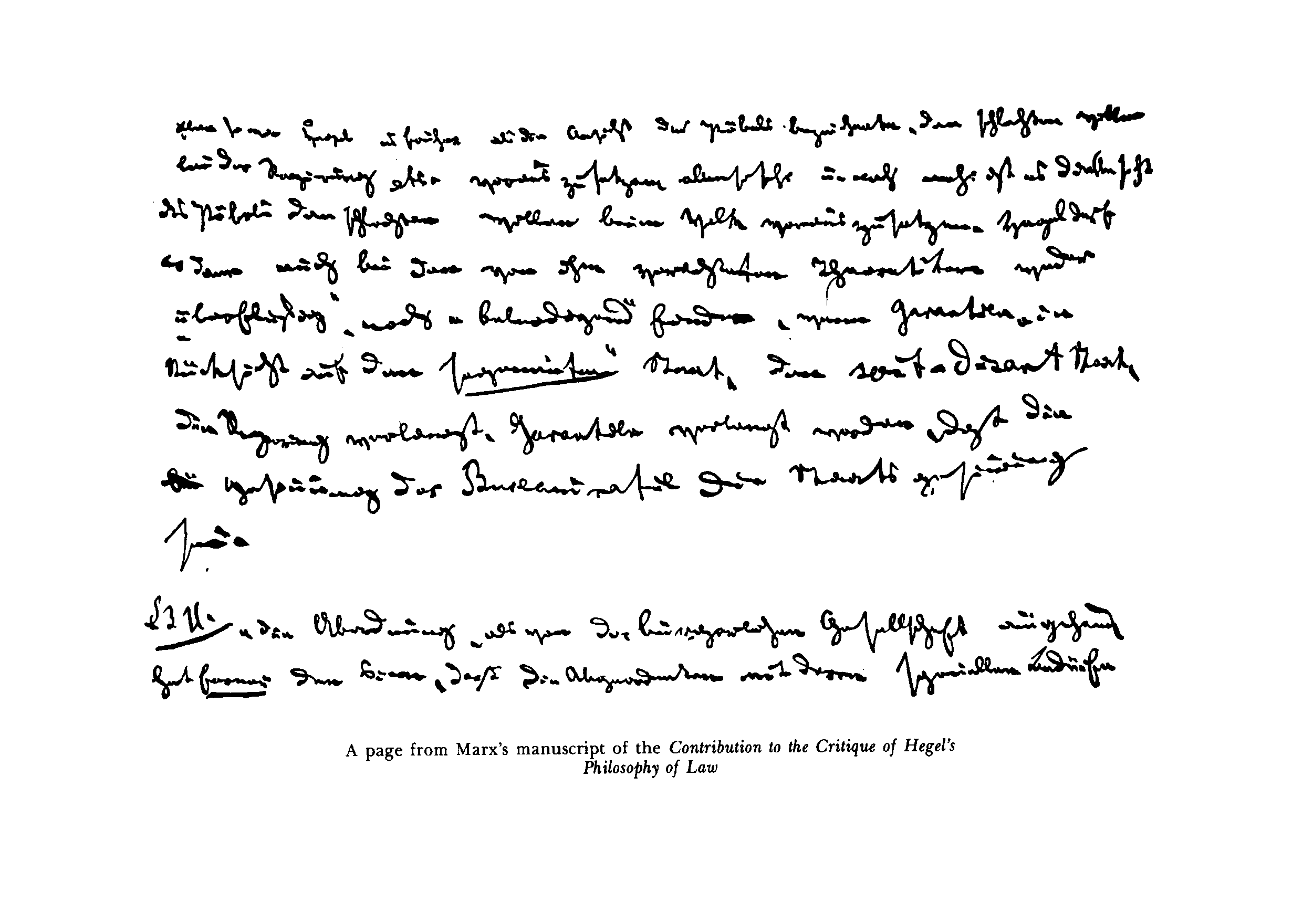
A page from Marx's manuscript of the Contribution to the Critique of Hegel's Philosophy of Law
Now these "opinions and thoughts" are first to pass a government test to prove that they are "its" [the government's] opinions and thoughts. For Hegel here stupidly speaks of the state as a finished thing, although he is only now about to complete the construction of the state with the estates element. He speaks of the state as a concrete subject which "does not take into account subjective opinion and its self-confidence", and for which individuals must demonstrate their "recognisable" and "tested" qualities. All that is missing is for Hegel to demand that the estates should pass an examination set by their worshipful government. Hegel here descends almost to servility. We see him infected through and through with the miserable arrogance of the Prussian civil service which in its bureaucratic stupidity grandly looks down on the "self-confidence" of the "people's own subjective opinion". For Hegel the "state" is everywhere here identical with the "government".
In an actual state "mere trust", "subjective opinion", can indeed not suffice. But in the state constructed by Hegel, the political attitude of civil society is mere opinion, precisely because the political being of civil society is an abstraction from its actual being; precisely because the state as a whole is not the objectification of the political attitude. If Hegel wished to be consistent, he would on the contrary have to make every effort to construe the estates element in accordance with its essential character (para. 301) as the being for themselves of matters of general concern in the thoughts, etc., of the many, that is, to construe it quite independently of the other presuppositions of the political state.
Just as Hegel earlier described the view which presumes bad will in the government, etc., as the view of the vulgar crowd, so it is equally and still more characteristic of the vulgar crowd to presume bad will in the people. Hegel, then, must not find it either "superfluous" or "offensive" in the theoreticians, whom he despises, if they demand guarantees "with regard to what is called" the state, the soi-disant state, the government, if they demand guarantees that the attitude of the bureaucracy is the attitude of the state.
311. "Delegation, since it issues from civil society, means furthermore that the delegates are conversant with the special needs, difficulties and particular interests of civil society and share them. Since in accordance with the nature of civil society delegation is initiated by its various corporations (para. 308), and since the simplicity of this mode of appointment is not impeded by abstractions and atomistic notions, it is thus directly satisfactory from this point of view and elections are either something altogether superfluous or reduced to a minor play of opinion and caprice."
Firstly, Hegel links delegation in its character as "legislative power" (paras. 309, 310) to delegation as "issuing from civil society", i.e., to its representative nature, by a simple "furthermore". The huge contradictions which are implied in this "furthermore" are expressed equally thoughtlessly by him.
According to paragraph 309 the delegates are not to "champion the particular interests of a community or corporation against the general interest, but primarily assert the latter".
According to paragraph 311 they come from the corporations, represent these particular interests and needs and do not allow themselves to be impeded by "abstractions"—as if the "general interest" were not just such an abstraction, and an abstraction precisely from the interests of their corporations, etc.
In paragraph 310 it is stipulated that the delegates shall have acquired and tested an "administrative and political sense" through "the actual conduct of affairs, etc.". In paragraph 311 they are required to have a corporation and civil sense.
In the Addition to paragraph 309 we read that "representation is founded on trust". According to paragraph 311 "elections"—this realisation of trust, this giving effect to it and making it apparent—are "either something altogether superfluous or reduced to a minor play of opinion and caprice".
That on which representation is founded, its essence, is thus for representation "either something altogether superfluous", etc. In one breath Hegel thus utters the flat contradictions: Representation is founded on trust, on the reliance of one person on another, and it is not founded on that trust. This is merely an empty game. Not the particular interest but the person and his citizenship, the general interest, is the object of representation. On the other hand, the particular interest is the substance of representation, the spirit of this interest is the spirit of the representative.
In the Remark to the paragraph which we are now considering, these contradictions are developed even more glaringly. At one time representation is the representation of the person; at another time, of a particular interest, a particular matter.
"It is obviously of advantage that amongst the delegates there should be individuals who can speak for each particular main branch of society—e. g., for trade, manufacture, etc.—who know that branch thoroughly, and themselves belong to it. With the notion of free, unrestricted elections this important consideration is left to chance only. Each of these branches, however, has the same right to be represented as the others. If the delegates are regarded as representatives, this has an organically rational meaning only when they are representatives not of individuals, of a conglomerate, but are representatives of one of the essential spheres of society, of its major interests. In this case representation no longer means that one takes the place of another, the point is rather that the interest itself is actually present in the representative, just as the representative is there for the sake of his own objective element.
"It may further be remarked that election by the many individuals necessarily brings with it indifference towards voting, especially in large states, since one vote has an insignificant effect where there are so many, and those who are entitled to vote, however much this right is brought to their notice as something valuable, simply do not turn up to vote. The result of this institution is thus the very opposite of that which it was meant to produce and election falls under the control of a few, of a party, and thus of some particular, chance interest, which is precisely what was to have been neutralised." [Para. 311.]
The two paragraphs 312 and 313 have been dealt with in what has gone before, and do not deserve any special discussion. We therefore simply quote them at this point:
312. "Each of the two sections contained in the estates element (paras. 305, 308) makes a particular contribution to the work of deliberation; and since, moreover, one of them has the specific function of mediation in this sphere, and of mediating in fact between existing entities, it follows that this itself, likewise, has a distinct and separate existence. The assembly of the estates will thus be divided into two homes."
Good Lord!
313. "This division of the assembly, by providing more than one decision-making body, gives greater assurance of mature decisions, and eliminates both the fortuity of a passing mood and the accidental character which can belong to decision by a numerical majority. But above all, with this the estates element is less liable to confront the government in direct opposition; or in the event of the mediating element finding itself on the side of the second estate, the opinion of this estate will carry all the greater weight, since it will then seem more unbiassed, and its opposition will appear to be neutralised."[a]
Endnotes
[1] Marx mentions his intention of critically analysing Hegel's views on the state and law as far back as in the spring of 1842. In a letter to Arnold Ruge of March 5 he writes that he is preparing an article on Hegel's legal and political views in which he intends first of all to criticise Hegel's apology on behalf of the constitutional monarchy (see this edition, Vol. 1). The above-mentioned article is not extant and it is unknown whether he actually wrote it, but the subject-matter continued to attract his attention. As Marx's theoretical views developed and he gradually adopted a materialist standpoint, largely due to Feuerbach's influence, his plans of writing a critique of Hegel's philosophy became more extensive and profound and finally he conceived the idea of counterposing the materialist conception of social phenomena to their idealist interpretation. For Marx the basic problem was the interdependence of material social relations, property relations and so on — which Hegel called "civil society"—and the political system of society, the state. Marx began to work on his plan during his stay from May to October 1843 in Kreuznach (where his bride Jenny von Westphalen, whom he married in June 1843, lived with her mother). Here, apparently, he wrote the original version of the work. In the process of writing it he felt the need for greater concrete historical material, and with this aim in view he began to study problems related not only to the theory and history of the state as a whole but to the history of individual countries (England, France, Germany, the United States, Italy, Sweden) and major world-historical events, in particular the Great French Revolution, as can be seen from his five notebooks containing excerpts (the Kreuznach Notebooks). Later on, he wrote an introduction to that work which was published in February 1844 in the Deutsch-Französische Jahrbücher. But Marx did not manage to prepare the main sections of his work for publication because he turned to other studies and conceived other literary plans (economic studies, preparation of a book against the Young Hegelians, work on the history of the Convention and so on). However, his work on the manuscript dealing with the criticism of the Hegelian philosophy of law played a major role in his spiritual development and was an important stage in the formation of his materialist views. Marx himself pointed to this in 1859 in the Preface to A Contribution to the Critique of Political Economy. Engels, for his part, in his article "Karl Marx" (1869) described the conclusions arrived at by his friend as a result of the critical analysis of 20* Hegel's views in the following way: "Proceeding from the Hegelian philosophy of law, Marx came to the conclusion that it was not the state which Hegel had described as the 'top of the edifice' but 'the civil society' which Hegel had regarded with disdain that was the sphere in which a key to the understanding of the process of historical development of mankind should be looked for." The extant manuscript consists of 39 big sheets numbered in Roman figures by the author (II-XL), apparently after the work had been finished. The first sheet is missing. Each sheet is folded in two to form four pages, which are numbered in Arabic figures from sheet I-XXII. The manuscript contains a critical analysis of paragraphs 261-313 of G. W. F. Hegel's Grundlinien der Philosophie des Rechts. These paragraphs comprise the subsection "Internal State Law" in the third part of Hegel's work. The missing first sheet apparently dealt with §§257-260 as can be seen from the extant text. The manuscript bears the imprint of an unfinished work. Some problems which the author promises to deal with below have not been treated by him in the extant part. The title of the work given by the author, which is missing in the manuscript, is reproduced from the above-mentioned introduction published in the Deutsch-Französische Jahrbücher. In one of the notebooks written by Marx in Bonn in 1842 there are some notes connected with this manuscript. The date of writing the notes is not established. The notes contain some subheadings, the first of which refers to the non-extant part of the manuscript and contains references to the sheets and pages of the manuscript of the Contribution to the Critique of Hegel's Philosophy of Law. The content of the notes is as follows: "Duplication of the Development System. I. 3,4. Logical Mysticism. II, 8. Ill, 9 [see this volume, pp. 7, 8]. "Mystical way of presentation. "Ibid. Example, §267. IV, pp. 13, 14 [see this volume, pp. 10, 11]. "Idea as Subject. IV, pp. 15, 16 [see this volume, pp. 11-13]. (Real subjects become mere names.) P. 17, p. 18, pp. 20, 21, pp. 24, 26, 27, p. 28, p. 40, p. 57, pp. 75, 78 [see this volume, pp. 13, 14-15, 16-18, 20-21, 22-24, 33-34, 48-49, 60, 62-63]. XXVI, 2. XXVIII. XXX, 3. XXXI, 3. XXXII, 2. XXXIV, 2, 3, 4. P. XXXVII, 2 [see this volume p. 82-83, 89-90, 98-99, 101-02, 109-10, 114-15]. Opposites. XXXIX [see this volume, p. 121-24]." Marx's manuscript was first published in Moscow by the Institute of Marxism-Leninism. This work was first published in English in part in the book Writings of the Young Marx on Philosophy and Society, New York, 1967, and in full as a separate edition entitled Critique of Hegel's 'Philosophy of Right' by Karl Marx. Translated from the German by Annette Jolin and Joseph O'Malley, Cambridge, 1970. In translating the term "Hegeische Rechtsphilosophie", the translators and editors, being aware of the difficulty of its rendering into English, proceeded from the interpretation of this and similar concepts in the works of Marx and Engels written in English. Thus, in the English authorised edition of Engels' work Socialism: Utopian and Scientific, Hegel's expression "Begriff des Rechts" is translated in one of the notes as "concept of law" (see Karl Marx and Frederick Engels, Selected Works, Vol. 3, Moscow, 1970, p. 115). In this manuscript as in the other works published in this volume Marx frequently uses two similar German terms, "Entäusserung" and "Entfremdung", to express the notion of "alienation". In the present edition the former is generally translated as "alienation", the latter as "estrangement", because in the later economic works (Theories of Surplus-Value) Marx himself used the word "alienation" as the English equivalent of the term "Entäusserung".
[3] [Editorial note 3: text not recovered from the source scan.]
[1] Marx mentions his intention of critically analysing Hegel's views on the state and law as far back as in the spring of 1842. In a letter to Arnold Ruge of March 5 he writes that he is preparing an article on Hegel's legal and political views in which he intends first of all to criticise Hegel's apology on behalf of the constitutional monarchy (see this edition, Vol. 1). The above-mentioned article is not extant and it is unknown whether he actually wrote it, but the subject-matter continued to attract his attention. As Marx's theoretical views developed and he gradually adopted a materialist standpoint, largely due to Feuerbach's influence, his plans of writing a critique of Hegel's philosophy became more extensive and profound and finally he conceived the idea of counterposing the materialist conception of social phenomena to their idealist interpretation. For Marx the basic problem was the interdependence of material social relations, property relations and so on — which Hegel called "civil society"—and the political system of society, the state. Marx began to work on his plan during his stay from May to October 1843 in Kreuznach (where his bride Jenny von Westphalen, whom he married in June 1843, lived with her mother). Here, apparently, he wrote the original version of the work. In the process of writing it he felt the need for greater concrete historical material, and with this aim in view he began to study problems related not only to the theory and history of the state as a whole but to the history of individual countries (England, France, Germany, the United States, Italy, Sweden) and major world-historical events, in particular the Great French Revolution, as can be seen from his five notebooks containing excerpts (the Kreuznach Notebooks). Later on, he wrote an introduction to that work which was published in February 1844 in the Deutsch-Französische Jahrbücher. But Marx did not manage to prepare the main sections of his work for publication because he turned to other studies and conceived other literary plans (economic studies, preparation of a book against the Young Hegelians, work on the history of the Convention and so on). However, his work on the manuscript dealing with the criticism of the Hegelian philosophy of law played a major role in his spiritual development and was an important stage in the formation of his materialist views. Marx himself pointed to this in 1859 in the Preface to A Contribution to the Critique of Political Economy. Engels, for his part, in his article "Karl Marx" (1869) described the conclusions arrived at by his friend as a result of the critical analysis of 20* Hegel's views in the following way: "Proceeding from the Hegelian philosophy of law, Marx came to the conclusion that it was not the state which Hegel had described as the 'top of the edifice' but 'the civil society' which Hegel had regarded with disdain that was the sphere in which a key to the understanding of the process of historical development of mankind should be looked for." The extant manuscript consists of 39 big sheets numbered in Roman figures by the author (II-XL), apparently after the work had been finished. The first sheet is missing. Each sheet is folded in two to form four pages, which are numbered in Arabic figures from sheet I-XXII. The manuscript contains a critical analysis of paragraphs 261-313 of G. W. F. Hegel's Grundlinien der Philosophie des Rechts. These paragraphs comprise the subsection "Internal State Law" in the third part of Hegel's work. The missing first sheet apparently dealt with §§257-260 as can be seen from the extant text. The manuscript bears the imprint of an unfinished work. Some problems which the author promises to deal with below have not been treated by him in the extant part. The title of the work given by the author, which is missing in the manuscript, is reproduced from the above-mentioned introduction published in the Deutsch-Französische Jahrbücher. In one of the notebooks written by Marx in Bonn in 1842 there are some notes connected with this manuscript. The date of writing the notes is not established. The notes contain some subheadings, the first of which refers to the non-extant part of the manuscript and contains references to the sheets and pages of the manuscript of the Contribution to the Critique of Hegel's Philosophy of Law. The content of the notes is as follows: "Duplication of the Development System. I. 3,4. Logical Mysticism. II, 8. Ill, 9 [see this volume, pp. 7, 8]. "Mystical way of presentation. "Ibid. Example, §267. IV, pp. 13, 14 [see this volume, pp. 10, 11]. "Idea as Subject. IV, pp. 15, 16 [see this volume, pp. 11-13]. (Real subjects become mere names.) P. 17, p. 18, pp. 20, 21, pp. 24, 26, 27, p. 28, p. 40, p. 57, pp. 75, 78 [see this volume, pp. 13, 14-15, 16-18, 20-21, 22-24, 33-34, 48-49, 60, 62-63]. XXVI, 2. XXVIII. XXX, 3. XXXI, 3. XXXII, 2. XXXIV, 2, 3, 4. P. XXXVII, 2 [see this volume p. 82-83, 89-90, 98-99, 101-02, 109-10, 114-15]. Opposites. XXXIX [see this volume, p. 121-24]." Marx's manuscript was first published in Moscow by the Institute of Marxism-Leninism. This work was first published in English in part in the book Writings of the Young Marx on Philosophy and Society, New York, 1967, and in full as a separate edition entitled Critique of Hegel's 'Philosophy of Right' by Karl Marx. Translated from the German by Annette Jolin and Joseph O'Malley, Cambridge, 1970. In translating the term "Hegeische Rechtsphilosophie", the translators and editors, being aware of the difficulty of its rendering into English, proceeded from the interpretation of this and similar concepts in the works of Marx and Engels written in English. Thus, in the English authorised edition of Engels' work Socialism: Utopian and Scientific, Hegel's expression "Begriff des Rechts" is translated in one of the notes as "concept of law" (see Karl Marx and Frederick Engels, Selected Works, Vol. 3, Moscow, 1970, p. 115). In this manuscript as in the other works published in this volume Marx frequently uses two similar German terms, "Entäusserung" and "Entfremdung", to express the notion of "alienation". In the present edition the former is generally translated as "alienation", the latter as "estrangement", because in the later economic works (Theories of Surplus-Value) Marx himself used the word "alienation" as the English equivalent of the term "Entäusserung".
[3] [Editorial note 3: text not recovered from the source scan.]
[5] [Editorial note 5: text not recovered from the source scan.]
[2] [Editorial note 2: text not recovered from the source scan.]
[6] [Editorial note 6: text not recovered from the source scan.]
[7] [Editorial note 7: text not recovered from the source scan.]
[3] [Editorial note 3: text not recovered from the source scan.]
[3] [Editorial note 3: text not recovered from the source scan.]
[1] Marx mentions his intention of critically analysing Hegel's views on the state and law as far back as in the spring of 1842. In a letter to Arnold Ruge of March 5 he writes that he is preparing an article on Hegel's legal and political views in which he intends first of all to criticise Hegel's apology on behalf of the constitutional monarchy (see this edition, Vol. 1). The above-mentioned article is not extant and it is unknown whether he actually wrote it, but the subject-matter continued to attract his attention. As Marx's theoretical views developed and he gradually adopted a materialist standpoint, largely due to Feuerbach's influence, his plans of writing a critique of Hegel's philosophy became more extensive and profound and finally he conceived the idea of counterposing the materialist conception of social phenomena to their idealist interpretation. For Marx the basic problem was the interdependence of material social relations, property relations and so on — which Hegel called "civil society"—and the political system of society, the state. Marx began to work on his plan during his stay from May to October 1843 in Kreuznach (where his bride Jenny von Westphalen, whom he married in June 1843, lived with her mother). Here, apparently, he wrote the original version of the work. In the process of writing it he felt the need for greater concrete historical material, and with this aim in view he began to study problems related not only to the theory and history of the state as a whole but to the history of individual countries (England, France, Germany, the United States, Italy, Sweden) and major world-historical events, in particular the Great French Revolution, as can be seen from his five notebooks containing excerpts (the Kreuznach Notebooks). Later on, he wrote an introduction to that work which was published in February 1844 in the Deutsch-Französische Jahrbücher. But Marx did not manage to prepare the main sections of his work for publication because he turned to other studies and conceived other literary plans (economic studies, preparation of a book against the Young Hegelians, work on the history of the Convention and so on). However, his work on the manuscript dealing with the criticism of the Hegelian philosophy of law played a major role in his spiritual development and was an important stage in the formation of his materialist views. Marx himself pointed to this in 1859 in the Preface to A Contribution to the Critique of Political Economy. Engels, for his part, in his article "Karl Marx" (1869) described the conclusions arrived at by his friend as a result of the critical analysis of 20* Hegel's views in the following way: "Proceeding from the Hegelian philosophy of law, Marx came to the conclusion that it was not the state which Hegel had described as the 'top of the edifice' but 'the civil society' which Hegel had regarded with disdain that was the sphere in which a key to the understanding of the process of historical development of mankind should be looked for." The extant manuscript consists of 39 big sheets numbered in Roman figures by the author (II-XL), apparently after the work had been finished. The first sheet is missing. Each sheet is folded in two to form four pages, which are numbered in Arabic figures from sheet I-XXII. The manuscript contains a critical analysis of paragraphs 261-313 of G. W. F. Hegel's Grundlinien der Philosophie des Rechts. These paragraphs comprise the subsection "Internal State Law" in the third part of Hegel's work. The missing first sheet apparently dealt with §§257-260 as can be seen from the extant text. The manuscript bears the imprint of an unfinished work. Some problems which the author promises to deal with below have not been treated by him in the extant part. The title of the work given by the author, which is missing in the manuscript, is reproduced from the above-mentioned introduction published in the Deutsch-Französische Jahrbücher. In one of the notebooks written by Marx in Bonn in 1842 there are some notes connected with this manuscript. The date of writing the notes is not established. The notes contain some subheadings, the first of which refers to the non-extant part of the manuscript and contains references to the sheets and pages of the manuscript of the Contribution to the Critique of Hegel's Philosophy of Law. The content of the notes is as follows: "Duplication of the Development System. I. 3,4. Logical Mysticism. II, 8. Ill, 9 [see this volume, pp. 7, 8]. "Mystical way of presentation. "Ibid. Example, §267. IV, pp. 13, 14 [see this volume, pp. 10, 11]. "Idea as Subject. IV, pp. 15, 16 [see this volume, pp. 11-13]. (Real subjects become mere names.) P. 17, p. 18, pp. 20, 21, pp. 24, 26, 27, p. 28, p. 40, p. 57, pp. 75, 78 [see this volume, pp. 13, 14-15, 16-18, 20-21, 22-24, 33-34, 48-49, 60, 62-63]. XXVI, 2. XXVIII. XXX, 3. XXXI, 3. XXXII, 2. XXXIV, 2, 3, 4. P. XXXVII, 2 [see this volume p. 82-83, 89-90, 98-99, 101-02, 109-10, 114-15]. Opposites. XXXIX [see this volume, p. 121-24]." Marx's manuscript was first published in Moscow by the Institute of Marxism-Leninism. This work was first published in English in part in the book Writings of the Young Marx on Philosophy and Society, New York, 1967, and in full as a separate edition entitled Critique of Hegel's 'Philosophy of Right' by Karl Marx. Translated from the German by Annette Jolin and Joseph O'Malley, Cambridge, 1970. In translating the term "Hegeische Rechtsphilosophie", the translators and editors, being aware of the difficulty of its rendering into English, proceeded from the interpretation of this and similar concepts in the works of Marx and Engels written in English. Thus, in the English authorised edition of Engels' work Socialism: Utopian and Scientific, Hegel's expression "Begriff des Rechts" is translated in one of the notes as "concept of law" (see Karl Marx and Frederick Engels, Selected Works, Vol. 3, Moscow, 1970, p. 115). In this manuscript as in the other works published in this volume Marx frequently uses two similar German terms, "Entäusserung" and "Entfremdung", to express the notion of "alienation". In the present edition the former is generally translated as "alienation", the latter as "estrangement", because in the later economic works (Theories of Surplus-Value) Marx himself used the word "alienation" as the English equivalent of the term "Entäusserung".
[9] The text of this comment in the conspectus is immediately preceded by the following excerpts from James Mill's book: "...A medium of exchange ... is some one commodity, which, in order to effect an exchange between two other commodities, is first received in exchange for the one, and is then given in exchange for the other." (P. 93.) Gold, silver, mon«y. "By valut of money, is here to be understood the proportion in which it exchanges for other commodities, or the quantity of it which exchanges for a certain quantity of other things." "This proportion is determined by the total amount of money existing in a given country." (P. 95.) "What regulates the quantity of money?" "Money is made under two sets of circumstances: Government either leaves the increase or diminution of it free; or it controls the quantity, making it greater or smaller as it pleases. "When the increase or diminution of money is left free, government opens the mint to the public, making bullion into money for as many as require it. Individuals possessed of bullion will desire to convert it into money only when it is their interest to do so; that is, when their bullion, converted into money, will be more valuable than in its original form. This can only happen when money is peculiarly valuable, and when the same quantity of metal, in the state of coin, will exchange for a greater quantity of other articles than in the state of bullion. As the value of money depends upon the quantity of it, it has a greater value when it is in short supply. It is then that bullion is made into coin. But precisely because of this conversion, the old ratio is restored. Therefore, if the value of money rises above that of the metal of which it is made, the interest of individuals operates immediately, in a state of freedom, to restore the balance by augmenting the quantity of money." (Pp. 99-101.) "Whenever the coining of money, therefore, is free, its quantity is regulated by the value of the metal, it being the interest of individuals to increase or diminish the quantity, in proportion as the value of the metal in coins is greater or less than its value in bullion. "But if the quantity of money is determined by the value of the metal, it is still necessary to inquire what it is which determines the value of the metal.... Gold and silver are in reality commodities. They are commodities for the attaining of which labour and capital must be employed. It is cost of production, therefore, which determines the value of these, as of other ordinary productions." (P. 101.)
[3] [Editorial note 3: text not recovered from the source scan.]
[3] [Editorial note 3: text not recovered from the source scan.]
[11] [Editorial note 11: text not recovered from the source scan.]
[3] [Editorial note 3: text not recovered from the source scan.]
[3] [Editorial note 3: text not recovered from the source scan.]
[10] [Editorial note 10: text not recovered from the source scan.]
[11] [Editorial note 11: text not recovered from the source scan.]
[3] [Editorial note 3: text not recovered from the source scan.]